Q9N297
Gene name |
HTR1A |
Protein name |
5-hydroxytryptamine receptor 1A |
Names |
5-HT-1A, 5-HT1A, Serotonin receptor 1A |
Species |
Gorilla gorilla gorilla (Western lowland gorilla) |
KEGG Pathway |
ggo:101145070 |
EC number |
|
Protein Class |
|
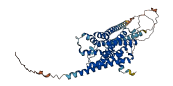
Descriptions
The autoinhibited protein was predicted that may have potential autoinhibitory elements via cis-regPred.
Autoinhibitory domains (AIDs)
Target domain |
|
Relief mechanism |
|
Assay |
cis-regPred |
Accessory elements
No accessory elements
Autoinhibited structure

Activated structure
1 structures for Q9N297
| Entry ID | Method | Resolution | Chain | Position | Source |
|---|---|---|---|---|---|
| AF-Q9N297-F1 | Predicted | AlphaFoldDB |
No variants for Q9N297
| Variant ID(s) | Position | Change | Description | Diseaes Association | Provenance |
|---|---|---|---|---|---|
| No variants for Q9N297 | |||||
No associated diseases with Q9N297
1 regional properties for Q9N297
| Type | Name | Position | InterPro Accession |
|---|---|---|---|
| domain | GPCR, rhodopsin-like, 7TM | 53 - 400 | IPR017452 |
3 GO annotations of cellular component
| Name | Definition |
|---|---|
| dendrite | A neuron projection that has a short, tapering, morphology. Dendrites receive and integrate signals from other neurons or from sensory stimuli, and conduct nerve impulses towards the axon or the cell body. In most neurons, the impulse is conveyed from dendrites to axon via the cell body, but in some types of unipolar neuron, the impulse does not travel via the cell body. |
| integral component of plasma membrane | The component of the plasma membrane consisting of the gene products and protein complexes having at least some part of their peptide sequence embedded in the hydrophobic region of the membrane. |
| synapse | The junction between an axon of one neuron and a dendrite of another neuron, a muscle fiber or a glial cell. As the axon approaches the synapse it enlarges into a specialized structure, the presynaptic terminal bouton, which contains mitochondria and synaptic vesicles. At the tip of the terminal bouton is the presynaptic membrane; facing it, and separated from it by a minute cleft (the synaptic cleft) is a specialized area of membrane on the receiving cell, known as the postsynaptic membrane. In response to the arrival of nerve impulses, the presynaptic terminal bouton secretes molecules of neurotransmitters into the synaptic cleft. These diffuse across the cleft and transmit the signal to the postsynaptic membrane. |
4 GO annotations of molecular function
| Name | Definition |
|---|---|
| G protein-coupled serotonin receptor activity | Combining with the biogenic amine serotonin and transmitting the signal across the membrane by activating an associated G-protein. Serotonin (5-hydroxytryptamine) is a neurotransmitter and hormone found in vertebrates and invertebrates. |
| neurotransmitter receptor activity | Combining with a neurotransmitter and transmitting the signal to initiate a change in cell activity. |
| receptor-receptor interaction | The aggregation, arrangement and bonding together of two or more different receptor complexes that individually undergo combination with a hormone, neurotransmitter, drug or intracellular messenger to form a higher level receptor complex. The formation of the higher level complex initiates a change in cell function. |
| serotonin binding | Binding to serotonin (5-hydroxytryptamine), a monoamine neurotransmitter occurring in the peripheral and central nervous systems, also having hormonal properties. |
13 GO annotations of biological process
| Name | Definition |
|---|---|
| adenylate cyclase-inhibiting serotonin receptor signaling pathway | An adenylate cyclase-inhibiting G protein-coupled receptor signaling pathway initiated by serotonin binding to its receptor, and ending with the regulation of a downstream cellular process. |
| behavioral fear response | An acute behavioral change resulting from a perceived external threat. |
| chemical synaptic transmission | The vesicular release of classical neurotransmitter molecules from a presynapse, across a chemical synapse, the subsequent activation of neurotransmitter receptors at the postsynapse of a target cell (neuron, muscle, or secretory cell) and the effects of this activation on the postsynaptic membrane potential and ionic composition of the postsynaptic cytosol. This process encompasses both spontaneous and evoked release of neurotransmitter and all parts of synaptic vesicle exocytosis. Evoked transmission starts with the arrival of an action potential at the presynapse. |
| exploration behavior | The specific behavior of an organism in response to a novel environment or stimulus. |
| G protein-coupled receptor signaling pathway, coupled to cyclic nucleotide second messenger | A G protein-coupled receptor signaling pathway in which the signal is transmitted via the activation or inhibition of a nucleotide cyclase activity and a subsequent change in the concentration of a cyclic nucleotide. |
| gamma-aminobutyric acid signaling pathway | The series of molecular signals generated by the binding of gamma-aminobutyric acid (GABA, 4-aminobutyrate), an amino acid which acts as a neurotransmitter in some organisms, to its receptor on the surface of a target cell. |
| regulation of behavior | Any process that modulates the frequency, rate or extent of behavior, the internally coordinated responses (actions or inactions) of whole living organisms (individuals or groups) to internal or external stimuli. |
| regulation of dopamine metabolic process | Any process that modulates the frequency, rate or extent of the chemical reactions and pathways involving dopamine. |
| regulation of hormone secretion | Any process that modulates the frequency, rate or extent of the regulated release of a hormone from a cell. |
| regulation of serotonin secretion | Any process that modulates the frequency, rate or extent of the regulated release of serotonin. |
| regulation of vasoconstriction | Any process that modulates the frequency, rate or extent of reductions in the diameter of blood vessels. |
| serotonin metabolic process | The chemical reactions and pathways involving serotonin (5-hydroxytryptamine), a monoamine neurotransmitter occurring in the peripheral and central nervous systems, also having hormonal properties. |
| serotonin receptor signaling pathway | The series of molecular signals generated as a consequence of a serotonin receptor binding to one of its physiological ligands. |
No homologous proteins in AiPD
| UniProt AC | Gene Name | Protein Name | Species | Evidence Code |
|---|---|---|---|---|
| No homologous proteins | ||||
| 10 | 20 | 30 | 40 | 50 | 60 |
| MDVLSPGQGN | NTTSPPAPFE | TGGNTTGISD | VTFSYQVITS | LLLGTLIFCA | VLGNACVVAA |
| 70 | 80 | 90 | 100 | 110 | 120 |
| IALERSLQNV | ANYLIGSLAV | TDLMVSVLVL | PMAALYQVLN | KWTLGQVTCD | LFIALDVLCC |
| 130 | 140 | 150 | 160 | 170 | 180 |
| TSSILHLCAI | ALDRYWAITD | PIDYVNKRTP | RRAAALISLT | WLIGFLISIP | PMLGWRTPED |
| 190 | 200 | 210 | 220 | 230 | 240 |
| RSDPDACTIS | KDHGYTIYST | FGAFYIPLLL | MLVLYGRIFR | AARFRIRKTV | KKVEKTGADT |
| 250 | 260 | 270 | 280 | 290 | 300 |
| RHGASPAPQP | KKSVNGESGS | RNWRLGVESK | AGGALCANGA | VRQGDDGAAL | EVIEVHRVGN |
| 310 | 320 | 330 | 340 | 350 | 360 |
| SKEHLPLPSE | AGPTPCAPAS | FERKNERNAE | AKRKMALARE | RKTVKTLGII | MGTFILCWLP |
| 370 | 380 | 390 | 400 | 410 | 420 |
| FFIVALVLPF | CESSCHMPTL | LGAIINWLGY | SNSLLNPVIY | AYFNKDFQNA | FKKIIKCKFC |
| RQ |