Q9N0V3
Gene name |
ABCB11 |
Protein name |
Bile salt export pump |
Names |
ATP-binding cassette sub-family B member 11, Sister of P-glycoprotein |
Species |
Oryctolagus cuniculus (Rabbit) |
KEGG Pathway |
ocu:100008767 |
EC number |
|
Protein Class |
|
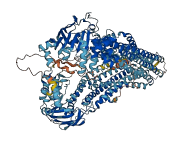
Descriptions
The autoinhibited protein was predicted that may have potential autoinhibitory elements via cis-regPred.
Autoinhibitory domains (AIDs)
Target domain |
|
Relief mechanism |
|
Assay |
cis-regPred |
Accessory elements
No accessory elements
Autoinhibited structure

Activated structure
1 structures for Q9N0V3
| Entry ID | Method | Resolution | Chain | Position | Source |
|---|---|---|---|---|---|
| AF-Q9N0V3-F1 | Predicted | AlphaFoldDB |
No variants for Q9N0V3
| Variant ID(s) | Position | Change | Description | Diseaes Association | Provenance |
|---|---|---|---|---|---|
| No variants for Q9N0V3 | |||||
No associated diseases with Q9N0V3
7 regional properties for Q9N0V3
| Type | Name | Position | InterPro Accession |
|---|---|---|---|
| domain | ABC transporter-like, ATP-binding domain | 420 - 656 | IPR003439-1 |
| domain | ABC transporter-like, ATP-binding domain | 1078 - 1316 | IPR003439-2 |
| domain | AAA+ ATPase domain | 447 - 633 | IPR003593-1 |
| domain | AAA+ ATPase domain | 1105 - 1299 | IPR003593-2 |
| domain | ABC transporter type 1, transmembrane domain | 62 - 385 | IPR011527-1 |
| domain | ABC transporter type 1, transmembrane domain | 756 - 1043 | IPR011527-2 |
| conserved_site | ABC transporter-like, conserved site | 559 - 573 | IPR017871 |
Functions
8 GO annotations of cellular component
| Name | Definition |
|---|---|
| apical plasma membrane | The region of the plasma membrane located at the apical end of the cell. |
| cell surface | The external part of the cell wall and/or plasma membrane. |
| endosome | A vacuole to which materials ingested by endocytosis are delivered. |
| integral component of membrane | The component of a membrane consisting of the gene products and protein complexes having at least some part of their peptide sequence embedded in the hydrophobic region of the membrane. |
| intracellular canaliculus | An apical plasma membrane part that forms a narrow enfolded luminal membrane channel, lined with numerous microvilli, that appears to extend into the cytoplasm of the cell. A specialized network of intracellular canaliculi is a characteristic feature of parietal cells of the gastric mucosa in vertebrates. |
| plasma membrane | The membrane surrounding a cell that separates the cell from its external environment. It consists of a phospholipid bilayer and associated proteins. |
| recycling endosome | An organelle consisting of a network of tubules that functions in targeting molecules, such as receptors transporters and lipids, to the plasma membrane. |
| recycling endosome membrane | The lipid bilayer surrounding a recycling endosome. |
5 GO annotations of molecular function
| Name | Definition |
|---|---|
| ABC-type bile acid transporter activity | Enables the transfer of a solute or solutes from one side of a membrane to the other according to the reaction: bile acid(in) + ATP + H2O -> bile acid(out) + ADP + phosphate. |
| ABC-type xenobiotic transporter activity | Catalysis of the reaction: ATP + H2O + xenobiotic(in) = ADP + phosphate + xenobiotic(out). |
| ATP binding | Binding to ATP, adenosine 5'-triphosphate, a universally important coenzyme and enzyme regulator. |
| bile acid transmembrane transporter activity | Enables the transfer of bile acid from one side of a membrane to the other. Bile acids are any of a group of steroid carboxylic acids occurring in bile, where they are present as the sodium salts of their amides with glycine or taurine. |
| canalicular bile acid transmembrane transporter activity | The directed movement of bile acid and bile salts out of a hepatocyte and into the bile canaliculus by means of an agent such as a transporter or pore. Bile canaliculi are the thin tubes formed by hepatocyte membranes. Bile acids are any of a group of steroid carboxylic acids occurring in bile, where they are present as the sodium salts of their amides with glycine or taurine. |
14 GO annotations of biological process
| Name | Definition |
|---|---|
| bile acid and bile salt transport | The directed movement of bile acid and bile salts into, out of or within a cell, or between cells, by means of some agent such as a transporter or pore. |
| bile acid metabolic process | The chemical reactions and pathways involving bile acids, a group of steroid carboxylic acids occurring in bile, where they are present as the sodium salts of their amides with glycine or taurine. |
| canalicular bile acid transport | Enables the transfer of bile acid from one side of a hepatocyte plasma membrane into a bile canaliculus. Bile canaliculi are the thin tubes formed by hepatocyte membranes. Bile acids are any of a group of steroid carboxylic acids occurring in bile, where they are present as the sodium salts of their amides with glycine or taurine. |
| cholesterol homeostasis | Any process involved in the maintenance of an internal steady state of cholesterol within an organism or cell. |
| fatty acid metabolic process | The chemical reactions and pathways involving fatty acids, aliphatic monocarboxylic acids liberated from naturally occurring fats and oils by hydrolysis. |
| lipid homeostasis | Any process involved in the maintenance of an internal steady state of lipid within an organism or cell. |
| phospholipid homeostasis | Any process involved in the maintenance of an internal steady state of phospholipid within an organism or cell. |
| positive regulation of bile acid secretion | Any process that activates or increases the frequency, rate or extent of the controlled release of bile acid from a cell or a tissue. |
| protein ubiquitination | The process in which one or more ubiquitin groups are added to a protein. |
| regulation of bile acid metabolic process | Any process that modulates the frequency, rate or extent of bile acid metabolic process. |
| regulation of fatty acid beta-oxidation | Any process that modulates the frequency, rate or extent of fatty acid bbeta-oxidation. |
| xenobiotic export from cell | The directed movement of a xenobiotic from a cell, into the extracellular region. A xenobiotic is a compound foreign to the organim exposed to it. It may be synthesized by another organism (like ampicilin) or it can be a synthetic chemical. |
| xenobiotic metabolic process | The chemical reactions and pathways involving a xenobiotic compound, a compound foreign to the organim exposed to it. It may be synthesized by another organism (like ampicilin) or it can be a synthetic chemical. |
| xenobiotic transmembrane transport | The process in which a xenobiotic, a compound foreign to the organim exposed to it, is transported across a membrane. It may be synthesized by another organism (like ampicilin) or it can be a synthetic chemical. |
No homologous proteins in AiPD
| UniProt AC | Gene Name | Protein Name | Species | Evidence Code |
|---|---|---|---|---|
| No homologous proteins | ||||
| 10 | 20 | 30 | 40 | 50 | 60 |
| MSDSVILRSV | KKFGEENHGF | ESDGSYNNEK | KSRLQDKKKS | DSVRIGFFQL | FRFSSWTDIW |
| 70 | 80 | 90 | 100 | 110 | 120 |
| LMCMGSLCAC | IHGIAQPGVL | LIFGTMTDVF | IDYDTELQEL | KIPGKACVNN | TIVWINSSLN |
| 130 | 140 | 150 | 160 | 170 | 180 |
| QNVTNGTRCG | LLDIESEMIR | FAGYYAGIGI | AVLTTGYIQI | CFWGIAAAHQ | IQKMRKSYFR |
| 190 | 200 | 210 | 220 | 230 | 240 |
| KIMRMGIGWV | DCNSVGKLNT | PFSVDFNKIN | DSSADQLAIF | IQGMTSPIFG | FLVGFSQWWK |
| 250 | 260 | 270 | 280 | 290 | 300 |
| LTLVIISVSP | LIGLGAAIIG | LSVSKFTDYE | LKAYAKAGSV | ADEVISSMRT | VAAFGGEKKE |
| 310 | 320 | 330 | 340 | 350 | 360 |
| VERYEKNLVF | AQRWGIRKGI | VMGFFTGYMW | CLIFFCYALA | FWYGSKLVLE | EGEYSPGALV |
| 370 | 380 | 390 | 400 | 410 | 420 |
| QIFLSVIIGA | LNLGNASPCL | EAFAAGRAAA | SSIFETIDRK | PIIDCMSEDG | YKLERIKGEI |
| 430 | 440 | 450 | 460 | 470 | 480 |
| EFHNVTFHYP | SRPEVKILNN | LSMVIKPGEM | TALVGPSGAG | KSTALQLIHR | FYGPTEGMVT |
| 490 | 500 | 510 | 520 | 530 | 540 |
| VESHDIRSSH | IQWLRNQIGI | VEQEPVLFFH | TIAEKIRYGR | EDATMEDLIQ | AAKEANAYNF |
| 550 | 560 | 570 | 580 | 590 | 600 |
| IMDLPQQFDT | LVGEGGGQMS | GGQKQRVAIA | RALIRNPKIL | LLDMATSALD | NESEAMVQEA |
| 610 | 620 | 630 | 640 | 650 | 660 |
| LSKTQHGHTI | VSVAHRPATI | RTADVIIGCE | HGAAVERGTE | EELLERKGVY | FALVTLQSQR |
| 670 | 680 | 690 | 700 | 710 | 720 |
| NQGDQEENEK | DATEDDIPEK | TFSRGNYQDS | LRASLRQRSK | SQLSYLAHEP | PMAVEDHKST |
| 730 | 740 | 750 | 760 | 770 | 780 |
| HEEDRKDKDL | PAQEDIEPAS | VRRIMKLNAP | EWPYMLLGSM | GAAVNGAVTP | LYAFLFSQIL |
| 790 | 800 | 810 | 820 | 830 | 840 |
| GTFSLPDKEE | QRSQINGICL | LFVTLGCVSF | FTQFLQGYTF | AKSGELLTKR | LRKFGFRAML |
| 850 | 860 | 870 | 880 | 890 | 900 |
| GQDIGWFDDL | RNSPGALTTR | LATDASQVQG | ATGSQIGMMV | NSFTNVTVAM | IIAFLFSWKL |
| 910 | 920 | 930 | 940 | 950 | 960 |
| TLGIVCFFPF | LALSGALQTK | MLTGFASRDK | QALEKAGQIT | SEALSNIRTV | AGIGKERKFI |
| 970 | 980 | 990 | 1000 | 1010 | 1020 |
| ETFEAELEKP | YKMAIKKANV | YGLCFGFSQC | ITFIANSASY | RYGGYLISNE | GLHFSYVFRV |
| 1030 | 1040 | 1050 | 1060 | 1070 | 1080 |
| ISAVVLSATA | LGRASSYTPS | YAKAKISAAR | FFQLLDRQPP | INVYSSAGEK | WDNFQGKIDF |
| 1090 | 1100 | 1110 | 1120 | 1130 | 1140 |
| VDCKFTYPSR | PDIQVLNGLS | VSMSPRQTLA | FVGSSGCGKS | TSIQLLERFY | DPDHGKVMID |
| 1150 | 1160 | 1170 | 1180 | 1190 | 1200 |
| GHDSRKVNIQ | FLRSNIGIVS | QEPVLFACSI | KDNIKYGDNT | QEIPMERIIA | AAKKAQVHDF |
| 1210 | 1220 | 1230 | 1240 | 1250 | 1260 |
| VMSLPEKYET | NVGSQGSQLS | RGEKQRIAIA | RAIVRDPKIL | LLDEATSALD | TESEKTVQVA |
| 1270 | 1280 | 1290 | 1300 | 1310 | 1320 |
| LDKAREGRTC | IVIAHRLSTI | QNSDIIAVMS | QGMVIEKGTH | EELMVQKGAY | YKLVTTGSPI |
| S |