Q9MZU4
Gene name |
RSAD2 |
Protein name |
Radical S-adenosyl methionine domain-containing protein 2 |
Names |
Inflammatory response gene 6 protein, Viperin, Virus inhibitory protein, endoplasmic reticulum-associated, interferon-inducible |
Species |
Sus scrofa (Pig) |
KEGG Pathway |
ssc:396752 |
EC number |
|
Protein Class |
|
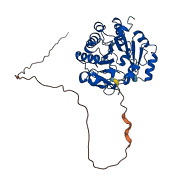
Descriptions
The autoinhibited protein was predicted that may have potential autoinhibitory elements via cis-regPred.
Autoinhibitory domains (AIDs)
Target domain |
|
Relief mechanism |
|
Assay |
cis-regPred |
Accessory elements
No accessory elements
Autoinhibited structure

Activated structure
1 structures for Q9MZU4
| Entry ID | Method | Resolution | Chain | Position | Source |
|---|---|---|---|---|---|
| AF-Q9MZU4-F1 | Predicted | AlphaFoldDB |
No variants for Q9MZU4
| Variant ID(s) | Position | Change | Description | Diseaes Association | Provenance |
|---|---|---|---|---|---|
| No variants for Q9MZU4 | |||||
No associated diseases with Q9MZU4
Functions
6 GO annotations of cellular component
| Name | Definition |
|---|---|
| endoplasmic reticulum | The irregular network of unit membranes, visible only by electron microscopy, that occurs in the cytoplasm of many eukaryotic cells. The membranes form a complex meshwork of tubular channels, which are often expanded into slitlike cavities called cisternae. The ER takes two forms, rough (or granular), with ribosomes adhering to the outer surface, and smooth (with no ribosomes attached). |
| endoplasmic reticulum membrane | The lipid bilayer surrounding the endoplasmic reticulum. |
| Golgi apparatus | A membrane-bound cytoplasmic organelle of the endomembrane system that further processes the core oligosaccharides (e.g. N-glycans) added to proteins in the endoplasmic reticulum and packages them into membrane-bound vesicles. The Golgi apparatus operates at the intersection of the secretory, lysosomal, and endocytic pathways. |
| lipid droplet | An intracellular non-membrane-bounded organelle comprising a matrix of coalesced lipids surrounded by a phospholipid monolayer. May include associated proteins. |
| mitochondrial inner membrane | The inner, i.e. lumen-facing, lipid bilayer of the mitochondrial envelope. It is highly folded to form cristae. |
| mitochondrial outer membrane | The outer, i.e. cytoplasm-facing, lipid bilayer of the mitochondrial envelope. |
4 GO annotations of molecular function
| Name | Definition |
|---|---|
| 4 iron, 4 sulfur cluster binding | Binding to a 4 iron, 4 sulfur (4Fe-4S) cluster; this cluster consists of four iron atoms, with the inorganic sulfur atoms found between the irons and acting as bridging ligands. |
| lyase activity | Catalysis of the cleavage of C-C, C-O, C-N and other bonds by other means than by hydrolysis or oxidation, or conversely adding a group to a double bond. They differ from other enzymes in that two substrates are involved in one reaction direction, but only one in the other direction. When acting on the single substrate, a molecule is eliminated and this generates either a new double bond or a new ring. |
| metal ion binding | Binding to a metal ion. |
| protein self-association | Binding to a domain within the same polypeptide. |
9 GO annotations of biological process
| Name | Definition |
|---|---|
| CD4-positive, alpha-beta T cell activation | The change in morphology and behavior of a CD4-positive, alpha-beta T cell resulting from exposure to a mitogen, cytokine, chemokine, cellular ligand, or an antigen for which it is specific. |
| CD4-positive, alpha-beta T cell differentiation | The process in which a relatively unspecialized T cell acquires specialized features of a mature CD4-positive, alpha-beta T cell. |
| defense response to virus | Reactions triggered in response to the presence of a virus that act to protect the cell or organism. |
| innate immune response | Innate immune responses are defense responses mediated by germline encoded components that directly recognize components of potential pathogens. |
| negative regulation of protein secretion | Any process that stops, prevents, or reduces the frequency, rate or extent of the controlled release of a protein from a cell. |
| positive regulation of T-helper 2 cell cytokine production | Any process that activates or increases the frequency, rate or extent of T-helper 2 cell cytokine production. |
| positive regulation of toll-like receptor 7 signaling pathway | Any process that activates or increases the frequency, rate, or extent of toll-like receptor 7 signaling pathway. |
| positive regulation of toll-like receptor 9 signaling pathway | Any process that activates or increases the frequency, rate, or extent of toll-like receptor 9 signaling pathway. |
| response to virus | Any process that results in a change in state or activity of a cell or an organism (in terms of movement, secretion, enzyme production, gene expression, etc.) as a result of a stimulus from a virus. |
1 homologous proteins in AiPD
| UniProt AC | Gene Name | Protein Name | Species | Evidence Code |
|---|---|---|---|---|
| Q8CBB9 | Rsad2 | Radical S-adenosyl methionine domain-containing protein 2 | Mus musculus (Mouse) | PR |
| 10 | 20 | 30 | 40 | 50 | 60 |
| MWTLVPVTFA | LRLLSTFVQP | LGSLGSSLGP | LFLWLWAAFW | RAGGDRSRQQ | LQGKTEAGEP |
| 70 | 80 | 90 | 100 | 110 | 120 |
| PRAQEDSHLP | TTPTSVNYHF | TRQCNYKCGF | CFHTAKTSFV | LPLEEAKRGL | WLLKEAGMEK |
| 130 | 140 | 150 | 160 | 170 | 180 |
| INFSGGEPFI | HDRGEYLGKL | VRFCKEELQL | PSVSIVSNGS | LIWERWFKSY | GEYLDILAIS |
| 190 | 200 | 210 | 220 | 230 | 240 |
| CDSFDEQVNV | LIGRGQGKKN | HVENLQKLRT | WCRDYKVAFK | INSVINRFNV | EEDMTEHIKA |
| 250 | 260 | 270 | 280 | 290 | 300 |
| LNPVRWKVFQ | CLLIEGENVG | EDALREAEQF | VISDEEFEEF | LDRHKDVSCL | VPESNRQMRD |
| 310 | 320 | 330 | 340 | 350 | 360 |
| SYLILDEYMR | FLNCRNGRKD | PSKSILDVGV | EKAIKFSGFD | EKMFLKRGGK | YVWSKADLKL |
| DW |