Q9MA98
Gene name |
ERCC1 (RAD10, UVR7, At3g05210, T12H1.18) |
Protein name |
DNA excision repair protein ERCC-1 |
Names |
AtERCC1, AtRAD10, Ultraviolet hypersensitive 7 |
Species |
Arabidopsis thaliana (Mouse-ear cress) |
KEGG Pathway |
ath:AT3G05210 |
EC number |
|
Protein Class |
|
Descriptions
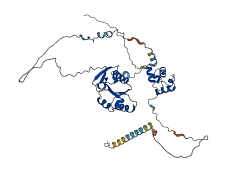
The autoinhibited protein was predicted that may have potential autoinhibitory elements via cis-regPred.
Autoinhibitory domains (AIDs)
Target domain |
|
Relief mechanism |
|
Assay |
cis-regPred |
Accessory elements
No accessory elements
Autoinhibited structure

Activated structure
1 structures for Q9MA98
| Entry ID | Method | Resolution | Chain | Position | Source |
|---|---|---|---|---|---|
| AF-Q9MA98-F1 | Predicted | AlphaFoldDB |
31 variants for Q9MA98
| Variant ID(s) | Position | Change | Description | Diseaes Association | Provenance |
|---|---|---|---|---|---|
| tmp_3_1479695_A_T | 35 | E>D | No | 1000Genomes | |
| ENSVATH05774547 | 47 | P>L | No | 1000Genomes | |
| tmp_3_1479759_T_C | 57 | S>P | No | 1000Genomes | |
| tmp_3_1479796_A_C | 69 | Y>S | No | 1000Genomes | |
| tmp_3_1479817_C_T | 76 | S>F | No | 1000Genomes | |
| tmp_3_1479822_G_T | 78 | A>S | No | 1000Genomes | |
| tmp_3_1479850_C_A | 87 | A>D | No | 1000Genomes | |
| tmp_3_1479853_C_G | 88 | S>C | No | 1000Genomes | |
| tmp_3_1479861_C_G | 91 | P>A | No | 1000Genomes | |
| ENSVATH05774548 | 93 | S>T | No | 1000Genomes | |
| ENSVATH05774555 | 110 | V>L | No | 1000Genomes | |
| tmp_3_1480315_C_G | 116 | P>A | No | 1000Genomes | |
| tmp_3_1480677_C_A | 180 | F>L | No | 1000Genomes | |
| tmp_3_1481199_A_C | 261 | N>T | No | 1000Genomes | |
| tmp_3_1481235_G_A | 273 | S>N | No | 1000Genomes | |
| ENSVATH10501200 | 316 | E>Q | No | 1000Genomes | |
| ENSVATH10501201 | 320 | R>L | No | 1000Genomes | |
| ENSVATH05774564 | 328 | V>I | No | 1000Genomes | |
| ENSVATH10501202 | 334 | P>L | No | 1000Genomes | |
| tmp_3_1481607_G_T | 339 | E>D | No | 1000Genomes | |
| tmp_3_1481630_C_T | 347 | P>L | No | 1000Genomes | |
| ENSVATH05774565 | 348 | V>I | No | 1000Genomes | |
| ENSVATH13872261 | 351 | D>A | No | 1000Genomes | |
| ENSVATH05774566 | 365 | E>D | No | 1000Genomes | |
| ENSVATH05774567 | 371 | T>I | No | 1000Genomes | |
| tmp_3_1481782_G_T | 398 | D>Y | No | 1000Genomes | |
| tmp_3_1481791_A_G | 401 | T>A | No | 1000Genomes | |
| tmp_3_1481803_G_T | 405 | A>S | No | 1000Genomes | |
| tmp_3_1481806_G_T | 406 | E>* | No | 1000Genomes | |
| ENSVATH05774569 | 407 | T>N | No | 1000Genomes | |
| tmp_3_1481812_C_T | 408 | H>Y | No | 1000Genomes |
No associated diseases with Q9MA98
1 regional properties for Q9MA98
| Type | Name | Position | InterPro Accession |
|---|---|---|---|
| domain | ERCC1-like, central domain | 124 - 251 | IPR047260 |
2 GO annotations of cellular component
| Name | Definition |
|---|---|
| ERCC4-ERCC1 complex | A heterodimeric nucleotide-excision repair complex that has endonuclease activity specific for bubble structures characteristic of certain DNA lesions. The subunits are known as XPF/ERCC4 and ERCC1 in mammals, and Rad1p and Rad10p in S. cerevisiae. |
| nucleotide-excision repair factor 1 complex | One of several protein complexes involved in nucleotide-excision repair; possesses DNA damage recognition and endodeoxynuclease activities. In S. cerevisiae, it is composed of Rad1p, Rad10p, and Rad14p; in human the subunits are ERCC4/XPF, ERCC1 and XPA, respectively. |
3 GO annotations of molecular function
| Name | Definition |
|---|---|
| 5'-flap endonuclease activity | Catalysis of the cleavage of a 5' flap structure in DNA, but not other DNA structures; processes the 5' ends of Okazaki fragments in lagging strand DNA synthesis. |
| damaged DNA binding | Binding to damaged DNA. |
| single-stranded DNA binding | Binding to single-stranded DNA. |
9 GO annotations of biological process
| Name | Definition |
|---|---|
| double-strand break repair via homologous recombination | The error-free repair of a double-strand break in DNA in which the broken DNA molecule is repaired using homologous sequences. A strand in the broken DNA searches for a homologous region in an intact chromosome to serve as the template for DNA synthesis. The restoration of two intact DNA molecules results in the exchange, reciprocal or nonreciprocal, of genetic material between the intact DNA molecule and the broken DNA molecule. |
| meiotic mismatch repair | A system for the identification and correction of base-base mismatches, small insertion-deletion loops, and regions of heterology that are present in duplex DNA formed with strands from two recombining molecules. Correction of the mismatch can result in non-Mendelian segregation of alleles following meiosis. |
| mitotic recombination | The exchange, reciprocal or nonreciprocal, of genetic material between one DNA molecule and a homologous DNA region that occurs during mitotic cell cycles. |
| non-photoreactive DNA repair | A DNA repair process that is involved in repairing UV-induced DNA damage under non-photoreactivating conditions. The mechanism by which this repair process operates has not yet been completely elucidated. |
| nucleotide-excision repair, DNA incision, 5'-to lesion | The endonucleolytic cleavage of the damaged strand of DNA 5' to the site of damage. The incision occurs at the junction of single-stranded DNA and double-stranded DNA that is formed when the DNA duplex is unwound. The incision follows the incision formed 3' to the site of damage. |
| nucleotide-excision repair, preincision complex assembly | The aggregation, arrangement and bonding together of proteins on DNA to form the multiprotein complex involved in damage recognition, DNA helix unwinding, and endonucleolytic cleavage at the site of DNA damage. This assembly occurs before the phosphodiester backbone of the damaged strand is cleaved 3' and 5' of the site of DNA damage. |
| response to gamma radiation | Any process that results in a change in state or activity of a cell or an organism (in terms of movement, secretion, enzyme production, gene expression, etc.) as a result of a gamma radiation stimulus. Gamma radiation is a form of electromagnetic radiation (EMR) or light emission of a specific frequency produced from sub-atomic particle interaction, such as electron-positron annihilation and radioactive decay. Gamma rays are generally characterized as EMR having the highest frequency and energy, and also the shortest wavelength, within the electromagnetic radiation spectrum. |
| response to UV-B | Any process that results in a change in state or activity of a cell or an organism (in terms of movement, secretion, enzyme production, gene expression, etc.) as a result of a UV-B radiation stimulus. UV-B radiation (UV-B light) spans the wavelengths 280 to 315 nm. |
| UV-damage excision repair | A DNA repair process that is initiated by an endonuclease that introduces a single-strand incision immediately 5' of a UV-induced damage site. UV-damage excision repair acts on both cyclobutane pyrimidine dimers (CPDs) and pyrimidine-pyrimidone 6-4 photoproducts (6-4PPs). |
No homologous proteins in AiPD
| UniProt AC | Gene Name | Protein Name | Species | Evidence Code |
|---|---|---|---|---|
| No homologous proteins | ||||
| 10 | 20 | 30 | 40 | 50 | 60 |
| MANEDDDGEK | SRSLHQQIAR | KPKTQIVIGV | PSYQEVLESS | QTKSTPPSLF | KPSQSFSQAF |
| 70 | 80 | 90 | 100 | 110 | 120 |
| AFVKSSDVYS | PPPPSSAAAS | SSQPSGASQV | PHSSSQTHQT | DGASSSSTPV | ATGSVPSNTT |
| 130 | 140 | 150 | 160 | 170 | 180 |
| QNRNAILVSH | RQKGNPLLKH | IRNVKWVFSD | IIPDYVLGQN | SCALYLSLRY | HLLHPDYLYF |
| 190 | 200 | 210 | 220 | 230 | 240 |
| RIRELQKNFK | LSVVLCHVDV | EDTVKPLLEV | TKTALLHDCT | LLCAWSMTEC | ARYLETIKVY |
| 250 | 260 | 270 | 280 | 290 | 300 |
| ENKPADLIQG | QMDTDYLSRL | NHSLTSIRHV | NKSDVVTLGS | TFGSLAHIID | ASMEDLARCP |
| 310 | 320 | 330 | 340 | 350 | 360 |
| GIGERKVKRL | YDTFHEPFKR | ATSSYPSVVE | PPIPEAPVEK | DVNSEEPVEE | DEDFVEDSRK |
| 370 | 380 | 390 | 400 | ||
| RKKKEPEPEK | TVKTALSAVF | ARYSDRLSKK | KEKQKEKDTT | TASDAETHQN |