Q9M2Y6
Gene name |
CGR2 |
Protein name |
Probable pectin methylesterase CGR2 |
Names |
Cotton Golgi-related 2 |
Species |
Arabidopsis thaliana (Mouse-ear cress) |
KEGG Pathway |
ath:AT3G49720 |
EC number |
|
Protein Class |
|
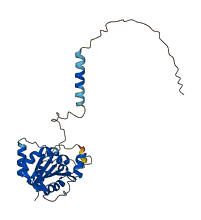
Descriptions
The autoinhibited protein was predicted that may have potential autoinhibitory elements via cis-regPred.
Autoinhibitory domains (AIDs)
Target domain |
|
Relief mechanism |
|
Assay |
cis-regPred |
Accessory elements
No accessory elements
Autoinhibited structure

Activated structure
1 structures for Q9M2Y6
| Entry ID | Method | Resolution | Chain | Position | Source |
|---|---|---|---|---|---|
| AF-Q9M2Y6-F1 | Predicted | AlphaFoldDB |
11 variants for Q9M2Y6
| Variant ID(s) | Position | Change | Description | Diseaes Association | Provenance |
|---|---|---|---|---|---|
| ENSVATH06281059 | 12 | V>A | No | 1000Genomes | |
| ENSVATH06281057 | 50 | A>G | No | 1000Genomes | |
| tmp_3_18441399_C_A | 50 | A>S | No | 1000Genomes | |
| tmp_3_18441098_C_T | 74 | A>T | No | 1000Genomes | |
| tmp_3_18440905_C_G | 138 | G>A | No | 1000Genomes | |
| ENSVATH12668221 | 180 | L>I | No | 1000Genomes | |
| tmp_3_18440759_C_T | 187 | G>S | No | 1000Genomes | |
| tmp_3_18440325_G_A | 218 | S>L | No | 1000Genomes | |
| ENSVATH14409805 | 225 | V>L | No | 1000Genomes | |
| ENSVATH00411359 | 227 | T>I | No | 1000Genomes | |
| ENSVATH06281040 | 234 | A>V | No | 1000Genomes |
No associated diseases with Q9M2Y6
10 GO annotations of cellular component
| Name | Definition |
|---|---|
| chloroplast thylakoid membrane | The pigmented membrane of a chloroplast thylakoid. An example of this component is found in Arabidopsis thaliana. |
| cytosol | The part of the cytoplasm that does not contain organelles but which does contain other particulate matter, such as protein complexes. |
| endosome | A vacuole to which materials ingested by endocytosis are delivered. |
| Golgi apparatus | A membrane-bound cytoplasmic organelle of the endomembrane system that further processes the core oligosaccharides (e.g. N-glycans) added to proteins in the endoplasmic reticulum and packages them into membrane-bound vesicles. The Golgi apparatus operates at the intersection of the secretory, lysosomal, and endocytic pathways. |
| Golgi medial cisterna | The middle Golgi cisterna (or cisternae). |
| Golgi membrane | The lipid bilayer surrounding any of the compartments of the Golgi apparatus. |
| integral component of membrane | The component of a membrane consisting of the gene products and protein complexes having at least some part of their peptide sequence embedded in the hydrophobic region of the membrane. |
| plant-type vacuole | A closed structure that is completely surrounded by a unit membrane, contains liquid, and retains the same shape regardless of cell cycle phase. An example of this structure is found in Arabidopsis thaliana. |
| plasma membrane | The membrane surrounding a cell that separates the cell from its external environment. It consists of a phospholipid bilayer and associated proteins. |
| trans-Golgi network | The network of interconnected tubular and cisternal structures located within the Golgi apparatus on the side distal to the endoplasmic reticulum, from which secretory vesicles emerge. The trans-Golgi network is important in the later stages of protein secretion where it is thought to play a key role in the sorting and targeting of secreted proteins to the correct destination. |
1 GO annotations of molecular function
| Name | Definition |
|---|---|
| methyltransferase activity | Catalysis of the transfer of a methyl group to an acceptor molecule. |
11 GO annotations of biological process
| Name | Definition |
|---|---|
| carbon utilization | A series of processes that forms an integrated mechanism by which a cell or an organism detects the depletion of primary carbon sources and then activates genes to scavenge the last traces of the primary carbon source and to transport and metabolize alternative carbon sources such as carbon dioxide or carbonic acid. The utilization process begins when the cell or organism detects carbon levels, includes the activation of genes whose products detect, transport or metabolize carbon-containing substances, and ends when carbon is incorporated into the cell or organism's metabolism. |
| leaf morphogenesis | The process in which the anatomical structures of the leaf are generated and organized. |
| methylation | The process in which a methyl group is covalently attached to a molecule. |
| pectin biosynthetic process | The chemical reactions and pathways resulting in the formation of pectin, a polymer containing a backbone of alpha-1,4-linked D-galacturonic acid residues. |
| pectin metabolic process | The chemical reactions and pathways involving pectin, a group of galacturonic acid-containing, water-soluble colloidal carbohydrates of high molecular weight and of net negative charge. |
| plant-type cell wall biogenesis | A cellular process that results in the biosynthesis of constituent macromolecules, assembly, and arrangement of constituent parts of a cellulose and pectin-containing cell wall. An example of this is found in Arabidopsis thaliana. |
| plant-type cell wall organization | A process that results in the assembly and arrangement of constituent parts of the cellulose and pectin-containing cell wall, or in the disassembly of the cellulose and pectin-containing cell wall. This process is carried out at the cellular level. An example of this process is found in Arabidopsis thaliana. |
| positive regulation of developmental growth | Any process that activates, maintains or increases the rate of developmental growth. |
| positive regulation of photosynthesis | Any process that activates or increases the frequency, rate or extent of photosynthesis. |
| positive regulation of respiratory gaseous exchange | Any process that activates or increases the frequency, rate or extent of respiratory gaseous exchange. |
| positive regulation of unidimensional cell growth | Any process that activates or increases the frequency, rate or extent of unidimensional cell growth, the process in which a cell irreversibly increases in size in one |
No homologous proteins in AiPD
| UniProt AC | Gene Name | Protein Name | Species | Evidence Code |
|---|---|---|---|---|
| No homologous proteins | ||||
| 10 | 20 | 30 | 40 | 50 | 60 |
| MARRQVGSTR | RVGDGGSFPF | AGALHSKSRS | SPLLSICLVL | VGACLLIGYA | YSGPGIFKSI |
| 70 | 80 | 90 | 100 | 110 | 120 |
| KEVSKVTGDY | SCTAEVQRAI | PVLKKAYGDG | MRKVLHVGPD | TCSVVSSLLK | EEETEAWGVE |
| 130 | 140 | 150 | 160 | 170 | 180 |
| PYDIEDADSH | CKSFVSKGLV | RVADIKFPLP | YRAKSFSLVI | VSDALDYLSP | KYLNKTVPEL |
| 190 | 200 | 210 | 220 | 230 | 240 |
| ARVASDGVVL | FAGLPGQQRA | KVAELSKFGR | PAKMRSASWW | NRFFVQTNLE | ENDAPSKKFE |
| 250 | 260 | ||||
| QAVSKGLYKP | ACQVFHLKPL | H |