Q9M2B0
Gene name |
RBX1B (At3g42830, T21C14.50) |
Protein name |
RING-box protein 1b |
Names |
At-Rbx12, RBX1-1, RBX1b-At |
Species |
Arabidopsis thaliana (Mouse-ear cress) |
KEGG Pathway |
ath:AT3G42830 |
EC number |
|
Protein Class |
|
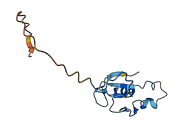
Descriptions
The autoinhibited protein was predicted that may have potential autoinhibitory elements via cis-regPred.
Autoinhibitory domains (AIDs)
Target domain |
|
Relief mechanism |
|
Assay |
cis-regPred |
Accessory elements
No accessory elements
Autoinhibited structure

Activated structure
1 structures for Q9M2B0
| Entry ID | Method | Resolution | Chain | Position | Source |
|---|---|---|---|---|---|
| AF-Q9M2B0-F1 | Predicted | AlphaFoldDB |
39 variants for Q9M2B0
| Variant ID(s) | Position | Change | Description | Diseaes Association | Provenance |
|---|---|---|---|---|---|
| tmp_3_14930671_G_A | 3 | S>F | No | 1000Genomes | |
| tmp_3_14930658_G_T | 7 | D>E | No | 1000Genomes | |
| ENSVATH00386514 | 11 | G>D | No | 1000Genomes | |
| ENSVATH00386513 | 12 | E>V | No | 1000Genomes | |
| ENSVATH00386512 | 14 | S>F | No | 1000Genomes | |
| ENSVATH06138971 | 19 | P>L | No | 1000Genomes | |
| ENSVATH06138970 | 21 | S>T | No | 1000Genomes | |
| ENSVATH06138968 | 22 | S>L | No | 1000Genomes | |
| ENSVATH06138969 | 22 | S>T | No | 1000Genomes | |
| ENSVATH02366618 | 23 | S>F | No | 1000Genomes | |
| ENSVATH02366617 | 28 | R>Q | No | 1000Genomes | |
| tmp_3_14930588_A_T | 31 | L>I | No | 1000Genomes | |
| tmp_3_14930566_G_C | 38 | A>G | No | 1000Genomes | |
| ENSVATH02366616 | 38 | A>T | No | 1000Genomes | |
| tmp_3_14930560_C_T | 40 | W>* | No | 1000Genomes | |
| ENSVATH06138967 | 41 | A>P | No | 1000Genomes | |
| ENSVATH06138966 | 41 | A>V | No | 1000Genomes | |
| ENSVATH02366610 | 46 | V>I | No | 1000Genomes | |
| ENSVATH00386510 | 48 | N>Y | No | 1000Genomes | |
| ENSVATH00386509 | 50 | A>T | No | 1000Genomes | |
| ENSVATH06138960 | 56 | I>T | No | 1000Genomes | |
| tmp_3_14930318_A_G | 61 | I>T | No | 1000Genomes | |
| tmp_3_14930310_G_C | 64 | L>V | No | 1000Genomes | |
| ENSVATH00386508 | 66 | N>K | No | 1000Genomes | |
| tmp_3_14930294_C_A | 69 | S>I | No | 1000Genomes | |
| ENSVATH14274728 | 74 | E>K | No | 1000Genomes | |
| tmp_3_14930273_G_A | 76 | T>I | No | 1000Genomes | |
| tmp_3_14930267_G_A | 78 | A>V | No | 1000Genomes | |
| ENSVATH12127393 | 93 | R>K | No | 1000Genomes | |
| tmp_3_14929871_C_A | 94 | W>L | No | 1000Genomes | |
| ENSVATH00386501 | 100 | V>L | No | 1000Genomes | |
| ENSVATH00386501 | 100 | V>M | No | 1000Genomes | |
| tmp_3_14929845_G_C | 103 | L>V | No | 1000Genomes | |
| ENSVATH06138945 | 106 | C>S | No | 1000Genomes | |
| ENSVATH02366585 | 106 | C>Y | No | 1000Genomes | |
| ENSVATH02366584 | 107 | E>D | No | 1000Genomes | |
| ENSVATH02366583 | 108 | W>* | No | 1000Genomes | |
| ENSVATH06138944 | 112 | K>R | No | 1000Genomes | |
| ENSVATH12127389 | 115 | H>Q | No | 1000Genomes |
No associated diseases with Q9M2B0
1 regional properties for Q9M2B0
| Type | Name | Position | InterPro Accession |
|---|---|---|---|
| domain | Calcipressin-2, RNA recognition motif | 11 - 87 | IPR034919 |
4 GO annotations of cellular component
| Name | Definition |
|---|---|
| cullin-RING ubiquitin ligase complex | Any ubiquitin ligase complex in which the catalytic core consists of a member of the cullin family and a RING domain protein; the core is associated with one or more additional proteins that confer substrate specificity. |
| cytoplasm | The contents of a cell excluding the plasma membrane and nucleus, but including other subcellular structures. |
| nucleus | A membrane-bounded organelle of eukaryotic cells in which chromosomes are housed and replicated. In most cells, the nucleus contains all of the cell's chromosomes except the organellar chromosomes, and is the site of RNA synthesis and processing. In some species, or in specialized cell types, RNA metabolism or DNA replication may be absent. |
| SCF ubiquitin ligase complex | A ubiquitin ligase complex in which a cullin from the Cul1 subfamily and a RING domain protein form the catalytic core; substrate specificity is conferred by a Skp1 adaptor and an F-box protein. SCF complexes are involved in targeting proteins for degradation by the proteasome. The best characterized complexes are those from yeast and mammals (with core subunits named Cdc53/Cul1, Rbx1/Hrt1/Roc1). |
3 GO annotations of molecular function
| Name | Definition |
|---|---|
| cullin family protein binding | Binding to a member of the cullin family, hydrophobic proteins that act as scaffolds for ubiquitin ligases (E3). |
| ubiquitin protein ligase activity | Catalysis of the transfer of ubiquitin to a substrate protein via the reaction X-ubiquitin + S -> X + S-ubiquitin, where X is either an E2 or E3 enzyme, the X-ubiquitin linkage is a thioester bond, and the S-ubiquitin linkage is an amide bond: an isopeptide bond between the C-terminal glycine of ubiquitin and the epsilon-amino group of lysine residues in the substrate or, in the linear extension of ubiquitin chains, a peptide bond the between the C-terminal glycine and N-terminal methionine of ubiquitin residues. |
| zinc ion binding | Binding to a zinc ion (Zn). |
6 GO annotations of biological process
| Name | Definition |
|---|---|
| auxin-activated signaling pathway | The series of molecular signals generated by the binding of the plant hormone auxin to a receptor, and ending with modulation of a downstream cellular process, e.g. transcription. |
| jasmonic acid mediated signaling pathway | The series of molecular signals mediated by jasmonic acid. |
| protein ubiquitination | The process in which one or more ubiquitin groups are added to a protein. |
| response to auxin | Any process that results in a change in state or activity of a cell or an organism (in terms of movement, secretion, enzyme production, gene expression, etc.) as a result of an auxin stimulus. |
| response to jasmonic acid | Any process that results in a change in state or activity of a cell or an organism (in terms of movement, secretion, enzyme production, gene expression, etc.) as a result of a jasmonic acid stimulus. |
| ubiquitin-dependent protein catabolic process | The chemical reactions and pathways resulting in the breakdown of a protein or peptide by hydrolysis of its peptide bonds, initiated by the covalent attachment of a ubiquitin group, or multiple ubiquitin groups, to the protein. |
No homologous proteins in AiPD
| UniProt AC | Gene Name | Protein Name | Species | Evidence Code |
|---|---|---|---|---|
| No homologous proteins | ||||
| 10 | 20 | 30 | 40 | 50 | 60 |
| MASLNSDVIM | GESSSISVPS | SSSKNSKRFE | LKKWSAVALW | AWDIVVDNCA | ICRNHIMDLC |
| 70 | 80 | 90 | 100 | 110 | |
| IECLANQASA | TSEECTVAWG | VCNHAFHFHC | ISRWLKTRQV | CPLDVCEWEF | QKYGH |