Q9M158
Gene name |
STR4 |
Protein name |
Rhodanese-like domain-containing protein 4, chloroplastic |
Names |
Protein THYLAKOID RHODANESE-LIKE, Sulfurtransferase 4, AtStr4 |
Species |
Arabidopsis thaliana (Mouse-ear cress) |
KEGG Pathway |
ath:AT4G01050 |
EC number |
|
Protein Class |
|
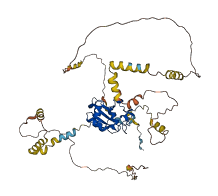
Descriptions
The autoinhibited protein was predicted that may have potential autoinhibitory elements via cis-regPred.
Autoinhibitory domains (AIDs)
Target domain |
|
Relief mechanism |
|
Assay |
cis-regPred |
Accessory elements
No accessory elements
Autoinhibited structure

Activated structure
3 structures for Q9M158
| Entry ID | Method | Resolution | Chain | Position | Source |
|---|---|---|---|---|---|
| 1VEE | NMR | - | A | 134-254 | PDB |
| 2DCQ | NMR | - | A | 134-254 | PDB |
| AF-Q9M158-F1 | Predicted | AlphaFoldDB |
32 variants for Q9M158
| Variant ID(s) | Position | Change | Description | Diseaes Association | Provenance |
|---|---|---|---|---|---|
| ENSVATH06410391 | 43 | E>G | No | 1000Genomes | |
| tmp_4_456048_G_C | 59 | V>L | No | 1000Genomes | |
| tmp_4_456077_A_T | 68 | K>N | No | 1000Genomes | |
| tmp_4_456078_T_G | 69 | S>A | No | 1000Genomes | |
| tmp_4_456147_A_G | 92 | I>V | No | 1000Genomes | |
| tmp_4_456157_T_C | 95 | I>T | No | 1000Genomes | |
| tmp_4_456202_T_C | 110 | V>A | No | 1000Genomes | |
| ENSVATH02607452 | 122 | V>F | No | 1000Genomes | |
| ENSVATH10483230 | 128 | K>I | No | 1000Genomes | |
| tmp_4_456324_C_A | 151 | L>I | No | 1000Genomes | |
| ENSVATH00450907 | 156 | T>N | No | 1000Genomes | |
| ENSVATH00450908 | 160 | R>S | No | 1000Genomes | |
| ENSVATH13867312 | 169 | G>S | No | 1000Genomes | |
| ENSVATH06410395 | 173 | K>N | No | 1000Genomes | |
| tmp_4_456405_G_A | 178 | V>I | No | 1000Genomes | |
| tmp_4_456440_G_T | 189 | K>N | No | 1000Genomes | |
| ENSVATH06410399 | 222 | L>R | No | 1000Genomes | |
| ENSVATH06410401 | 268 | G>S | No | 1000Genomes | |
| ENSVATH10483267 | 291 | V>F | No | 1000Genomes | |
| tmp_4_457711_G_A | 374 | A>T | No | 1000Genomes | |
| ENSVATH10483286 | 376 | S>A | No | 1000Genomes | |
| tmp_4_457760_A_G | 390 | E>G | No | 1000Genomes | |
| ENSVATH06410406 | 392 | E>K | No | 1000Genomes | |
| ENSVATH00450912 | 393 | T>A | No | 1000Genomes | |
| ENSVATH08201972 | 398 | T>P | No | 1000Genomes | |
| ENSVATH06410407 | 402 | D>N | No | 1000Genomes | |
| tmp_4_457801_C_T | 404 | P>S | No | 1000Genomes | |
| tmp_4_457814_C_T | 408 | P>L | No | 1000Genomes | |
| tmp_4_457861_G_T | 424 | V>F | No | 1000Genomes | |
| ENSVATH06410409 | 425 | A>T | No | 1000Genomes | |
| ENSVATH06410410 | 433 | T>A | No | 1000Genomes | |
| ENSVATH13867339 | 450 | A>T | No | 1000Genomes |
No associated diseases with Q9M158
Functions
7 GO annotations of cellular component
| Name | Definition |
|---|---|
| chloroplast | A chlorophyll-containing plastid with thylakoids organized into grana and frets, or stroma thylakoids, and embedded in a stroma. |
| chloroplast envelope | The double lipid bilayer enclosing the chloroplast and separating its contents from the rest of the cytoplasm; includes the intermembrane space. |
| chloroplast thylakoid | Sac-like membranous structures (cisternae) in a chloroplast combined into stacks (grana) and present singly in the stroma (stroma thylakoids or frets) as interconnections between grana. An example of this component is found in Arabidopsis thaliana. |
| chloroplast thylakoid membrane | The pigmented membrane of a chloroplast thylakoid. An example of this component is found in Arabidopsis thaliana. |
| chloroplast thylakoid membrane protein complex | A protein complex that is part of a chloroplast thylakoid membrane. |
| cytosol | The part of the cytoplasm that does not contain organelles but which does contain other particulate matter, such as protein complexes. |
| integral component of membrane | The component of a membrane consisting of the gene products and protein complexes having at least some part of their peptide sequence embedded in the hydrophobic region of the membrane. |
No GO annotations of molecular function
| Name | Definition |
|---|---|
| No GO annotations for molecular function |
1 GO annotations of biological process
| Name | Definition |
|---|---|
| photosynthetic electron transport in photosystem II | A photosynthetic electron transport chain in which electrons move from the primary electron acceptor (Quinone, Q) through a chain of electron transport molecules in the thylakoid membrane until they reach the ultimate electron acceptor of Photosystem II, which is plastocyanin (PC). The electron is then passed to the P700 chlorophyll a molecules of the reaction centre of photosystem I. |
No homologous proteins in AiPD
| UniProt AC | Gene Name | Protein Name | Species | Evidence Code |
|---|---|---|---|---|
| No homologous proteins | ||||
| 10 | 20 | 30 | 40 | 50 | 60 |
| MEALKTATFS | PMSVLSEKRS | EPRKPFSLPN | LFPPKSQRPI | SQESFLKRFN | GGLALLTSVL |
| 70 | 80 | 90 | 100 | 110 | 120 |
| SSATAPAKSL | TYEEALQQSM | TTSSSFDSDG | LIEGISNFVT | DNPLVIAGGV | AALAVPFVLS |
| 130 | 140 | 150 | 160 | 170 | 180 |
| QVLNKKPKSW | GVESAKNAYT | KLGTDDNAQL | LDIRATADFR | QVGSPNIKGL | GKKAVSTVYN |
| 190 | 200 | 210 | 220 | 230 | 240 |
| GEDKPGFLKK | LSLKFKDPEN | TTLYILDKFD | GNSELVAELV | ALNGFKSAYA | IKDGAEGPRG |
| 250 | 260 | 270 | 280 | 290 | 300 |
| WLNSSLPWIE | PKKTLSLDLS | SLTDSISGVF | GESSDGVSVA | LGVAAAAGLS | VFAFTEIETI |
| 310 | 320 | 330 | 340 | 350 | 360 |
| LQLLGSAALV | QLAGKKLLFA | EDRKQTLKQV | DEFLNTKVAP | KELVDELKEI | GKALLPQSTS |
| 370 | 380 | 390 | 400 | 410 | 420 |
| NKALPAPATV | TAEAESATAT | TTTVDKPVPE | PETVAATTTT | VDKPVPEPEP | VPEPVPVPAI |
| 430 | 440 | 450 | 460 | ||
| EAAVAAQVIT | EPTETEAKPK | PHSRPLSPYA | SYPDLKPPSS | PMPSQP |