Q9LZ66
Gene name |
SIR (At5g04590, T32M21.190) |
Protein name |
Assimilatory sulfite reductase (ferredoxin), chloroplastic |
Names |
AtSiR, Sulfite reductase (ferredoxin) |
Species |
Arabidopsis thaliana (Mouse-ear cress) |
KEGG Pathway |
ath:AT5G04590 |
EC number |
1.8.7.1: With an iron-sulfur protein as acceptor |
Protein Class |
|
Descriptions
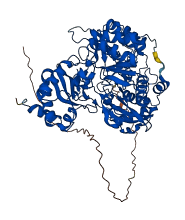
The autoinhibited protein was predicted that may have potential autoinhibitory elements via cis-regPred.
Autoinhibitory domains (AIDs)
Target domain |
|
Relief mechanism |
|
Assay |
cis-regPred |
Accessory elements
No accessory elements
Autoinhibited structure

Activated structure
1 structures for Q9LZ66
| Entry ID | Method | Resolution | Chain | Position | Source |
|---|---|---|---|---|---|
| AF-Q9LZ66-F1 | Predicted | AlphaFoldDB |
35 variants for Q9LZ66
| Variant ID(s) | Position | Change | Description | Diseaes Association | Provenance |
|---|---|---|---|---|---|
| ENSVATH10570226 | 2 | S>P | No | 1000Genomes | |
| ENSVATH06922084 | 4 | T>K | No | 1000Genomes | |
| ENSVATH10570228 | 9 | A>G | No | 1000Genomes | |
| ENSVATH06922086 | 43 | G>R | No | 1000Genomes | |
| ENSVATH06922087 | 45 | V>A | No | 1000Genomes | |
| tmp_5_1319548_C_T | 49 | P>S | No | 1000Genomes | |
| tmp_5_1319949_C_G | 65 | P>R | No | 1000Genomes | |
| ENSVATH13922231 | 71 | A>T | No | 1000Genomes | |
| tmp_5_1320110_T_C | 119 | Y>H | No | 1000Genomes | |
| ENSVATH10570268 | 189 | K>Q | No | 1000Genomes | |
| tmp_5_1320380_G_A | 209 | A>T | No | 1000Genomes | |
| ENSVATH00606587 | 216 | D>N | No | 1000Genomes | |
| tmp_5_1320521_G_C | 256 | V>L | No | 1000Genomes | |
| ENSVATH06922089 | 258 | K>T | No | 1000Genomes | |
| tmp_5_1320545_T_G | 264 | S>A | No | 1000Genomes | |
| tmp_5_1320549_A_G | 265 | H>R | No | 1000Genomes | |
| ENSVATH00606588 | 275 | P>S | No | 1000Genomes | |
| tmp_5_1321055_T_G | 387 | I>M | No | 1000Genomes | |
| tmp_5_1321111_G_A | 406 | R>H | No | 1000Genomes | |
| ENSVATH13922234 | 421 | E>V | No | 1000Genomes | |
| ENSVATH10570271 | 424 | D>N | No | 1000Genomes | |
| tmp_5_1321312_T_C | 441 | I>T | No | 1000Genomes | |
| tmp_5_1321338_A_G | 450 | I>V | No | 1000Genomes | |
| ENSVATH06922095 | 471 | K>N | No | 1000Genomes | |
| ENSVATH06922094 | 471 | K>R | No | 1000Genomes | |
| ENSVATH06922096 | 481 | V>A | No | 1000Genomes | |
| tmp_5_1321661_G_T | 529 | A>S | No | 1000Genomes | |
| ENSVATH00606590 | 539 | D>Y | No | 1000Genomes | |
| ENSVATH13922258 | 592 | V>L | No | 1000Genomes | |
| ENSVATH06922103 | 599 | K>N | No | 1000Genomes | |
| tmp_5_1322071_C_A | 607 | H>N | No | 1000Genomes | |
| tmp_5_1322093_C_G | 614 | T>S | No | 1000Genomes | |
| tmp_5_1322272_G_C | 635 | D>H | No | 1000Genomes | |
| tmp_5_1322283_A_C | 638 | K>N | No | 1000Genomes | |
| tmp_5_1322284_G_A | 639 | G>R | No | 1000Genomes |
No associated diseases with Q9LZ66
6 regional properties for Q9LZ66
| Type | Name | Position | InterPro Accession |
|---|---|---|---|
| domain | TRAM domain | 376 - 441 | IPR002792 |
| domain | Elp3/MiaA/NifB-like, radical SAM core domain | 140 - 365 | IPR006638 |
| domain | Radical SAM | 136 - 373 | IPR007197 |
| domain | Methylthiotransferase, N-terminal | 8 - 118 | IPR013848 |
| conserved_site | Methylthiotransferase, conserved site | 144 - 164 | IPR020612 |
| domain | RimO, TRAM domain | 379 - 441 | IPR041582 |
Functions
| Description | ||
|---|---|---|
| EC Number | 1.8.7.1 | With an iron-sulfur protein as acceptor |
| Subcellular Localization |
|
|
| PANTHER Family | ||
| PANTHER Subfamily | ||
| PANTHER Protein Class | ||
| PANTHER Pathway Category | No pathway information available | |
9 GO annotations of cellular component
| Name | Definition |
|---|---|
| apoplast | The cell membranes and intracellular regions in a plant are connected through plasmodesmata, and plants may be described as having two major compartments: the living symplast and the non-living apoplast. The apoplast is external to the plasma membrane and includes cell walls, intercellular spaces and the lumen of dead structures such as xylem vessels. Water and solutes pass freely through it. |
| chloroplast | A chlorophyll-containing plastid with thylakoids organized into grana and frets, or stroma thylakoids, and embedded in a stroma. |
| chloroplast envelope | The double lipid bilayer enclosing the chloroplast and separating its contents from the rest of the cytoplasm; includes the intermembrane space. |
| chloroplast nucleoid | The region of a chloroplast to which the DNA is confined. |
| chloroplast stroma | The space enclosed by the double membrane of a chloroplast but excluding the thylakoid space. It contains DNA, ribosomes and some temporary products of photosynthesis. |
| plasma membrane | The membrane surrounding a cell that separates the cell from its external environment. It consists of a phospholipid bilayer and associated proteins. |
| plastid | Any member of a family of organelles found in the cytoplasm of plants and some protists, which are membrane-bounded and contain DNA. Plant plastids develop from a common type, the proplastid. |
| stromule | Thin filamentous structure extending from the surface of all plastid types examined so far, including chloroplast, proplastid, etioplast, leucoplast, amyloplast, and chromoplast. In general, stromules are more abundant in tissues containing non-green plastids, and in cells containing smaller plastids. The primary function of stromules is still unresolved, although the presence of stromules markedly increases the plastid surface area, potentially increasing transport to and from the cytosol. Other functions of stromules, such as transfer of macromolecules between plastids and starch granule formation in cereal endosperm, may be restricted to particular tissues and cell types. |
| sulfite reductase complex (NADPH) | A multisubunit iron flavoprotein, which in yeast is composed of 2 alpha and 2 beta subunits. Catalyzes the reduction of sulfite to sulfide. |
6 GO annotations of molecular function
| Name | Definition |
|---|---|
| 4 iron, 4 sulfur cluster binding | Binding to a 4 iron, 4 sulfur (4Fe-4S) cluster; this cluster consists of four iron atoms, with the inorganic sulfur atoms found between the irons and acting as bridging ligands. |
| copper ion binding | Binding to a copper (Cu) ion. |
| DNA binding | Any molecular function by which a gene product interacts selectively and non-covalently with DNA (deoxyribonucleic acid). |
| heme binding | Binding to a heme, a compound composed of iron complexed in a porphyrin (tetrapyrrole) ring. |
| sulfite reductase (ferredoxin) activity | Catalysis of the reaction: hydrogen sulfide + 3 oxidized ferredoxin + 3 H2O = sulfite + 3 reduced ferredoxin. |
| sulfite reductase activity | Catalysis of the reaction: hydrogen sulfide + acceptor + 3 H2O = sulfite + reduced acceptor. |
5 GO annotations of biological process
| Name | Definition |
|---|---|
| negative regulation of DNA-templated transcription | Any process that stops, prevents, or reduces the frequency, rate or extent of cellular DNA-templated transcription. |
| response to cold | Any process that results in a change in state or activity of a cell or an organism (in terms of movement, secretion, enzyme production, gene expression, etc.) as a result of a cold stimulus, a temperature stimulus below the optimal temperature for that organism. |
| sulfate assimilation | The pathways by which inorganic sulfate is processed and incorporated into sulfated compounds. |
| sulfide oxidation, using siroheme sulfite reductase | A sulfide oxidation process that proceeds via the reaction catalyzed by siroheme sulfite reductase. |
| sulfur compound metabolic process | The chemical reactions and pathways involving the nonmetallic element sulfur or compounds that contain sulfur, such as the amino acids methionine and cysteine or the tripeptide glutathione. |
1 homologous proteins in AiPD
| UniProt AC | Gene Name | Protein Name | Species | Evidence Code |
|---|---|---|---|---|
| Q9AWB2 | SIR | Sulfite reductase [ferredoxin], chloroplastic | Glycine max (Soybean) (Glycine hispida) | PR |
| 10 | 20 | 30 | 40 | 50 | 60 |
| MSSTFRAPAG | AATVFTADQK | IRLGRLDALR | SSHSVFLGRY | GRGGVPVPPS | ASSSSSSPIQ |
| 70 | 80 | 90 | 100 | 110 | 120 |
| AVSTPAKPET | ATKRSKVEII | KEKSNFIRYP | LNEELLTEAP | NVNESAVQLI | KFHGSYQQYN |
| 130 | 140 | 150 | 160 | 170 | 180 |
| REERGGRSYS | FMLRTKNPSG | KVPNQLYLTM | DDLADEFGIG | TLRLTTRQTF | QLHGVLKQNL |
| 190 | 200 | 210 | 220 | 230 | 240 |
| KTVMSSIIKN | MGSTLGACGD | LNRNVLAPAA | PYVKKDYLFA | QETADNIAAL | LSPQSGFYYD |
| 250 | 260 | 270 | 280 | 290 | 300 |
| MWVDGEQFMT | AEPPEVVKAR | NDNSHGTNFV | DSPEPIYGTQ | FLPRKFKVAV | TVPTDNSVDL |
| 310 | 320 | 330 | 340 | 350 | 360 |
| LTNDIGVVVV | SDENGEPQGF | NIYVGGGMGR | THRMESTFAR | LAEPIGYVPK | EDILYAVKAI |
| 370 | 380 | 390 | 400 | 410 | 420 |
| VVTQREHGRR | DDRKYSRMKY | LISSWGIEKF | RDVVEQYYGK | KFEPSRELPE | WEFKSYLGWH |
| 430 | 440 | 450 | 460 | 470 | 480 |
| EQGDGAWFCG | LHVDSGRVGG | IMKKTLREVI | EKYKIDVRIT | PNQNIVLCDI | KTEWKRPITT |
| 490 | 500 | 510 | 520 | 530 | 540 |
| VLAQAGLLQP | EFVDPLNQTA | MACPAFPLCP | LAITEAERGI | PSILKRVRAM | FEKVGLDYDE |
| 550 | 560 | 570 | 580 | 590 | 600 |
| SVVIRVTGCP | NGCARPYMAE | LGLVGDGPNS | YQVWLGGTPN | LTQIARSFMD | KVKVHDLEKV |
| 610 | 620 | 630 | 640 | ||
| CEPLFYHWKL | ERQTKESFGE | YTTRMGFEKL | KELIDTYKGV | SQ |