Q9LV85
Gene name |
CPR5 |
Protein name |
Protein CPR-5 |
Names |
Protein constitutive expression of pathogenesis-related genes 5, Protein constitutive expression of PR genes 5, Protein hypersenescence-1 |
Species |
Arabidopsis thaliana (Mouse-ear cress) |
KEGG Pathway |
ath:AT5G64930 |
EC number |
|
Protein Class |
|
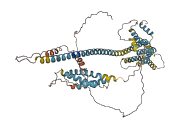
Descriptions
The autoinhibited protein was predicted that may have potential autoinhibitory elements via cis-regPred.
Autoinhibitory domains (AIDs)
Target domain |
|
Relief mechanism |
|
Assay |
cis-regPred |
Accessory elements
No accessory elements
Autoinhibited structure

Activated structure
1 structures for Q9LV85
| Entry ID | Method | Resolution | Chain | Position | Source |
|---|---|---|---|---|---|
| AF-Q9LV85-F1 | Predicted | AlphaFoldDB |
36 variants for Q9LV85
| Variant ID(s) | Position | Change | Description | Diseaes Association | Provenance |
|---|---|---|---|---|---|
| tmp_5_25948317_T_C | 2 | E>G | No | 1000Genomes | |
| ENSVATH03476078 | 2 | E>K | No | 1000Genomes | |
| ENSVATH07480436 | 10 | P>Q | No | 1000Genomes | |
| tmp_5_25948290_T_G | 11 | E>A | No | 1000Genomes | |
| ENSVATH03476077 | 19 | P>S | No | 1000Genomes | |
| ENSVATH12933838 | 21 | N>K | No | 1000Genomes | |
| ENSVATH07480435 | 22 | S>A | No | 1000Genomes | |
| tmp_5_25948252_G_T | 24 | P>T | No | 1000Genomes | |
| ENSVATH12933837 | 26 | H>N | No | 1000Genomes | |
| ENSVATH14648653 | 33 | K>R | No | 1000Genomes | |
| ENSVATH03476076 | 41 | K>M | No | 1000Genomes | |
| ENSVATH03476076 | 41 | K>R | No | 1000Genomes | |
| ENSVATH07480434 | 45 | T>M | No | 1000Genomes | |
| ENSVATH07480433 | 46 | N>I | No | 1000Genomes | |
| tmp_5_25948170_T_A | 51 | E>V | No | 1000Genomes | |
| tmp_5_25948162_T_G | 54 | K>Q | No | 1000Genomes | |
| ENSVATH00751967 | 114 | K>N | No | 1000Genomes | |
| ENSVATH00751966 | 128 | N>H | No | 1000Genomes | |
| ENSVATH07480423 | 130 | V>L | No | 1000Genomes | |
| tmp_5_25947358_T_A | 135 | N>I | No | 1000Genomes | |
| tmp_5_25947033_T_C | 183 | I>V | No | 1000Genomes | |
| tmp_5_25946999_T_C | 194 | H>R | No | 1000Genomes | |
| ENSVATH12933835 | 227 | A>D | No | 1000Genomes | |
| tmp_5_25946862_C_T | 240 | A>T | No | 1000Genomes | |
| ENSVATH12933824 | 258 | C>Y | No | 1000Genomes | |
| tmp_5_25946762_C_G | 273 | R>T | No | 1000Genomes | |
| ENSVATH12933823 | 279 | T>I | No | 1000Genomes | |
| tmp_5_25946683_T_G | 299 | K>N | No | 1000Genomes | |
| ENSVATH07480417 | 328 | A>V | No | 1000Genomes | |
| ENSVATH07480416 | 343 | M>V | No | 1000Genomes | |
| tmp_5_25946435_T_C | 382 | D>G | No | 1000Genomes | |
| ENSVATH07480415 | 393 | V>I | No | 1000Genomes | |
| tmp_5_25946258_G_T | 441 | T>K | No | 1000Genomes | |
| ENSVATH07480414 | 475 | I>L | No | 1000Genomes | |
| ENSVATH07480413 | 506 | Q>E | No | 1000Genomes | |
| ENSVATH14648651 | 536 | V>I | No | 1000Genomes |
No associated diseases with Q9LV85
5 regional properties for Q9LV85
| Type | Name | Position | InterPro Accession |
|---|---|---|---|
| domain | C2 domain | 1 - 115 | IPR000008-1 |
| domain | C2 domain | 124 - 247 | IPR000008-2 |
| domain | von Willebrand factor, type A | 289 - 495 | IPR002035 |
| domain | Copine, C-terminal | 263 - 524 | IPR010734 |
| domain | Copine, C2B domain | 139 - 251 | IPR037768 |
6 GO annotations of cellular component
| Name | Definition |
|---|---|
| endoplasmic reticulum | The irregular network of unit membranes, visible only by electron microscopy, that occurs in the cytoplasm of many eukaryotic cells. The membranes form a complex meshwork of tubular channels, which are often expanded into slitlike cavities called cisternae. The ER takes two forms, rough (or granular), with ribosomes adhering to the outer surface, and smooth (with no ribosomes attached). |
| integral component of membrane | The component of a membrane consisting of the gene products and protein complexes having at least some part of their peptide sequence embedded in the hydrophobic region of the membrane. |
| membrane | A lipid bilayer along with all the proteins and protein complexes embedded in it an attached to it. |
| nuclear envelope | The double lipid bilayer enclosing the nucleus and separating its contents from the rest of the cytoplasm; includes the intermembrane space, a gap of width 20-40 nm (also called the perinuclear space). |
| nuclear membrane | Either of the lipid bilayers that surround the nucleus and form the nuclear envelope; excludes the intermembrane space. |
| nucleus | A membrane-bounded organelle of eukaryotic cells in which chromosomes are housed and replicated. In most cells, the nucleus contains all of the cell's chromosomes except the organellar chromosomes, and is the site of RNA synthesis and processing. In some species, or in specialized cell types, RNA metabolism or DNA replication may be absent. |
No GO annotations of molecular function
| Name | Definition |
|---|---|
| No GO annotations for molecular function |
8 GO annotations of biological process
| Name | Definition |
|---|---|
| aging | A developmental process that is a deterioration and loss of function over time. Aging includes loss of functions such as resistance to disease, homeostasis, and fertility, as well as wear and tear. Aging includes cellular senescence, but is more inclusive. May precede death and may succeed developmental maturation (GO:0021700). |
| defense response | Reactions, triggered in response to the presence of a foreign body or the occurrence of an injury, which result in restriction of damage to the organism attacked or prevention/recovery from the infection caused by the attack. |
| leaf senescence | The last stage of leaf development during which programmed degradation of macromolecules and nutrient recycling take place. |
| photoperiodism, flowering | A change from the vegetative to the reproductive phase as a result of detection of, or exposure to, a period of light or dark of a given length. The length of the period of light or dark required to initiate the change is set relative to a particular duration known as the 'critical day length'. The critical day length varies between species. |
| response to ethylene | Any process that results in a change in state or activity of a cell or an organism (in terms of movement, secretion, enzyme production, gene expression, etc.) as a result of an ethylene (ethene) stimulus. |
| sugar mediated signaling pathway | The process in which a change in the level of a mono- or disaccharide such as glucose, fructose or sucrose triggers the expression of genes controlling metabolic and developmental processes. |
| systemic acquired resistance | The salicylic acid mediated response to a pathogen which confers broad spectrum resistance. |
| trichome morphogenesis | The process in which the structures of a hair cell (trichome) cell are generated and organized. This process occurs while the initially relatively unspecialized epidermal cell is acquiring the specialized features of a hair cell. An example of this process is found in Arabidopsis thaliana. |
No homologous proteins in AiPD
| UniProt AC | Gene Name | Protein Name | Species | Evidence Code |
|---|---|---|---|---|
| No homologous proteins | ||||
| 10 | 20 | 30 | 40 | 50 | 60 |
| MEALLLPPSP | EPQNQITNPA | NSKPNHQSGD | VHKDETMMMK | KKKDTNPSNL | EKRKLKGKKK |
| 70 | 80 | 90 | 100 | 110 | 120 |
| EIMDNDEASS | SYCSTSSTSN | SNSTKRVTRV | VHRLRNPMRL | GMARRSVGER | QAEKLAKPLG |
| 130 | 140 | 150 | 160 | 170 | 180 |
| FSLAAFANMV | IARKNAAGQN | VYVDDLVEIF | ATLVEESLAN | VYGNKLGSFA | TNFEQTFSST |
| 190 | 200 | 210 | 220 | 230 | 240 |
| LKILKLTNEC | ANPHQSNNND | GGSCNLDRST | IDGCSDTELF | ERETSSATSA | YEVMQGSATA |
| 250 | 260 | 270 | 280 | 290 | 300 |
| TSLMNELALF | EETLQLSCVP | PRSSAMALTT | DERFLKEQTR | ANDLKTVEIG | LQIRELRCKE |
| 310 | 320 | 330 | 340 | 350 | 360 |
| TALGLKFESN | NLGKAALELD | VSKAAFRAEK | FKTELEDTRK | EEMVTRIMDW | LLVSVFSMLA |
| 370 | 380 | 390 | 400 | 410 | 420 |
| SMVLGVYNFS | IKRIEDATSV | CDQSEEKSSS | WWVPKQVSSI | NSGFNTFICR | VRVWVQIFFG |
| 430 | 440 | 450 | 460 | 470 | 480 |
| VLMIIVFTYF | LNKRSSGTKQ | TMPISFIVLF | LGIFCGVSGK | LCVDTLGGDG | KLWLIVWEVF |
| 490 | 500 | 510 | 520 | 530 | 540 |
| CLLQFVANVF | TLALYGLMFG | PINVTQETRS | NRCNSMFPYW | ARRSVVYVVI | LFVLPVINGL |
| 550 | 560 | ||||
| LPFATFGEWR | DFAMYHLHGG | SDYA |