Q9LPV5
Gene name |
NRT2.5 (At1g12940, F13K23.20) |
Protein name |
High affinity nitrate transporter 2.5 |
Names |
AtNRT2:5 |
Species |
Arabidopsis thaliana (Mouse-ear cress) |
KEGG Pathway |
ath:AT1G12940 |
EC number |
|
Protein Class |
|
Descriptions
The autoinhibited protein was predicted that may have potential autoinhibitory elements via cis-regPred.
Autoinhibitory domains (AIDs)
Target domain |
|
Relief mechanism |
|
Assay |
cis-regPred |
Accessory elements
No accessory elements
Autoinhibited structure

Activated structure
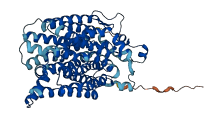
1 structures for Q9LPV5
| Entry ID | Method | Resolution | Chain | Position | Source |
|---|---|---|---|---|---|
| AF-Q9LPV5-F1 | Predicted | AlphaFoldDB |
5 variants for Q9LPV5
| Variant ID(s) | Position | Change | Description | Diseaes Association | Provenance |
|---|---|---|---|---|---|
| ENSVATH11110556 | 19 | R>W | No | 1000Genomes | |
| ENSVATH13888572 | 176 | W>G | No | 1000Genomes | |
| ENSVATH04567791 | 255 | S>F | No | 1000Genomes | |
| tmp_1_4417734_G_A | 327 | R>Q | No | 1000Genomes | |
| ENSVATH04567794 | 502 | T>I | No | 1000Genomes |
No associated diseases with Q9LPV5
3 GO annotations of cellular component
| Name | Definition |
|---|---|
| integral component of membrane | The component of a membrane consisting of the gene products and protein complexes having at least some part of their peptide sequence embedded in the hydrophobic region of the membrane. |
| plant-type vacuole membrane | The lipid bilayer surrounding a vacuole that retains the same shape regardless of cell cycle phase. The membrane separates its contents from the cytoplasm of the cell. An example of this component is found in Arabidopsis thaliana. |
| plasma membrane | The membrane surrounding a cell that separates the cell from its external environment. It consists of a phospholipid bilayer and associated proteins. |
1 GO annotations of molecular function
| Name | Definition |
|---|---|
| nitrate transmembrane transporter activity | Enables the transfer of nitrate ions (NO3-) from one side of a membrane to the other. |
3 GO annotations of biological process
| Name | Definition |
|---|---|
| cellular response to nitrate | Any process that results in a change in state or activity of a cell (in terms of movement, secretion, enzyme production, gene expression, etc.) as a result of a nitrate stimulus. |
| nitrate assimilation | The nitrogen metabolic process that encompasses the uptake of nitrate from the environment and reduction to ammonia, and results in the incorporation of nitrogen derived from nitrate into cellular substances. |
| nitrate transmembrane transport | The directed movement of nitrate into, out of or within a cell, or between cells, by means of some agent such as a transporter or pore. |
No homologous proteins in AiPD
| UniProt AC | Gene Name | Protein Name | Species | Evidence Code |
|---|---|---|---|---|
| No homologous proteins | ||||
| 10 | 20 | 30 | 40 | 50 | 60 |
| MEVEGKGGEA | GTTTTTAPRR | FALPVDAENK | ATTFRLFSVA | KPHMRAFHLS | WFQFFCCFVS |
| 70 | 80 | 90 | 100 | 110 | 120 |
| TFAAPPLLPV | IRENLNLTAT | DIGNAGIASV | SGAVFARIVM | GTACDLFGPR | LASAALTLST |
| 130 | 140 | 150 | 160 | 170 | 180 |
| APAVYFTAGI | KSPIGFIMVR | FFAGFSLATF | VSTQFWMSSM | FSGPVVGSAN | GIAAGWGNLG |
| 190 | 200 | 210 | 220 | 230 | 240 |
| GGATQLIMPI | VFSLIRNMGA | TKFTAWRIAF | FIPGLFQTLS | AFAVLLFGQD | LPDGDYWAMH |
| 250 | 260 | 270 | 280 | 290 | 300 |
| KSGEREKDDV | GKVISNGIKN | YRGWITALAY | GYCFGVELTI | DNIIAEYFFD | RFHLKLQTAG |
| 310 | 320 | 330 | 340 | 350 | 360 |
| IIAASFGLAN | FFARPGGGIF | SDFMSRRFGM | RGRLWAWWIV | QTSGGVLCAC | LGQISSLTVS |
| 370 | 380 | 390 | 400 | 410 | 420 |
| IIVMLVFSVF | VQAACGLTFG | VVPFISRRSL | GVVSGMTGAG | GNVGAVLTQL | IFFKGSTYTR |
| 430 | 440 | 450 | 460 | 470 | 480 |
| ETGITLMGVM | SIACSLPICL | IYFPQWGGMF | CGPSSKKVTE | EDYYLAEWND | EEKEKNLHIG |
| 490 | 500 | ||||
| SQKFAETSIS | ERGRATTTHP | QT |