Q9LD45
Gene name |
BI-1 (At5g47120, K14A3.7) |
Protein name |
Bax inhibitor 1 |
Names |
AtBI-1, BI-1 |
Species |
Arabidopsis thaliana (Mouse-ear cress) |
KEGG Pathway |
ath:AT5G47120 |
EC number |
|
Protein Class |
|
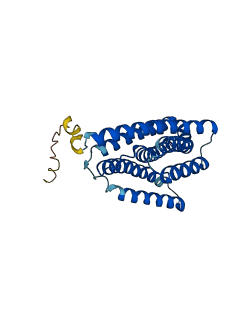
Descriptions
The autoinhibited protein was predicted that may have potential autoinhibitory elements via cis-regPred.
Autoinhibitory domains (AIDs)
Target domain |
|
Relief mechanism |
|
Assay |
cis-regPred |
Accessory elements
No accessory elements
Autoinhibited structure

Activated structure
1 structures for Q9LD45
| Entry ID | Method | Resolution | Chain | Position | Source |
|---|---|---|---|---|---|
| AF-Q9LD45-F1 | Predicted | AlphaFoldDB |
15 variants for Q9LD45
| Variant ID(s) | Position | Change | Description | Diseaes Association | Provenance |
|---|---|---|---|---|---|
| tmp_5_19136077_G_T | 3 | A>S | No | 1000Genomes | |
| tmp_5_19136097_T_G | 9 | D>E | No | 1000Genomes | |
| tmp_5_19136108_G_A | 13 | G>D | No | 1000Genomes | |
| ENSVATH14604981 | 15 | R>S | No | 1000Genomes | |
| ENSVATH12600794 | 21 | S>T | No | 1000Genomes | |
| ENSVATH12600875 | 25 | F>L | No | 1000Genomes | |
| tmp_5_19136639_G_A | 58 | V>M | No | 1000Genomes | |
| ENSVATH14604984 | 60 | W>L | No | 1000Genomes | |
| ENSVATH00716418 | 74 | T>S | No | 1000Genomes | |
| ENSVATH00716419 | 80 | S>A | No | 1000Genomes | |
| ENSVATH00716420 | 95 | V>A | No | 1000Genomes | |
| tmp_5_19136892_A_T | 109 | K>N | No | 1000Genomes | |
| ENSVATH07360290 | 150 | G>A | No | 1000Genomes | |
| tmp_5_19137158_G_A | 165 | A>T | No | 1000Genomes | |
| tmp_5_19137165_C_T | 167 | S>L | No | 1000Genomes |
No associated diseases with Q9LD45
1 regional properties for Q9LD45
| Type | Name | Position | InterPro Accession |
|---|---|---|---|
| conserved_site | Bax inhibitor 1, conserved site | 101 - 130 | IPR006213 |
6 GO annotations of cellular component
| Name | Definition |
|---|---|
| cytoplasm | The contents of a cell excluding the plasma membrane and nucleus, but including other subcellular structures. |
| endoplasmic reticulum | The irregular network of unit membranes, visible only by electron microscopy, that occurs in the cytoplasm of many eukaryotic cells. The membranes form a complex meshwork of tubular channels, which are often expanded into slitlike cavities called cisternae. The ER takes two forms, rough (or granular), with ribosomes adhering to the outer surface, and smooth (with no ribosomes attached). |
| endoplasmic reticulum membrane | The lipid bilayer surrounding the endoplasmic reticulum. |
| integral component of membrane | The component of a membrane consisting of the gene products and protein complexes having at least some part of their peptide sequence embedded in the hydrophobic region of the membrane. |
| membrane | A lipid bilayer along with all the proteins and protein complexes embedded in it an attached to it. |
| nuclear envelope | The double lipid bilayer enclosing the nucleus and separating its contents from the rest of the cytoplasm; includes the intermembrane space, a gap of width 20-40 nm (also called the perinuclear space). |
No GO annotations of molecular function
| Name | Definition |
|---|---|
| No GO annotations for molecular function |
6 GO annotations of biological process
| Name | Definition |
|---|---|
| ER overload response | The series of molecular signals initiated by the accumulation of normal or misfolded proteins in the endoplasmic reticulum and leading to activation of transcription by NF-kappaB. |
| negative regulation of apoptotic process | Any process that stops, prevents, or reduces the frequency, rate or extent of cell death by apoptotic process. |
| negative regulation of programmed cell death | Any process that stops, prevents, or reduces the frequency, rate or extent of programmed cell death, cell death resulting from activation of endogenous cellular processes. |
| response to water deprivation | Any process that results in a change in state or activity of a cell or an organism (in terms of movement, secretion, enzyme production, gene expression, etc.) as a result of a water deprivation stimulus, prolonged deprivation of water. |
| very long-chain fatty acid biosynthetic process | The chemical reactions and pathways resulting in the formation of a fatty acid which has a chain length greater than C22. |
| very long-chain fatty acid metabolic process | The chemical reactions and pathways involving a fatty acid which has a chain length greater than C22. |
No homologous proteins in AiPD
| UniProt AC | Gene Name | Protein Name | Species | Evidence Code |
|---|---|---|---|---|
| No homologous proteins | ||||
| 10 | 20 | 30 | 40 | 50 | 60 |
| MDAFSSFFDS | QPGSRSWSYD | SLKNFRQISP | AVQNHLKRVY | LTLCCALVAS | AFGAYLHVLW |
| 70 | 80 | 90 | 100 | 110 | 120 |
| NIGGILTTIG | CIGTMIWLLS | CPPYEHQKRL | SLLFVSAVLE | GASVGPLIKV | AIDVDPSILI |
| 130 | 140 | 150 | 160 | 170 | 180 |
| TAFVGTAIAF | VCFSAAAMLA | RRREYLYLGG | LLSSGLSMLM | WLQFASSIFG | GSASIFKFEL |
| 190 | 200 | 210 | 220 | 230 | 240 |
| YFGLLIFVGY | MVVDTQEIIE | KAHLGDMDYV | KHSLTLFTDF | VAVFVRILII | MLKNSADKEE |
| KKKKRRN |