Q9KTY5
Gene name |
VC_0745 |
Protein name |
Nus factor SuhB |
Names |
Inositol-1-monophosphatase, I-1-Pase, IMPase, Inositol-1-phosphatase |
Species |
Vibrio cholerae serotype O1 (strain ATCC 39315 / El Tor Inaba N16961) |
KEGG Pathway |
vch:VC_0745 |
EC number |
3.1.3.25: Phosphoric monoester hydrolases |
Protein Class |
|
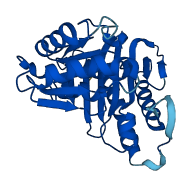
Descriptions
The autoinhibited protein was predicted that may have potential autoinhibitory elements via cis-regPred.
Autoinhibitory domains (AIDs)
Target domain |
|
Relief mechanism |
|
Assay |
cis-regPred |
Accessory elements
No accessory elements
Autoinhibited structure

Activated structure
1 structures for Q9KTY5
| Entry ID | Method | Resolution | Chain | Position | Source |
|---|---|---|---|---|---|
| AF-Q9KTY5-F1 | Predicted | AlphaFoldDB |
No variants for Q9KTY5
| Variant ID(s) | Position | Change | Description | Diseaes Association | Provenance |
|---|---|---|---|---|---|
| No variants for Q9KTY5 | |||||
No associated diseases with Q9KTY5
Functions
| Description | ||
|---|---|---|
| EC Number | 3.1.3.25 | Phosphoric monoester hydrolases |
| Subcellular Localization |
|
|
| PANTHER Family | ||
| PANTHER Subfamily | ||
| PANTHER Protein Class | ||
| PANTHER Pathway Category | No pathway information available | |
1 GO annotations of cellular component
| Name | Definition |
|---|---|
| cytoplasm | The contents of a cell excluding the plasma membrane and nucleus, but including other subcellular structures. |
5 GO annotations of molecular function
| Name | Definition |
|---|---|
| inositol monophosphate 1-phosphatase activity | Catalysis of the reaction: myo-inositol 1-phosphate + H2O = myo-inositol + phosphate. |
| inositol monophosphate 3-phosphatase activity | Catalysis of the reaction: myo-inositol 3-phosphate + H2O = myo-inositol + phosphate. |
| inositol monophosphate 4-phosphatase activity | Catalysis of the reaction: myo-inositol 4-phosphate + H2O = myo-inositol + phosphate. |
| metal ion binding | Binding to a metal ion. |
| RNA binding | Binding to an RNA molecule or a portion thereof. |
6 GO annotations of biological process
| Name | Definition |
|---|---|
| inositol metabolic process | The chemical reactions and pathways involving inositol, 1,2,3,4,5,6-cyclohexanehexol, a growth factor for animals and microorganisms. |
| inositol phosphate dephosphorylation | The process of removing a phosphate group from any mono- or polyphosphorylated inositol. |
| phosphatidylinositol phosphate biosynthetic process | The chemical reactions and pathways resulting in the formation of phosphatidylinositol phosphate. |
| ribosome biogenesis | A cellular process that results in the biosynthesis of constituent macromolecules, assembly, and arrangement of constituent parts of ribosome subunits; includes transport to the sites of protein synthesis. |
| signal transduction | The cellular process in which a signal is conveyed to trigger a change in the activity or state of a cell. Signal transduction begins with reception of a signal (e.g. a ligand binding to a receptor or receptor activation by a stimulus such as light), or for signal transduction in the absence of ligand, signal-withdrawal or the activity of a constitutively active receptor. Signal transduction ends with regulation of a downstream cellular process, e.g. regulation of transcription or regulation of a metabolic process. Signal transduction covers signaling from receptors located on the surface of the cell and signaling via molecules located within the cell. For signaling between cells, signal transduction is restricted to events at and within the receiving cell. |
| transcription antitermination | Regulation of transcription by a mechanism that allows RNA polymerase to continue transcription beyond termination site(s). |
No homologous proteins in AiPD
| UniProt AC | Gene Name | Protein Name | Species | Evidence Code |
|---|---|---|---|---|
| No homologous proteins | ||||
| 10 | 20 | 30 | 40 | 50 | 60 |
| MHPMLNIAIR | AARKAGNHIA | KSLENAEKIQ | TTQKGSNDFV | TNVDKEAEAI | IVSTIKSSYP |
| 70 | 80 | 90 | 100 | 110 | 120 |
| EHCIIAEEGG | LIEGKDKEVQ | WIIDPLDGTT | NFVKGFPHFA | VSIAVRFRGK | TEVACVYDPM |
| 130 | 140 | 150 | 160 | 170 | 180 |
| TNELFTAQRG | AGAQLNNARI | RVQPIKDLQG | AVLATAFPFK | QKQHSESFMK | ILSAMFVECA |
| 190 | 200 | 210 | 220 | 230 | 240 |
| DFRRTGSAAL | DLCYLAANRV | DGYFELGLKP | WDMAAGELIA | REAGAIVTDF | AGGTDYMQSG |
| 250 | 260 | ||||
| NIVASSPRGV | KAILQHIREN | GNSAILK |