Q9KS67
Gene name |
cry2 (VcCry2, VC_1392) |
Protein name |
Cryptochrome-like protein cry2 |
Names |
|
Species |
Vibrio cholerae serotype O1 (strain ATCC 39315 / El Tor Inaba N16961) |
KEGG Pathway |
vch:VC_1392 |
EC number |
|
Protein Class |
|
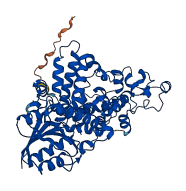
Descriptions
The autoinhibited protein was predicted that may have potential autoinhibitory elements via cis-regPred.
Autoinhibitory domains (AIDs)
Target domain |
|
Relief mechanism |
|
Assay |
cis-regPred |
Accessory elements
No accessory elements
Autoinhibited structure

Activated structure
1 structures for Q9KS67
| Entry ID | Method | Resolution | Chain | Position | Source |
|---|---|---|---|---|---|
| AF-Q9KS67-F1 | Predicted | AlphaFoldDB |
No variants for Q9KS67
| Variant ID(s) | Position | Change | Description | Diseaes Association | Provenance |
|---|---|---|---|---|---|
| No variants for Q9KS67 | |||||
No associated diseases with Q9KS67
No GO annotations of cellular component
| Name | Definition |
|---|---|
| No GO annotations for cellular component |
3 GO annotations of molecular function
| Name | Definition |
|---|---|
| deoxyribodipyrimidine photo-lyase activity | Catalysis of the reaction: cyclobutadipyrimidine (in DNA) = 2 pyrimidine residues (in DNA). This reaction represents the reactivation of irradiated DNA by light. |
| DNA binding | Any molecular function by which a gene product interacts selectively and non-covalently with DNA (deoxyribonucleic acid). |
| FAD binding | Binding to the oxidized form, FAD, of flavin-adenine dinucleotide, the coenzyme or the prosthetic group of various flavoprotein oxidoreductase enzymes. |
4 GO annotations of biological process
| Name | Definition |
|---|---|
| cellular response to stimulus | Any process that results in a change in state or activity of a cell (in terms of movement, secretion, enzyme production, gene expression, etc.) as a result of a stimulus. The process begins with detection of the stimulus by a cell and ends with a change in state or activity or the cell. |
| nucleobase-containing compound metabolic process | Any cellular metabolic process involving nucleobases, nucleosides, nucleotides and nucleic acids. |
| response to light stimulus | Any process that results in a change in state or activity of a cell or an organism (in terms of movement, secretion, enzyme production, gene expression, etc.) as a result of a light stimulus, electromagnetic radiation of wavelengths classified as infrared, visible or ultraviolet light. |
| response to stress | Any process that results in a change in state or activity of a cell or an organism (in terms of movement, secretion, enzyme production, gene expression, etc.) as a result of a disturbance in organismal or cellular homeostasis, usually, but not necessarily, exogenous (e.g. temperature, humidity, ionizing radiation). |
No homologous proteins in AiPD
| UniProt AC | Gene Name | Protein Name | Species | Evidence Code |
|---|---|---|---|---|
| No homologous proteins | ||||
| 10 | 20 | 30 | 40 | 50 | 60 |
| MEKINLVWLK | RDLRLTDHAP | LQAALTSGRP | TLLLYLFEPM | LLGDAHYSER | HWRFVWQSLQ |
| 70 | 80 | 90 | 100 | 110 | 120 |
| AINRDLAQSK | GEVLIVTSDW | QTCFARIAER | YAIEAIYSHQ | EVGLACTFQR | DLALAQWCQQ |
| 130 | 140 | 150 | 160 | 170 | 180 |
| HDIVWHEFPY | AAVIRGAQTR | KNWDEHWQQV | MRSPCCDPDL | TRANWLKLDA | ATLGLRSDIP |
| 190 | 200 | 210 | 220 | 230 | 240 |
| ATWQSKQAGM | QTGGSDMAWA | TLEDFFARRG | REYYRSISSP | SLARHACSRM | SPYLAWGNIS |
| 250 | 260 | 270 | 280 | 290 | 300 |
| LREMYQTLLK | HWSVAGFRRS | LIALSSRLHW | HCHFIQKFES | ECEMEFRCVN | RAYDSLLQQS |
| 310 | 320 | 330 | 340 | 350 | 360 |
| SDAPAAQLAA | WQTGHTGIPL | VDACMRCLIQ | TGYLNFRMRA | MLVSVLTHHM | NVDWRAGVTY |
| 370 | 380 | 390 | 400 | 410 | 420 |
| LAQLFLDFEP | GIHYPQFQMQ | AGVTGTNTIR | IYNPTKQAQE | HDSEGQFIHK | WVPELAQVPV |
| 430 | 440 | 450 | 460 | 470 | 480 |
| PLLFEPWLMT | PLEAQMYQVP | LESPYLKPVM | DLEASAKQAR | DRLWQWQKLP | AVQAEAMRIL |
| 490 | 500 | ||||
| ARHVRQAKPR | TSPRQPNKRQ | PEMD |