Q9KPV6
Gene name |
uppS |
Protein name |
Ditrans,polycis-undecaprenyl-diphosphate synthase ((2E,6E)-farnesyl-diphosphate specific) |
Names |
Ditrans,polycis-undecaprenylcistransferase, Undecaprenyl diphosphate synthase, UDS, Undecaprenyl pyrophosphate synthase, UPP synthase |
Species |
Vibrio cholerae serotype O1 (strain ATCC 39315 / El Tor Inaba N16961) |
KEGG Pathway |
vch:VC_2256 |
EC number |
2.5.1.31: Transferring alkyl or aryl groups, other than methyl groups |
Protein Class |
|
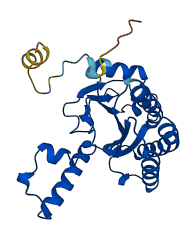
Descriptions
The autoinhibited protein was predicted that may have potential autoinhibitory elements via cis-regPred.
Autoinhibitory domains (AIDs)
Target domain |
|
Relief mechanism |
|
Assay |
cis-regPred |
Accessory elements
No accessory elements
Autoinhibited structure

Activated structure
1 structures for Q9KPV6
| Entry ID | Method | Resolution | Chain | Position | Source |
|---|---|---|---|---|---|
| AF-Q9KPV6-F1 | Predicted | AlphaFoldDB |
No variants for Q9KPV6
| Variant ID(s) | Position | Change | Description | Diseaes Association | Provenance |
|---|---|---|---|---|---|
| No variants for Q9KPV6 | |||||
No associated diseases with Q9KPV6
1 regional properties for Q9KPV6
| Type | Name | Position | InterPro Accession |
|---|---|---|---|
| conserved_site | Di-trans-poly-cis-decaprenylcistransferase-like, conserved site | 184 - 201 | IPR018520 |
Functions
| Description | ||
|---|---|---|
| EC Number | 2.5.1.31 | Transferring alkyl or aryl groups, other than methyl groups |
| Subcellular Localization |
|
|
| PANTHER Family | ||
| PANTHER Subfamily | ||
| PANTHER Protein Class | ||
| PANTHER Pathway Category | No pathway information available | |
1 GO annotations of cellular component
| Name | Definition |
|---|---|
| cytosol | The part of the cytoplasm that does not contain organelles but which does contain other particulate matter, such as protein complexes. |
4 GO annotations of molecular function
| Name | Definition |
|---|---|
| di-trans,poly-cis-decaprenylcistransferase activity | Catalysis of the reaction: di-trans-poly-cis-decaprenyl diphosphate + isopentenyl diphosphate = diphosphate + di-trans-poly-cis-undecaprenyl diphosphate. |
| magnesium ion binding | Binding to a magnesium (Mg) ion. |
| manganese ion binding | Binding to a manganese ion (Mn). |
| polyprenyltransferase activity | Catalysis of the transfer of multiple prenyl groups from one compound (donor) to another (acceptor). |
4 GO annotations of biological process
| Name | Definition |
|---|---|
| cell wall organization | A process that results in the assembly, arrangement of constituent parts, or disassembly of the cell wall, the rigid or semi-rigid envelope lying outside the cell membrane of plant, fungal and most prokaryotic cells, maintaining their shape and protecting them from osmotic lysis. |
| peptidoglycan biosynthetic process | The chemical reactions and pathways resulting in the formation of peptidoglycans, any of a class of glycoconjugates found in bacterial cell walls. |
| polyprenol biosynthetic process | The chemical reactions and pathways resulting in the formation of polyprenols, prenols with more than 4 isoprenoid residues, which may be all-trans, or a mixture of cis and trans. |
| regulation of cell shape | Any process that modulates the surface configuration of a cell. |
No homologous proteins in AiPD
| UniProt AC | Gene Name | Protein Name | Species | Evidence Code |
|---|---|---|---|---|
| No homologous proteins | ||||
| 10 | 20 | 30 | 40 | 50 | 60 |
| MQNLSLSQDV | LPKHIAVIMD | GNGRWAKAQG | KPRVFGHKNG | VAAVRKTIST | SARLGIKAVT |
| 70 | 80 | 90 | 100 | 110 | 120 |
| LFAFSSENWR | RPEEEVGVLM | ELFMTVLSTE | IKKLHKNNLR | LRVIGDKSRF | SERLQTKIAQ |
| 130 | 140 | 150 | 160 | 170 | 180 |
| AEQLTASNTG | MVVNIAANYG | GQWDILQATQ | ALAEKVTQGE | LQPSDIDEDV | FKQHLTMADL |
| 190 | 200 | 210 | 220 | 230 | 240 |
| PDVDLLIRTS | GECRISNFML | WQLAYAEMYF | TPVFWPEFDE | NCLIEAVTWF | VNRERRFGCT |
| GEQVKALMEN |