Q9K498
Gene name |
SCO5223 |
Protein name |
Bifunctional albaflavenone monooxygenase/terpene synthase |
Names |
Cytochrome P450 170A1, CYP170A1 |
Species |
Streptomyces coelicolor (strain ATCC BAA-471 / A3(2) / M145) |
KEGG Pathway |
sco:SCO5223 |
EC number |
1.14.15.39: With reduced iron-sulfur protein as one donor, and incorporation of one atom of oxygen |
Protein Class |
|
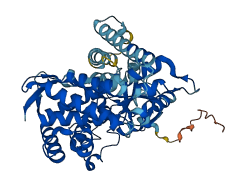
Descriptions
The autoinhibited protein was predicted that may have potential autoinhibitory elements via cis-regPred.
Autoinhibitory domains (AIDs)
Target domain |
|
Relief mechanism |
|
Assay |
cis-regPred |
Accessory elements
No accessory elements
Autoinhibited structure

Activated structure
3 structures for Q9K498
| Entry ID | Method | Resolution | Chain | Position | Source |
|---|---|---|---|---|---|
| 3DBG | X-ray | 260 A | A/B | 1-461 | PDB |
| 3EL3 | X-ray | 330 A | A/B | 1-461 | PDB |
| AF-Q9K498-F1 | Predicted | AlphaFoldDB |
No variants for Q9K498
| Variant ID(s) | Position | Change | Description | Diseaes Association | Provenance |
|---|---|---|---|---|---|
| No variants for Q9K498 | |||||
No associated diseases with Q9K498
No regional properties for Q9K498
| Type | Name | Position | InterPro Accession |
|---|---|---|---|
| No domain, repeats, and functional sites for Q9K498 | |||
Functions
| Description | ||
|---|---|---|
| EC Number | 1.14.15.39 | With reduced iron-sulfur protein as one donor, and incorporation of one atom of oxygen |
| Subcellular Localization |
|
|
| PANTHER Family | ||
| PANTHER Subfamily | ||
| PANTHER Protein Class | ||
| PANTHER Pathway Category | No pathway information available | |
1 GO annotations of cellular component
| Name | Definition |
|---|---|
| cytosol | The part of the cytoplasm that does not contain organelles but which does contain other particulate matter, such as protein complexes. |
6 GO annotations of molecular function
| Name | Definition |
|---|---|
| heme binding | Binding to a heme, a compound composed of iron complexed in a porphyrin (tetrapyrrole) ring. |
| iron ion binding | Binding to an iron (Fe) ion. |
| monooxygenase activity | Catalysis of the incorporation of one atom from molecular oxygen into a compound and the reduction of the other atom of oxygen to water. |
| oxidoreductase activity, acting on paired donors, with incorporation or reduction of molecular oxygen | Catalysis of an oxidation-reduction (redox) reaction in which hydrogen or electrons are transferred from each of two donors, and molecular oxygen is reduced or incorporated into a donor. |
| sesquiterpene synthase activity | Catalysis of the reaction: trans,trans-farnesyl diphosphate = a sesquiterpene + diphosphate. Sesquiterpenes are terpenes containing three isoprene units, i.e. 15 carbons. |
| terpene synthase activity | Catalysis of the formation of cyclic terpenes through the cyclization of linear terpenes (e.g. isopentenyl-PP, geranyl-PP, farnesyl-PP and geranylgeranyl-PP) containing varying numbers of isoprene units. |
3 GO annotations of biological process
| Name | Definition |
|---|---|
| antibiotic biosynthetic process | The chemical reactions and pathways resulting in the formation of an antibiotic, a substance produced by or derived from certain fungi, bacteria, and other organisms, that can destroy or inhibit the growth of other microorganisms. |
| ketone biosynthetic process | The chemical reactions and pathways resulting in the formation of ketones, a class of organic compounds that contain the carbonyl group, CO, and in which the carbonyl group is bonded only to carbon atoms. The general formula for a ketone is RCOR, where R and R are alkyl or aryl groups. |
| sesquiterpene biosynthetic process | The chemical reactions and pathways resulting in the formation of sesquiterpenes, any of a class of terpenes of the formula C15H24 or a derivative of such a terpene. |
No homologous proteins in AiPD
| UniProt AC | Gene Name | Protein Name | Species | Evidence Code |
|---|---|---|---|---|
| No homologous proteins | ||||
| 10 | 20 | 30 | 40 | 50 | 60 |
| MTVESVNPET | RAPAAPGAPE | LREPPVAGGG | VPLLGHGWRL | ARDPLAFMSQ | LRDHGDVVRI |
| 70 | 80 | 90 | 100 | 110 | 120 |
| KLGPKTVYAV | TNPELTGALA | LNPDYHIAGP | LWESLEGLLG | KEGVATANGP | LHRRQRRTIQ |
| 130 | 140 | 150 | 160 | 170 | 180 |
| PAFRLDAIPA | YGPIMEEEAH | ALTERWQPGK | TVDATSESFR | VAVRVAARCL | LRGQYMDERA |
| 190 | 200 | 210 | 220 | 230 | 240 |
| ERLCVALATV | FRGMYRRMVV | PLGPLYRLPL | PANRRFNDAL | ADLHLLVDEI | IAERRASGQK |
| 250 | 260 | 270 | 280 | 290 | 300 |
| PDDLLTALLE | AKDDNGDPIG | EQEIHDQVVA | ILTPGSETIA | STIMWLLQAL | ADHPEHADRI |
| 310 | 320 | 330 | 340 | 350 | 360 |
| RDEVEAVTGG | RPVAFEDVRK | LRHTGNVIVE | AMRLRPAVWV | LTRRAVAESE | LGGYRIPAGA |
| 370 | 380 | 390 | 400 | 410 | 420 |
| DIIYSPYAIQ | RDPKSYDDNL | EFDPDRWLPE | RAANVPKYAM | KPFSAGKRKC | PSDHFSMAQL |
| 430 | 440 | 450 | 460 | ||
| TLITAALATK | YRFEQVAGSN | DAVRVGITLR | PHDLLVRPVA | R |