Q9JMB0
Gene name |
Gkap1 (Gkap42) |
Protein name |
G kinase-anchoring protein 1 |
Names |
cGMP-dependent protein kinase-anchoring protein of 42 kDa |
Species |
Mus musculus (Mouse) |
KEGG Pathway |
mmu:56278 |
EC number |
|
Protein Class |
|
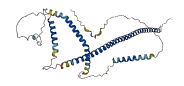
Descriptions
The autoinhibited protein was predicted that may have potential autoinhibitory elements via cis-regPred.
Autoinhibitory domains (AIDs)
Target domain |
|
Relief mechanism |
|
Assay |
cis-regPred |
Accessory elements
No accessory elements
Autoinhibited structure

Activated structure
1 structures for Q9JMB0
| Entry ID | Method | Resolution | Chain | Position | Source |
|---|---|---|---|---|---|
| AF-Q9JMB0-F1 | Predicted | AlphaFoldDB |
14 variants for Q9JMB0
| Variant ID(s) | Position | Change | Description | Diseaes Association | Provenance |
|---|---|---|---|---|---|
| rs3389260550 | 52 | N>K | No | EVA | |
| rs3389289756 | 93 | Q>L | No | EVA | |
| rs3389260528 | 106 | S>* | No | EVA | |
| rs234698486 | 117 | K>R | No | EVA | |
| rs250380433 | 152 | E>D | No | EVA | |
| rs3389244403 | 174 | D>E | No | EVA | |
| rs3389215347 | 176 | P>H | No | EVA | |
| rs3389298071 | 181 | L>F | No | EVA | |
| rs3389283328 | 182 | K>N | No | EVA | |
| rs3389283382 | 197 | S>L | No | EVA | |
| rs3389288142 | 197 | S>T | No | EVA | |
| rs3389283369 | 199 | S>Y | No | EVA | |
| rs3389288094 | 225 | K>Q | No | EVA | |
| rs3389280133 | 236 | T>R | No | EVA |
No associated diseases with Q9JMB0
1 regional properties for Q9JMB0
| Type | Name | Position | InterPro Accession |
|---|---|---|---|
| domain | Pyruvate phosphate dikinase, AMP/ATP-binding | 1079 - 1277 | IPR002192 |
1 GO annotations of cellular component
| Name | Definition |
|---|---|
| Golgi apparatus | A membrane-bound cytoplasmic organelle of the endomembrane system that further processes the core oligosaccharides (e.g. N-glycans) added to proteins in the endoplasmic reticulum and packages them into membrane-bound vesicles. The Golgi apparatus operates at the intersection of the secretory, lysosomal, and endocytic pathways. |
1 GO annotations of molecular function
| Name | Definition |
|---|---|
| identical protein binding | Binding to an identical protein or proteins. |
3 GO annotations of biological process
| Name | Definition |
|---|---|
| G protein-coupled receptor signaling pathway coupled to cGMP nucleotide second messenger | The series of molecular signals generated as a consequence of a G protein-coupled receptor binding to its physiological ligand, followed by activation of guanylyl cyclase (GC) activity and a subsequent increase in the concentration of cyclic GMP (cGMP). |
| positive regulation of insulin receptor signaling pathway | Any process that increases the frequency, rate or extent of insulin receptor signaling. |
| signal transduction | The cellular process in which a signal is conveyed to trigger a change in the activity or state of a cell. Signal transduction begins with reception of a signal (e.g. a ligand binding to a receptor or receptor activation by a stimulus such as light), or for signal transduction in the absence of ligand, signal-withdrawal or the activity of a constitutively active receptor. Signal transduction ends with regulation of a downstream cellular process, e.g. regulation of transcription or regulation of a metabolic process. Signal transduction covers signaling from receptors located on the surface of the cell and signaling via molecules located within the cell. For signaling between cells, signal transduction is restricted to events at and within the receiving cell. |
No homologous proteins in AiPD
| UniProt AC | Gene Name | Protein Name | Species | Evidence Code |
|---|---|---|---|---|
| No homologous proteins | ||||
| 10 | 20 | 30 | 40 | 50 | 60 |
| MASAVLSSVL | TTASRFALLQ | VDSGSGSDSE | PGKGKGRSNG | KSQTLGNKAT | SNEKKREKRR |
| 70 | 80 | 90 | 100 | 110 | 120 |
| KKKEQQQSEA | NELRNLAFKK | IPQKSSHSIC | NVQHELSSPN | PAQKESREEN | WQEWRQKDEQ |
| 130 | 140 | 150 | 160 | 170 | 180 |
| LTSEMFEADL | EKALLLSKLE | YEEHKQDYEN | AETASTQTKG | INKKDKRKNH | QGKDKPVTVS |
| 190 | 200 | 210 | 220 | 230 | 240 |
| LKDFQCEDHI | SKKAEESNSA | QTLSHDGGFF | NRLEDDVHKI | LIREKRREQL | TEHNGTDNSP |
| 250 | 260 | 270 | 280 | 290 | 300 |
| APEHNQEVGL | KDGRIERLKL | ELERKDAEIQ | KLKAVITQWE | AKYKEVKARN | GQLLKMLQEG |
| 310 | 320 | 330 | 340 | 350 | 360 |
| EMKDKAEILL | QVDESQSIKN | ELTVQVSSLH | AALEQERSKV | KVLQAELAKY | QGGRKGKRNF |
| EPDHCR |