Q9JKX4
Gene name |
Aatf (Che1, Trb) |
Protein name |
Protein AATF |
Names |
Apoptosis-antagonizing transcription factor, Rb-binding protein Che-1, Traube protein |
Species |
Mus musculus (Mouse) |
KEGG Pathway |
mmu:56321 |
EC number |
|
Protein Class |
|
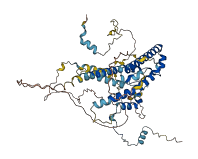
Descriptions
The autoinhibited protein was predicted that may have potential autoinhibitory elements via cis-regPred.
Autoinhibitory domains (AIDs)
Target domain |
|
Relief mechanism |
|
Assay |
cis-regPred |
Accessory elements
No accessory elements
Autoinhibited structure

Activated structure
1 structures for Q9JKX4
| Entry ID | Method | Resolution | Chain | Position | Source |
|---|---|---|---|---|---|
| AF-Q9JKX4-F1 | Predicted | AlphaFoldDB |
27 variants for Q9JKX4
| Variant ID(s) | Position | Change | Description | Diseaes Association | Provenance |
|---|---|---|---|---|---|
| rs263706992 | 74 | T>A | No | EVA | |
| rs29406874 | 75 | T>I | No | EVA | |
| rs224180680 | 84 | H>Q | No | EVA | |
| rs29469402 | 86 | E>K | No | EVA | |
| rs232969182 | 88 | A>T | No | EVA | |
| rs229827964 | 97 | A>V | No | EVA | |
| rs29453055 | 128 | K>E | No | EVA | |
| rs29425227 | 146 | E>Q | No | EVA | |
| rs233623972 | 150 | E>K | No | EVA | |
| rs29442505 | 177 | A>T | No | EVA | |
| rs3389187210 | 181 | S>N | No | EVA | |
| rs3389189832 | 183 | K>I | No | EVA | |
| rs3389176588 | 205 | L>S | No | EVA | |
| rs215447135 | 239 | A>S | No | EVA | |
| rs3389185160 | 268 | P>S | No | EVA | |
| rs3389157538 | 288 | S>C | No | EVA | |
| rs3389157555 | 371 | R>SE* | No | EVA | |
| rs3389151535 | 372 | L>WLR* | No | EVA | |
| rs3389176573 | 374 | R>G | No | EVA | |
| rs28224212 | 382 | A>T | No | EVA | |
| rs3389124158 | 394 | E>* | No | EVA | |
| rs3389164153 | 412 | A>S | No | EVA | |
| rs3389188091 | 424 | F>I | No | EVA | |
| rs3389187751 | 460 | I>L | No | EVA | |
| rs3389187761 | 464 | R>Q | No | EVA | |
| rs217049543 | 468 | R>C | No | EVA | |
| rs3389203456 | 479 | R>W | No | EVA |
No associated diseases with Q9JKX4
7 GO annotations of cellular component
| Name | Definition |
|---|---|
| cytoplasm | The contents of a cell excluding the plasma membrane and nucleus, but including other subcellular structures. |
| cytosol | The part of the cytoplasm that does not contain organelles but which does contain other particulate matter, such as protein complexes. |
| Golgi apparatus | A membrane-bound cytoplasmic organelle of the endomembrane system that further processes the core oligosaccharides (e.g. N-glycans) added to proteins in the endoplasmic reticulum and packages them into membrane-bound vesicles. The Golgi apparatus operates at the intersection of the secretory, lysosomal, and endocytic pathways. |
| nucleolus | A small, dense body one or more of which are present in the nucleus of eukaryotic cells. It is rich in RNA and protein, is not bounded by a limiting membrane, and is not seen during mitosis. Its prime function is the transcription of the nucleolar DNA into 45S ribosomal-precursor RNA, the processing of this RNA into 5.8S, 18S, and 28S components of ribosomal RNA, and the association of these components with 5S RNA and proteins synthesized outside the nucleolus. This association results in the formation of ribonucleoprotein precursors; these pass into the cytoplasm and mature into the 40S and 60S subunits of the ribosome. |
| nucleoplasm | That part of the nuclear content other than the chromosomes or the nucleolus. |
| nucleus | A membrane-bounded organelle of eukaryotic cells in which chromosomes are housed and replicated. In most cells, the nucleus contains all of the cell's chromosomes except the organellar chromosomes, and is the site of RNA synthesis and processing. In some species, or in specialized cell types, RNA metabolism or DNA replication may be absent. |
| transcription regulator complex | A protein complex that is capable of associating with DNA by direct binding, or via other DNA-binding proteins or complexes, and regulating transcription. |
3 GO annotations of molecular function
| Name | Definition |
|---|---|
| leucine zipper domain binding | Binding to a leucine zipper domain, a protein secondary structure exhibiting a periodic repetition of leucine residues at every seventh position over a distance covering eight helical turns. |
| protein kinase binding | Binding to a protein kinase, any enzyme that catalyzes the transfer of a phosphate group, usually from ATP, to a protein substrate. |
| tau protein binding | Binding to tau protein. tau is a microtubule-associated protein, implicated in Alzheimer's disease, Down Syndrome and ALS. |
13 GO annotations of biological process
| Name | Definition |
|---|---|
| cell adhesion | The attachment of a cell, either to another cell or to an underlying substrate such as the extracellular matrix, via cell adhesion molecules. |
| cellular response to DNA damage stimulus | Any process that results in a change in state or activity of a cell (in terms of movement, secretion, enzyme production, gene expression, etc.) as a result of a stimulus indicating damage to its DNA from environmental insults or errors during metabolism. |
| embryonic cleavage | The first few specialized divisions of an activated animal egg. |
| negative regulation of amyloid precursor protein biosynthetic process | Any process that stops, prevents, or reduces the frequency, rate or extent of the chemical reactions and pathways resulting in the formation of amyloid precursor protein (APP), the precursor of amyloid-beta. |
| negative regulation of apoptotic process | Any process that stops, prevents, or reduces the frequency, rate or extent of cell death by apoptotic process. |
| negative regulation of apoptotic signaling pathway | Any process that stops, prevents or reduces the frequency, rate or extent of apoptotic signaling pathway. |
| negative regulation of reactive oxygen species metabolic process | Any process that stops, prevents or reduces the frequency, rate or extent of reactive oxygen species metabolic process. |
| negative regulation of superoxide anion generation | Any process that stops, prevents, or reduces the frequency, rate or extent of enzymatic generation of superoxide by a cell. |
| positive regulation of DNA-templated transcription | Any process that activates or increases the frequency, rate or extent of cellular DNA-templated transcription. |
| positive regulation of transcription by RNA polymerase II | Any process that activates or increases the frequency, rate or extent of transcription from an RNA polymerase II promoter. |
| regulation of mitotic cell cycle | Any process that modulates the rate or extent of progress through the mitotic cell cycle. |
| regulation of transcription by RNA polymerase II | Any process that modulates the frequency, rate or extent of transcription mediated by RNA polymerase II. |
| ribosome biogenesis | A cellular process that results in the biosynthesis of constituent macromolecules, assembly, and arrangement of constituent parts of ribosome subunits; includes transport to the sites of protein synthesis. |
1 homologous proteins in AiPD
| UniProt AC | Gene Name | Protein Name | Species | Evidence Code |
|---|---|---|---|---|
| Q9NY61 | AATF | Protein AATF | Homo sapiens (Human) | PR |
| 10 | 20 | 30 | 40 | 50 | 60 |
| MAAPQPLALQ | LEQLLNPRPR | EADPEADPEE | ATRARVIDRF | DEGEEEKDDL | AVSSIRKLAP |
| 70 | 80 | 90 | 100 | 110 | 120 |
| VSLLDTDKRY | SGKTTSRKAW | KEDHWEQALP | SSSDNEASDE | GGSEDGDSEG | LGLEEISEDV |
| 130 | 140 | 150 | 160 | 170 | 180 |
| DEDLEDNKIS | DEGGSEDGDS | EGLGLEEFSE | DVEEDLEGED | EEDREEDRNS | EDDGVVAAFS |
| 190 | 200 | 210 | 220 | 230 | 240 |
| SVKVSEEVEK | GRAVKNQIAL | WDQLLEGRIK | LQKALLTTNQ | LPQPDVFPVF | KDKGGPEFAS |
| 250 | 260 | 270 | 280 | 290 | 300 |
| ALKNSHKALK | ALLRSLVDLQ | EELLFQYPDT | RHIVNGAKPN | TESEEISSED | DELVGEKKKQ |
| 310 | 320 | 330 | 340 | 350 | 360 |
| RKAPPKRKLE | MEDYPSFMAK | RFADFTIYRN | HTLQKWHDKT | KLASGKLGKG | FGAFERSILT |
| 370 | 380 | 390 | 400 | 410 | 420 |
| QIDHIMMDKE | RLLRRTQTKR | SAYRVLGKPE | PVPEPVAETL | PGEPETLPQG | PANAHLRDLD |
| 430 | 440 | 450 | 460 | 470 | 480 |
| EEIFDDDDFY | HQLLRELIER | KTSSLDPNDQ | VAMGRQWLAI | QKLRSKIRKK | VDRKASKGRK |
| 490 | 500 | 510 | 520 | ||
| LRFHVLSKLL | SFMAPIDHTA | MSDDARTELF | RSLFGQLNPP | DADRGK |