Descriptions
The autoinhibited protein was predicted that may have potential autoinhibitory elements via cis-regPred.
Autoinhibitory domains (AIDs)
Target domain |
|
Relief mechanism |
|
Assay |
cis-regPred |
Accessory elements
No accessory elements
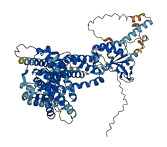
Autoinhibited structure

Activated structure
2 structures for Q9JKQ2
| Entry ID | Method | Resolution | Chain | Position | Source |
|---|---|---|---|---|---|
| 7SUN | EM | 360 A | A/B | 1-744 | PDB |
| AF-Q9JKQ2-F1 | Predicted | AlphaFoldDB |
No variants for Q9JKQ2
| Variant ID(s) | Position | Change | Description | Diseaes Association | Provenance |
|---|---|---|---|---|---|
| No variants for Q9JKQ2 | |||||
No associated diseases with Q9JKQ2
Functions
2 GO annotations of cellular component
| Name | Definition |
|---|---|
| basolateral plasma membrane | The region of the plasma membrane that includes the basal end and sides of the cell. Often used in reference to animal polarized epithelial membranes, where the basal membrane is the part attached to the extracellular matrix, or in plant cells, where the basal membrane is defined with respect to the zygotic axis. |
| integral component of membrane | The component of a membrane consisting of the gene products and protein complexes having at least some part of their peptide sequence embedded in the hydrophobic region of the membrane. |
1 GO annotations of molecular function
| Name | Definition |
|---|---|
| secondary active sulfate transmembrane transporter activity | Enables the secondary active transfer of sulfate from one side of a membrane to the other. Secondary active transport is the transfer of a solute across a membrane, up its concentration gradient. The transporter binds the solute and undergoes a series of conformational changes. Transport works equally well in either direction and is driven by a chemiosmotic source of energy. Secondary active transporters include symporters and antiporters. |
2 GO annotations of biological process
| Name | Definition |
|---|---|
| regulation of cell shape | Any process that modulates the surface configuration of a cell. |
| sensory perception of sound | The series of events required for an organism to receive an auditory stimulus, convert it to a molecular signal, and recognize and characterize the signal. Sonic stimuli are detected in the form of vibrations and are processed to form a sound. |
No homologous proteins in AiPD
| UniProt AC | Gene Name | Protein Name | Species | Evidence Code |
|---|---|---|---|---|
| No homologous proteins | ||||
| 10 | 20 | 30 | 40 | 50 | 60 |
| MDHAEENEIP | VATQKYHVER | PIFSHPVLQE | RLHVKDKVSE | SIGDKLKQAF | TCTPKKIRNI |
| 70 | 80 | 90 | 100 | 110 | 120 |
| IYMFLPITKW | LPAYKFKEYV | LGDLVSGIST | GVLQLPQGLA | FAMLAAVPPV | FGLYSSFYPV |
| 130 | 140 | 150 | 160 | 170 | 180 |
| IMYCFFGTSR | HISIGPFAVI | SLMIGGVAVR | LVPDDIVIPG | GVNATNGTEA | RDALRVKVAM |
| 190 | 200 | 210 | 220 | 230 | 240 |
| SVTLLSGIIQ | FCLGVCRFGF | VAIYLTEPLV | RGFTTAAAVH | VFTSMLKYLF | GVKTKRYSGI |
| 250 | 260 | 270 | 280 | 290 | 300 |
| FSVVYSTVAV | LQNVKNLNVC | SLGVGLMVFG | LLLGGKEFNE | RFKEKLPAPI | PLEFFAVVMG |
| 310 | 320 | 330 | 340 | 350 | 360 |
| TGISAGFNLH | ESYSVDVVGT | LPLGLLPPAN | PDTSLFHLVY | VDAIAIAIVG | FSVTISMAKT |
| 370 | 380 | 390 | 400 | 410 | 420 |
| LANKHGYQVD | GNQELIALGI | CNSIGSLFQT | FSISCSLSRS | LVQEGTGGKT | QLAGCLASLM |
| 430 | 440 | 450 | 460 | 470 | 480 |
| ILLVILATGF | LFESLPQAVL | SAIVIVNLKG | MFMQFSDLPF | FWRTSKIELT | IWLTTFVSSL |
| 490 | 500 | 510 | 520 | 530 | 540 |
| FLGLDYGLIT | AVIIALLTVI | YRTQSPSYKV | LGQLPDTDVY | IDIDAYEEVK | EIPGIKIFQI |
| 550 | 560 | 570 | 580 | 590 | 600 |
| NAPIYYANSD | LYSNALKRKT | GVNPALIMGA | RRKAMRKYAK | EVGNANIANA | AVVKVDGEVD |
| 610 | 620 | 630 | 640 | 650 | 660 |
| GENATKPEEE | DDEVKYPPIV | IKTTFPEELQ | RFMPQTENVH | TIILDFTQVN | FIDSVGVKTL |
| 670 | 680 | 690 | 700 | 710 | 720 |
| AVMVKEYGDV | GIYVYLAGCS | PQVVNDLTRN | RFFENPALKE | LLFHSIHDAV | LGSHVREAMA |
| 730 | 740 | ||||
| EQEASAPPPQ | DDMEPNATPT | TPEA |