Q9JJG9
Gene name |
Noa1 (MNCb-4931) |
Protein name |
Nitric oxide-associated protein 1 |
Names |
|
Species |
Mus musculus (Mouse) |
KEGG Pathway |
mmu:56412 |
EC number |
|
Protein Class |
|
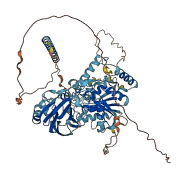
Descriptions
The autoinhibited protein was predicted that may have potential autoinhibitory elements via cis-regPred.
Autoinhibitory domains (AIDs)
Target domain |
|
Relief mechanism |
|
Assay |
cis-regPred |
Accessory elements
No accessory elements
Autoinhibited structure

Activated structure
1 structures for Q9JJG9
| Entry ID | Method | Resolution | Chain | Position | Source |
|---|---|---|---|---|---|
| AF-Q9JJG9-F1 | Predicted | AlphaFoldDB |
29 variants for Q9JJG9
| Variant ID(s) | Position | Change | Description | Diseaes Association | Provenance |
|---|---|---|---|---|---|
| rs235062910 | 8 | C>Y | No | EVA | |
| rs219139450 | 15 | R>P | No | EVA | |
| rs228596181 | 36 | C>S | No | EVA | |
| rs239593272 | 107 | L>F | No | EVA | |
| rs227088191 | 109 | Q>R | No | EVA | |
| rs246972108 | 128 | P>T | No | EVA | |
| rs226805503 | 130 | F>L | No | EVA | |
| rs245519599 | 155 | G>S | No | EVA | |
| rs250698779 | 176 | A>T | No | EVA | |
| rs233120241 | 223 | N>D | No | EVA | |
| rs1132509786 | 416 | A>P | No | EVA | |
| rs1133573232 | 421 | S>I | No | EVA | |
| rs239122971 | 449 | R>T | No | EVA | |
| rs252870476 | 469 | S>N | No | EVA | |
| rs241354295 | 476 | C>R | No | EVA | |
| rs225126896 | 476 | C>Y | No | EVA | |
| rs260276737 | 483 | E>D | No | EVA | |
| rs3395782736 | 487 | E>V | No | EVA | |
| rs3395671290 | 487 | E>V | No | EVA | |
| rs220026515 | 517 | N>D | No | EVA | |
| rs3388765247 | 541 | G>C | No | EVA | |
| rs3388767456 | 548 | F>L | No | EVA | |
| rs3388767829 | 597 | R>Q | No | EVA | |
| rs3388739269 | 602 | P>S | No | EVA | |
| rs3388765276 | 617 | F>I | No | EVA | |
| rs3388760822 | 622 | D>V | No | EVA | |
| rs3388771916 | 637 | S>C | No | EVA | |
| rs37114042 | 679 | T>I | No | EVA | |
| rs222493597 | 687 | H>Y | No | EVA |
No associated diseases with Q9JJG9
3 GO annotations of cellular component
| Name | Definition |
|---|---|
| extrinsic component of mitochondrial inner membrane | The component of mitochondrial inner membrane consisting of gene products and protein complexes that are loosely bound to one of its surfaces, but not integrated into the hydrophobic region. |
| mitochondrial inner membrane | The inner, i.e. lumen-facing, lipid bilayer of the mitochondrial envelope. It is highly folded to form cristae. |
| mitochondrion | A semiautonomous, self replicating organelle that occurs in varying numbers, shapes, and sizes in the cytoplasm of virtually all eukaryotic cells. It is notably the site of tissue respiration. |
1 GO annotations of molecular function
| Name | Definition |
|---|---|
| GTP binding | Binding to GTP, guanosine triphosphate. |
4 GO annotations of biological process
| Name | Definition |
|---|---|
| apoptotic process | A programmed cell death process which begins when a cell receives an internal (e.g. DNA damage) or external signal (e.g. an extracellular death ligand), and proceeds through a series of biochemical events (signaling pathway phase) which trigger an execution phase. The execution phase is the last step of an apoptotic process, and is typically characterized by rounding-up of the cell, retraction of pseudopodes, reduction of cellular volume (pyknosis), chromatin condensation, nuclear fragmentation (karyorrhexis), plasma membrane blebbing and fragmentation of the cell into apoptotic bodies. When the execution phase is completed, the cell has died. |
| mitochondrial translation | The chemical reactions and pathways resulting in the formation of a protein in a mitochondrion. This is a ribosome-mediated process in which the information in messenger RNA (mRNA) is used to specify the sequence of amino acids in the protein; the mitochondrion has its own ribosomes and transfer RNAs, and uses a genetic code that differs from the nuclear code. |
| regulation of cell death | Any process that modulates the rate or frequency of cell death. Cell death is the specific activation or halting of processes within a cell so that its vital functions markedly cease, rather than simply deteriorating gradually over time, which culminates in cell death. |
| regulation of cellular respiration | Any process that modulates the frequency, rate or extent of cellular respiration, the enzymatic release of energy from organic compounds. |
No homologous proteins in AiPD
| UniProt AC | Gene Name | Protein Name | Species | Evidence Code |
|---|---|---|---|---|
| No homologous proteins | ||||
| 10 | 20 | 30 | 40 | 50 | 60 |
| MLPARLACGL | LCGLRRGPAP | AAACYGPARW | LLEGKCEVPI | RQRASSLGRR | VPPSSTATED |
| 70 | 80 | 90 | 100 | 110 | 120 |
| YAEGPDTEER | FLFPEYVPER | TPEEQVRELQ | ELRELQQLQQ | EKERERLQQR | EERLQQKLRA |
| 130 | 140 | 150 | 160 | 170 | 180 |
| GFRTLPVPEF | PDASVPPSGI | YCSGCGAELH | CQHPGLPGYL | PEEKFRDAAQ | AEGGPARTVC |
| 190 | 200 | 210 | 220 | 230 | 240 |
| QRCWLLVHHG | RALRLQVSRD | QYLELVSAAL | RRPGPALVLY | MVNLLDLPDA | LLPDLPKLVG |
| 250 | 260 | 270 | 280 | 290 | 300 |
| PKQLIVLGNK | VDLLPQDAPG | YLKRLRKRLW | DDCIRAGLVV | APGHQGPQYP | AGDEPLEEIK |
| 310 | 320 | 330 | 340 | 350 | 360 |
| NQNPSSRSRT | VVKDVRLISA | KTGYGVEEMI | SALQRSWRYR | GDVYLVGTTN | AGKSTLFNTL |
| 370 | 380 | 390 | 400 | 410 | 420 |
| LESDYCTAKG | SEAIDRATIS | PWPGTTLNLL | KFPICNPTPY | RMFKRQRRLQ | EDATKAEEDL |
| 430 | 440 | 450 | 460 | 470 | 480 |
| SEEEQSQLNQ | LKKHGYIVGR | VGRTFSYSRE | QDEVPFEFDA | DSLAFDMGSE | PVVSVCKSTK |
| 490 | 500 | 510 | 520 | 530 | 540 |
| QIELTPEDVK | DAHWFYDTPG | ITKESCILNL | LTEKEINTVL | PTHSIIPRTF | VLKPGMVLFL |
| 550 | 560 | 570 | 580 | 590 | 600 |
| GGIARIDFLQ | GNQSAWFTVV | ASNFLPVHIT | SLDKADALYE | KHAGHELLLV | PMGGKERMAQ |
| 610 | 620 | 630 | 640 | 650 | 660 |
| FPPLVAEDIT | LKGGGKFEAV | ADIKFSSAGW | VAVTPYSEGT | LHLRGHTPEG | TALTVHPPVL |
| 670 | 680 | 690 | |||
| PYIVNVKGQR | MKKSVAYKTK | KPPSLVHNLK | KHR |