Q9JIP7
Gene name |
Slc15a1 |
Protein name |
Solute carrier family 15 member 1 |
Names |
Intestinal H(+)/peptide cotransporter, Oligopeptide transporter, small intestine isoform, Peptide transporter 1, Proton-coupled dipeptide cotransporter |
Species |
Mus musculus (Mouse) |
KEGG Pathway |
mmu:56643 |
EC number |
|
Protein Class |
|
Descriptions
The autoinhibited protein was predicted that may have potential autoinhibitory elements via cis-regPred.
Autoinhibitory domains (AIDs)
Target domain |
|
Relief mechanism |
|
Assay |
cis-regPred |
Accessory elements
No accessory elements
Autoinhibited structure

Activated structure
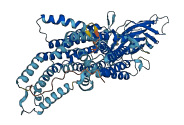
2 structures for Q9JIP7
| Entry ID | Method | Resolution | Chain | Position | Source |
|---|---|---|---|---|---|
| 5A9D | X-ray | 210 A | A/B | 391-579 | PDB |
| AF-Q9JIP7-F1 | Predicted | AlphaFoldDB |
52 variants for Q9JIP7
| Variant ID(s) | Position | Change | Description | Diseaes Association | Provenance |
|---|---|---|---|---|---|
| rs1133546254 | 4 | S>F | No | EVA | |
| rs3389342867 | 10 | F>Y | No | EVA | |
| rs3389354701 | 21 | V>I | No | EVA | |
| rs45659504 | 50 | N>D | No | EVA | |
| rs3405466053 | 65 | L>Q | No | EVA | |
| rs3389350177 | 66 | T>S | No | EVA | |
| rs3406052333 | 68 | I>S | No | EVA | |
| rs3404918006 | 69 | L>I | No | EVA | |
| rs3389342870 | 90 | V>F | No | EVA | |
| rs3405820638 | 101 | S>R | No | EVA | |
| rs3404259495 | 105 | D>E | No | EVA | |
| rs3389359544 | 112 | N>I | No | EVA | |
| rs3389344065 | 118 | L>H | No | EVA | |
| rs230063489 | 127 | V>I | No | EVA | |
| rs3389354759 | 145 | A>T | No | EVA | |
| rs3389339272 | 145 | A>V | No | EVA | |
| rs3389300944 | 169 | A>D | No | EVA | |
| rs3389350179 | 173 | G>E | No | EVA | |
| rs246030141 | 235 | K>R | No | EVA | |
| rs3389339290 | 261 | W>R | No | EVA | |
| rs3389345700 | 289 | P>S | No | EVA | |
| rs3405819261 | 299 | Q>LTSS* | No | EVA | |
| rs3389342862 | 314 | K>I | No | EVA | |
| rs3389350229 | 321 | Q>H | No | EVA | |
| rs3389320088 | 326 | Q>P | No | EVA | |
| rs3389350199 | 404 | N>I | No | EVA | |
| rs1132355378 | 405 | N>S | No | EVA | |
| rs3389320079 | 450 | T>I | No | EVA | |
| rs3405819298 | 453 | H>Q | No | EVA | |
| rs3405254151 | 454 | D>N | No | EVA | |
| rs3404988053 | 455 | F>L | No | EVA | |
| rs3404259500 | 455 | F>Y | No | EVA | |
| rs3405465006 | 463 | L>* | No | EVA | |
| rs3389339300 | 477 | G>D | No | EVA | |
| rs3389271568 | 477 | G>S | No | EVA | |
| rs3405759889 | 484 | K>R | No | EVA | |
| rs3389300923 | 501 | I>V | No | EVA | |
| rs3389351932 | 507 | V>I | No | EVA | |
| rs3389347601 | 510 | N>I | No | EVA | |
| rs8255954 | 526 | E>K | No | EVA | |
| rs3389271537 | 532 | N>K | No | EVA | |
| rs239860901 | 535 | A>E | No | EVA | |
| rs3389354776 | 538 | P>L | No | EVA | |
| rs219031338 | 539 | T>N | No | EVA | |
| rs248399080 | 545 | K>E | No | EVA | |
| rs232389072 | 562 | A>T | No | EVA | |
| rs8245291 | 562 | A>V | No | EVA | |
| rs3389350168 | 618 | V>M | No | EVA | |
| rs240403848 | 640 | A>G | No | EVA | |
| rs8255946 | 664 | F>L | No | EVA | |
| rs3389339320 | 676 | P>S | No | EVA | |
| rs3389271506 | 693 | G>E | No | EVA |
No associated diseases with Q9JIP7
3 regional properties for Q9JIP7
| Type | Name | Position | InterPro Accession |
|---|---|---|---|
| domain | Neutral trehalase Ca2+ binding | 106 - 135 | IPR011120 |
| conserved_site | Glycoside hydrolase, family 37, conserved site | 299 - 312 | IPR018232-1 |
| conserved_site | Glycoside hydrolase, family 37, conserved site | 623 - 632 | IPR018232-2 |
6 GO annotations of cellular component
| Name | Definition |
|---|---|
| apical plasma membrane | The region of the plasma membrane located at the apical end of the cell. |
| brush border | The dense covering of microvilli on the apical surface of an epithelial cell in tissues such as the intestine, kidney, and choroid plexus; the microvilli aid absorption by increasing the surface area of the cell. |
| integral component of membrane | The component of a membrane consisting of the gene products and protein complexes having at least some part of their peptide sequence embedded in the hydrophobic region of the membrane. |
| integral component of plasma membrane | The component of the plasma membrane consisting of the gene products and protein complexes having at least some part of their peptide sequence embedded in the hydrophobic region of the membrane. |
| membrane | A lipid bilayer along with all the proteins and protein complexes embedded in it an attached to it. |
| plasma membrane | The membrane surrounding a cell that separates the cell from its external environment. It consists of a phospholipid bilayer and associated proteins. |
4 GO annotations of molecular function
| Name | Definition |
|---|---|
| channel inhibitor activity | Binds to and stops, prevents, or reduces the activity of a channel. |
| dipeptide transmembrane transporter activity | Enables the transfer of a dipeptide from one side of a membrane to the other. A dipeptide is a combination of two amino acids linked together by a peptide (-CO-NH-) bond. |
| peptide:proton symporter activity | Enables the transfer of a solute or solutes from one side of a membrane to the other according to the reaction: peptide(out) + H+(out) = peptide(in) + H+(in), up its concentration gradient. The transporter binds the solute and undergoes a series of conformational changes. Transport works equally well in either direction and is driven by hydrogen ion movement. |
| proton-dependent oligopeptide secondary active transmembrane transporter activity | Enables the transfer of a oligopeptide from one side of a membrane to the other, up its concentration gradient. The transporter binds the solute and undergoes a series of conformational changes. Transport works equally well in either direction and is driven by proton movement. |
4 GO annotations of biological process
| Name | Definition |
|---|---|
| dipeptide import across plasma membrane | The directed movement of a dipeptide from outside of a cell, across the plasma membrane and into the cytosol. |
| negative regulation of amino acid transport | Any process that stops, prevents, or reduces the frequency, rate or extent of the directed movement of amino acids into, out of or within a cell, or between cells, by means of some agent such as a transporter or pore. |
| oligopeptide transport | The directed movement of oligopeptides into, out of or within a cell, or between cells, by means of some agent such as a transporter or pore. Oligopeptides are molecules that contain a small number (2 to 20) of amino-acid residues connected by peptide linkages. |
| protein transport | The directed movement of proteins into, out of or within a cell, or between cells, by means of some agent such as a transporter or pore. |
| 10 | 20 | 30 | 40 | 50 | 60 |
| MGMSKSRGCF | GYPLSIFFIV | VNEFCERFSY | YGMRALLVLY | FRNFLGWDDN | LSTAIYHTFV |
| 70 | 80 | 90 | 100 | 110 | 120 |
| ALCYLTPILG | ALIADSWLGK | FKTIVSLSIV | YTIGQAVISV | SSINDLTDHD | HNGSPDSLPV |
| 130 | 140 | 150 | 160 | 170 | 180 |
| HVALSMVGLA | LIALGTGGIK | PCVSAFGGDQ | FEEGQEKQRN | RFFSIFYLAI | NGGSLLSTII |
| 190 | 200 | 210 | 220 | 230 | 240 |
| TPILRVQQCG | IHSQQACYPL | AFGVPAALMA | VALIVFVLGS | GMYKKFQPQG | NIMGKVAKCI |
| 250 | 260 | 270 | 280 | 290 | 300 |
| GFAIKNRFRH | RSKAYPKREH | WLDWAKEKYD | ERLISQIKMV | TKVMFLYIPL | PMFWALFDQQ |
| 310 | 320 | 330 | 340 | 350 | 360 |
| GSRWTLQATT | MNGKIGAIEI | QPDQMQTVNA | ILIVIMVPIV | DAVVYPLIAK | CGFNFTSLKK |
| 370 | 380 | 390 | 400 | 410 | 420 |
| MTVGMFLASM | AFVVAAIVQV | EIDKTLPVFP | GGNQVQIKVL | NIGNNNMTVH | FPGNSVTLAQ |
| 430 | 440 | 450 | 460 | 470 | 480 |
| MSQTDTFMTF | DIDKLTSINI | SSSGSPGVTT | VAHDFEQGHR | HTLLVWNPSQ | YRVVKDGLNQ |
| 490 | 500 | 510 | 520 | 530 | 540 |
| KPEKGENGIR | FVNTLNEMVT | IKMSGKVYEN | VTSHNASGYQ | FFPSGEKQYT | INTTAVAPTC |
| 550 | 560 | 570 | 580 | 590 | 600 |
| LTDFKSSNLD | FGSAYTYVIR | RASDGCLEVK | EFEDIPPNTV | NMALQIPQYF | LLTCGEVVFS |
| 610 | 620 | 630 | 640 | 650 | 660 |
| VTGLEFSYSQ | APSNMKSVLQ | AGWLLTVAVG | NIIVLIVAGA | GHFPKQWAEY | ILFASLLLVV |
| 670 | 680 | 690 | 700 | ||
| CVIFAIMARF | YTYINPAEIE | AQFDEDEKKK | GIGKENPYSS | LEPVSQTNM |