Q9JI24
Gene name |
Il24 (Mob5) |
Protein name |
Interleukin-24 |
Names |
IL-24, Cytokine-like protein Mob-5 |
Species |
Rattus norvegicus (Rat) |
KEGG Pathway |
rno:170819 |
EC number |
|
Protein Class |
|
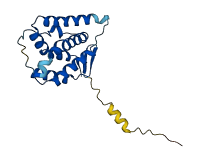
Descriptions
The autoinhibited protein was predicted that may have potential autoinhibitory elements via cis-regPred.
Autoinhibitory domains (AIDs)
Target domain |
|
Relief mechanism |
|
Assay |
cis-regPred |
Accessory elements
No accessory elements
Autoinhibited structure

Activated structure
1 structures for Q9JI24
| Entry ID | Method | Resolution | Chain | Position | Source |
|---|---|---|---|---|---|
| AF-Q9JI24-F1 | Predicted | AlphaFoldDB |
1 variants for Q9JI24
| Variant ID(s) | Position | Change | Description | Diseaes Association | Provenance |
|---|---|---|---|---|---|
| rs106990611 | 150 | Y>F | No | EVA |
No associated diseases with Q9JI24
2 GO annotations of cellular component
| Name | Definition |
|---|---|
| extracellular region | The space external to the outermost structure of a cell. For cells without external protective or external encapsulating structures this refers to space outside of the plasma membrane. This term covers the host cell environment outside an intracellular parasite. |
| extracellular space | That part of a multicellular organism outside the cells proper, usually taken to be outside the plasma membranes, and occupied by fluid. |
1 GO annotations of molecular function
| Name | Definition |
|---|---|
| cytokine activity | The activity of a soluble extracellular gene product that interacts with a receptor to effect a change in the activity of the receptor to control the survival, growth, differentiation and effector function of tissues and cells. |
11 GO annotations of biological process
| Name | Definition |
|---|---|
| apoptotic process | A programmed cell death process which begins when a cell receives an internal (e.g. DNA damage) or external signal (e.g. an extracellular death ligand), and proceeds through a series of biochemical events (signaling pathway phase) which trigger an execution phase. The execution phase is the last step of an apoptotic process, and is typically characterized by rounding-up of the cell, retraction of pseudopodes, reduction of cellular volume (pyknosis), chromatin condensation, nuclear fragmentation (karyorrhexis), plasma membrane blebbing and fragmentation of the cell into apoptotic bodies. When the execution phase is completed, the cell has died. |
| cellular response to interleukin-4 | Any process that results in a change in state or activity of a cell (in terms of movement, secretion, enzyme production, gene expression, etc.) as a result of an interleukin-4 stimulus. |
| cellular response to lipopolysaccharide | Any process that results in a change in state or activity of a cell (in terms of movement, secretion, enzyme production, gene expression, etc.) as a result of a lipopolysaccharide stimulus; lipopolysaccharide is a major component of the cell wall of gram-negative bacteria. |
| negative regulation of cell migration | Any process that stops, prevents, or reduces the frequency, rate or extent of cell migration. |
| negative regulation of cell population proliferation | Any process that stops, prevents or reduces the rate or extent of cell proliferation. |
| positive regulation of apoptotic process | Any process that activates or increases the frequency, rate or extent of cell death by apoptotic process. |
| positive regulation of cell population proliferation | Any process that activates or increases the rate or extent of cell proliferation. |
| positive regulation of cysteine-type endopeptidase activity involved in apoptotic process | Any process that activates or increases the activity of a cysteine-type endopeptidase involved in the apoptotic process. |
| positive regulation of tyrosine phosphorylation of STAT protein | Any process that activates or increases the frequency, rate or extent of the introduction of a phosphate group to a tyrosine residue of a STAT (Signal Transducer and Activator of Transcription) protein. |
| serine phosphorylation of STAT protein | The process of introducing a phosphate group to a serine residue of a STAT (Signal Transducer and Activator of Transcription) protein. |
| wound healing | The series of events that restore integrity to a damaged tissue, following an injury. |
1 homologous proteins in AiPD
| UniProt AC | Gene Name | Protein Name | Species | Evidence Code |
|---|---|---|---|---|
| Q925S4 | Il24 | Interleukin-24 | Mus musculus (Mouse) | PR |
| 10 | 20 | 30 | 40 | 50 | 60 |
| MQTSLRQQIL | PGLSLILLVL | NQVPELQGQE | FRFGPCQVTG | VVLPELWEAF | WTVKNTVKTQ |
| 70 | 80 | 90 | 100 | 110 | 120 |
| DELTSVRLLK | PQVLQNVSDA | ESCYLAHSLL | KFYLNTVFKN | YHSKIVKFKV | LKSFSTLANN |
| 130 | 140 | 150 | 160 | 170 | 180 |
| FLVIMSKLQP | SKDNAMLPIS | DSARRRFLLY | HRTFKQLDIE | VALAKAFGEV | DILLAWMQNF |
| YQL |