Q9JHL4
Gene name |
Dbnl |
Protein name |
Drebrin-like protein |
Names |
Actin-binding protein 1, Abp1, SH3 domain-containing protein 7 |
Species |
Rattus norvegicus (Rat) |
KEGG Pathway |
rno:83527 |
EC number |
|
Protein Class |
|
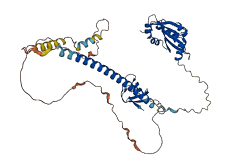
Descriptions
The autoinhibited protein was predicted that may have potential autoinhibitory elements via cis-regPred.
Autoinhibitory domains (AIDs)
Target domain |
|
Relief mechanism |
|
Assay |
cis-regPred |
Accessory elements
No accessory elements
Autoinhibited structure

Activated structure
1 structures for Q9JHL4
| Entry ID | Method | Resolution | Chain | Position | Source |
|---|---|---|---|---|---|
| AF-Q9JHL4-F1 | Predicted | AlphaFoldDB |
1 variants for Q9JHL4
| Variant ID(s) | Position | Change | Description | Diseaes Association | Provenance |
|---|---|---|---|---|---|
| rs199121555 | 329 | P>L | No | EVA |
No associated diseases with Q9JHL4
1 regional properties for Q9JHL4
| Type | Name | Position | InterPro Accession |
|---|---|---|---|
| domain | EGF-like domain | 35 - 73 | IPR000742 |
Functions
17 GO annotations of cellular component
| Name | Definition |
|---|---|
| anchoring junction | A cell junction that mechanically attaches a cell (and its cytoskeleton) to neighboring cells or to the extracellular matrix. |
| cell cortex | The region of a cell that lies just beneath the plasma membrane and often, but not always, contains a network of actin filaments and associated proteins. |
| clathrin-coated vesicle membrane | The lipid bilayer surrounding a clathrin-coated vesicle. |
| cortical actin cytoskeleton | The portion of the actin cytoskeleton, comprising filamentous actin and associated proteins, that lies just beneath the plasma membrane. |
| cytoplasm | The contents of a cell excluding the plasma membrane and nucleus, but including other subcellular structures. |
| cytosol | The part of the cytoplasm that does not contain organelles but which does contain other particulate matter, such as protein complexes. |
| dendrite | A neuron projection that has a short, tapering, morphology. Dendrites receive and integrate signals from other neurons or from sensory stimuli, and conduct nerve impulses towards the axon or the cell body. In most neurons, the impulse is conveyed from dendrites to axon via the cell body, but in some types of unipolar neuron, the impulse does not travel via the cell body. |
| early endosome | A membrane-bounded organelle that receives incoming material from primary endocytic vesicles that have been generated by clathrin-dependent and clathrin-independent endocytosis; vesicles fuse with the early endosome to deliver cargo for sorting into recycling or degradation pathways. |
| Golgi membrane | The lipid bilayer surrounding any of the compartments of the Golgi apparatus. |
| lamellipodium | A thin sheetlike process extended by the leading edge of a migrating cell or extending cell process; contains a dense meshwork of actin filaments. |
| perikaryon | The portion of the cell soma (neuronal cell body) that excludes the nucleus. |
| plasma membrane | The membrane surrounding a cell that separates the cell from its external environment. It consists of a phospholipid bilayer and associated proteins. |
| podosome | An actin-rich adhesion structure characterized by formation upon cell substrate contact and localization at the substrate-attached part of the cell, contain an F-actin-rich core surrounded by a ring structure containing proteins such as vinculin and talin, and have a diameter of 0.5 mm. |
| postsynaptic density | An electron dense network of proteins within and adjacent to the postsynaptic membrane of an asymmetric, neuron-neuron synapse. Its major components include neurotransmitter receptors and the proteins that spatially and functionally organize them such as anchoring and scaffolding molecules, signaling enzymes and cytoskeletal components. |
| postsynaptic membrane | A specialized area of membrane facing the presynaptic membrane on the tip of the nerve ending and separated from it by a minute cleft (the synaptic cleft). Neurotransmitters cross the synaptic cleft and transmit the signal to the postsynaptic membrane. |
| ruffle | Projection at the leading edge of a crawling cell; the protrusions are supported by a microfilament meshwork. |
| site of polarized growth | Any part of a cell where non-isotropic growth takes place. |
4 GO annotations of molecular function
| Name | Definition |
|---|---|
| actin binding | Binding to monomeric or multimeric forms of actin, including actin filaments. |
| actin filament binding | Binding to an actin filament, also known as F-actin, a helical filamentous polymer of globular G-actin subunits. |
| protein C-terminus binding | Binding to a protein C-terminus, the end of a peptide chain at which the 1-carboxyl function of a constituent amino acid is not attached in peptide linkage to another amino-acid residue. |
| protein domain specific binding | Binding to a specific domain of a protein. |
11 GO annotations of biological process
| Name | Definition |
|---|---|
| adaptive immune response | An immune response mediated by cells expressing specific receptors for antigen produced through a somatic diversification process, and allowing for an enhanced secondary response to subsequent exposures to the same antigen (immunological memory). |
| neuron projection morphogenesis | The process in which the anatomical structures of a neuron projection are generated and organized. A neuron projection is any process extending from a neural cell, such as axons or dendrites. |
| podosome assembly | The aggregation, arrangement and bonding together of a set of components to form a podosome, an actin-rich adhesion structure characterized by formation upon cell substrate contact and localization at the substrate-attached part of the cell. |
| positive regulation of axon extension | Any process that activates or increases the frequency, rate or extent of axon extension. |
| positive regulation of dendritic spine morphogenesis | Any process that increases the rate, frequency, or extent of dendritic spine morphogenesis, the process in which the anatomical structures of a dendritic spine are generated and organized. A dendritic spine is a protrusion from a dendrite and a specialized subcellular compartment involved in synaptic transmission. |
| postsynaptic actin cytoskeleton organization | A process that is carried out at the cellular level which results in the assembly, arrangement of constituent parts, or disassembly of cytoskeletal structures comprising actin filaments and their associated proteins in the postsynaptic actin cytoskeleton. |
| Rac protein signal transduction | The series of molecular signals within the cell that are mediated by a member of the Rac family of proteins switching to a GTP-bound active state. |
| receptor-mediated endocytosis | An endocytosis process in which cell surface receptors ensure specificity of transport. A specific receptor on the cell surface binds tightly to the extracellular macromolecule (the ligand) that it recognizes; the plasma-membrane region containing the receptor-ligand complex then undergoes endocytosis, forming a transport vesicle containing the receptor-ligand complex and excluding most other plasma-membrane proteins. Receptor-mediated endocytosis generally occurs via clathrin-coated pits and vesicles. |
| regulation of actin filament polymerization | Any process that modulates the frequency, rate or extent of the assembly of actin filaments by the addition of actin monomers to a filament. |
| ruffle assembly | The aggregation, arrangement and bonding together of a set of components to form a ruffle, a projection at the leading edge of a crawling cell; the protrusions are supported by a microfilament meshwork. The formation of ruffles (also called membrane ruffling) is thought to be controlled by a group of enzymes known as Rho GTPases, specifically RhoA, Rac1 and cdc42. |
| synapse assembly | The aggregation, arrangement and bonding together of a set of components to form a synapse. This process ends when the synapse is mature (functional). |
No homologous proteins in AiPD
| UniProt AC | Gene Name | Protein Name | Species | Evidence Code |
|---|---|---|---|---|
| No homologous proteins | ||||
| 10 | 20 | 30 | 40 | 50 | 60 |
| MAVNLSRNGP | ALQEAYVRVV | TEKSPTDWAL | FTYEGNSNDI | RVAGTGEGGL | EELVEELNSG |
| 70 | 80 | 90 | 100 | 110 | 120 |
| KVMYAFCRVK | DPNSGLPKFV | LINWTGEGVN | DVRKGACANH | VSTMANFLKG | AHVTINARAE |
| 130 | 140 | 150 | 160 | 170 | 180 |
| EDVEPECIME | KVAKASGANY | SFHKESSCFQ | DVGPQAPVGS | VYQKTNAVSE | IKRVGKDNFW |
| 190 | 200 | 210 | 220 | 230 | 240 |
| AKAEKEEENR | RLEEKRRAEE | EKQRLEEERR | ERELQEAARR | EQRYQEQHRS | AGPPSPSSRT |
| 250 | 260 | 270 | 280 | 290 | 300 |
| GELEQEVVSR | SRQEWESAGQ | QAPHPREIFK | QKERAMSTTS | VSSSQPGKLR | SPFLQKQFTQ |
| 310 | 320 | 330 | 340 | 350 | 360 |
| PEASYGREPT | SPVSRPAAGV | CEELAPSTPP | SAQTDDEPTY | EVPSEQETLY | EEPPPVQQPG |
| 370 | 380 | 390 | 400 | 410 | 420 |
| AGSGHIDNYM | QSQDLSGQGL | CARALYDYQA | ADDTEISFDP | ENLITGIEVI | DEGWWRGYGP |
| 430 | |||||
| DGHFGMFPAN | YVELIE |