Q9JHJ9
Gene name |
KCNJ11 |
Protein name |
ATP-sensitive inward rectifier potassium channel 11 |
Names |
B7 homolog 2, B7-H2, B7-like protein Gl50, B7-related protein 1, B7RP-1, LICOS, IKATP, Inward rectifier K(+) channel Kir6.2, Potassium channel, inwardly rectifying subfamily J member 11 |
Species |
Cavia porcellus (Guinea pig) |
KEGG Pathway |
cpoc:100135564 |
EC number |
|
Protein Class |
|
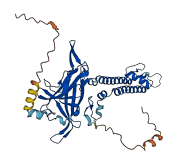
Descriptions
The autoinhibited protein was predicted that may have potential autoinhibitory elements via cis-regPred.
Autoinhibitory domains (AIDs)
Target domain |
|
Relief mechanism |
|
Assay |
cis-regPred |
Accessory elements
No accessory elements
Autoinhibited structure

Activated structure
1 structures for Q9JHJ9
| Entry ID | Method | Resolution | Chain | Position | Source |
|---|---|---|---|---|---|
| AF-Q9JHJ9-F1 | Predicted | AlphaFoldDB |
No variants for Q9JHJ9
| Variant ID(s) | Position | Change | Description | Diseaes Association | Provenance |
|---|---|---|---|---|---|
| No variants for Q9JHJ9 | |||||
No associated diseases with Q9JHJ9
2 GO annotations of cellular component
| Name | Definition |
|---|---|
| inward rectifying potassium channel | A protein complex that comprises four pore-forming (Kir6.x) and four regulatory sulphonylurea receptor (SURx) subunits and forms a transmembrane channel through which ions may pass. The opening and closing of the channel is regulated by ATP: binding of ATP to the Kir6.x subunit inhibits channel activity, whereas binding of Mg2+-complexed ATP or ADP to the SURx subunit stimulates channel activity. |
| T-tubule | Invagination of the plasma membrane of a muscle cell that extends inward from the cell surface around each myofibril. The ends of T-tubules make contact with the sarcoplasmic reticulum membrane. |
4 GO annotations of molecular function
| Name | Definition |
|---|---|
| ankyrin binding | Binding to ankyrin, a 200 kDa cytoskeletal protein that attaches other cytoskeletal proteins to integral membrane proteins. |
| ATP binding | Binding to ATP, adenosine 5'-triphosphate, a universally important coenzyme and enzyme regulator. |
| ATP-activated inward rectifier potassium channel activity | Enables the transmembrane transfer of a potassium ion by an inwardly-rectifying voltage-gated channel, where the inward rectification is due to a voltage-dependent block of the channel pore by ATP. An inwardly rectifying current-voltage relation is one where at any given driving force the inward flow of K+ ions exceeds the outward flow for the opposite driving force. |
| transmembrane transporter binding | Binding to a transmembrane transporter, a protein or protein complex that enables the transfer of a substance, usually a specific substance or a group of related substances, from one side of a membrane to the other. |
8 GO annotations of biological process
| Name | Definition |
|---|---|
| glucose metabolic process | The chemical reactions and pathways involving glucose, the aldohexose gluco-hexose. D-glucose is dextrorotatory and is sometimes known as dextrose; it is an important source of energy for living organisms and is found free as well as combined in homo- and hetero-oligosaccharides and polysaccharides. |
| negative regulation of insulin secretion | Any process that stops, prevents, or reduces the frequency, rate or extent of the regulated release of insulin. |
| nervous system process | A organ system process carried out by any of the organs or tissues of neurological system. |
| potassium ion import across plasma membrane | The directed movement of potassium ions from outside of a cell, across the plasma membrane and into the cytosol. |
| regulation of ion transmembrane transport | Any process that modulates the frequency, rate or extent of the directed movement of ions from one side of a membrane to the other. |
| regulation of membrane potential | Any process that modulates the establishment or extent of a membrane potential, the electric potential existing across any membrane arising from charges in the membrane itself and from the charges present in the media on either side of the membrane. |
| response to ATP | Any process that results in a change in state or activity of a cell or an organism (in terms of movement, secretion, enzyme production, gene expression, etc.) as a result of an ATP (adenosine 5'-triphosphate) stimulus. |
| response to xenobiotic stimulus | Any process that results in a change in state or activity of a cell or an organism (in terms of movement, secretion, enzyme production, gene expression, etc.) as a result of a stimulus from a xenobiotic, a compound foreign to the organim exposed to it. It may be synthesized by another organism (like ampicilin) or it can be a synthetic chemical. |
No homologous proteins in AiPD
| UniProt AC | Gene Name | Protein Name | Species | Evidence Code |
|---|---|---|---|---|
| No homologous proteins | ||||
| 10 | 20 | 30 | 40 | 50 | 60 |
| MLSRKGIIPE | EYVLTRLAED | PTEPRYRARE | RRARFVSKKG | NCNVAHKNIR | EQGRFLQDVF |
| 70 | 80 | 90 | 100 | 110 | 120 |
| TTLVDLKWPH | TLLIFTMSFL | CSWLLFAMVW | WLIAFAHGDL | APGEGTTVPC | VTSIHSFSSA |
| 130 | 140 | 150 | 160 | 170 | 180 |
| FLFSIEVQVT | IGFGGRMVTE | ECPLAILILI | VQNIVGLMIN | AIMLGCIFMK | TSQAHRRAET |
| 190 | 200 | 210 | 220 | 230 | 240 |
| LIFSKHAVIA | LRHGRLCFML | RVGDLRKSMI | ISATIHMQVV | RKTTSPEGEV | VPLHQVDIPM |
| 250 | 260 | 270 | 280 | 290 | 300 |
| ENGVGGNSIF | LVAPLIIYHV | IDANSPLYDL | GPSDLHHHQD | LEIIVILEGV | VETTGITTQA |
| 310 | 320 | 330 | 340 | 350 | 360 |
| RTSYLADEIL | WGHRFVPIVA | EEDGRYSVDY | SKFGNTIKVP | TPLCTAHQLD | EDHSLLDALT |
| 370 | 380 | ||||
| LASTRGPLRK | RSVPVAKAKP | RFSISPDSLS |