Q9I7H9
Gene name |
sud1 (CG18761, CG31120, CG44254) |
Protein name |
Prolyl 3-hydroxylase sudestada1 |
Names |
2-oxoglutarate and iron-dependent oxygenase domain-containing protein 1 homolog, uS12 prolyl 3-hydroxylase |
Species |
Drosophila melanogaster (Fruit fly) |
KEGG Pathway |
dme:Dmel_CG44254 |
EC number |
|
Protein Class |
|
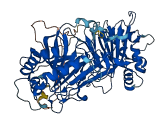
Descriptions
The autoinhibited protein was predicted that may have potential autoinhibitory elements via cis-regPred.
Autoinhibitory domains (AIDs)
Target domain |
|
Relief mechanism |
|
Assay |
cis-regPred |
Accessory elements
No accessory elements
Autoinhibited structure

Activated structure
1 structures for Q9I7H9
| Entry ID | Method | Resolution | Chain | Position | Source |
|---|---|---|---|---|---|
| AF-Q9I7H9-F1 | Predicted | AlphaFoldDB |
No variants for Q9I7H9
| Variant ID(s) | Position | Change | Description | Diseaes Association | Provenance |
|---|---|---|---|---|---|
| No variants for Q9I7H9 | |||||
No associated diseases with Q9I7H9
2 GO annotations of cellular component
| Name | Definition |
|---|---|
| cytoplasm | The contents of a cell excluding the plasma membrane and nucleus, but including other subcellular structures. |
| nucleus | A membrane-bounded organelle of eukaryotic cells in which chromosomes are housed and replicated. In most cells, the nucleus contains all of the cell's chromosomes except the organellar chromosomes, and is the site of RNA synthesis and processing. In some species, or in specialized cell types, RNA metabolism or DNA replication may be absent. |
3 GO annotations of molecular function
| Name | Definition |
|---|---|
| iron ion binding | Binding to an iron (Fe) ion. |
| L-ascorbic acid binding | Binding to L-ascorbic acid, (2R)-2-[(1S)-1,2-dihydroxyethyl]-4-hydroxy-5-oxo-2,5-dihydrofuran-3-olate; L-ascorbic acid is vitamin C and has co-factor and anti-oxidant activities in many species. |
| peptidyl-proline dioxygenase activity | Catalysis of the reaction: peptidyl L-proline + 2-oxoglutarate + O2 = peptidyl hydroxy-L-proline + succinate + CO2. |
4 GO annotations of biological process
| Name | Definition |
|---|---|
| peptidyl-proline hydroxylation | The hydroxylation of peptidyl-proline to form peptidyl-hydroxyproline. |
| protein hydroxylation | The addition of a hydroxy group to a protein amino acid. |
| regulation of translation | Any process that modulates the frequency, rate or extent of the chemical reactions and pathways resulting in the formation of proteins by the translation of mRNA or circRNA. |
| regulation of translational termination | Any process that modulates the frequency, rate or extent of translational termination. |
No homologous proteins in AiPD
| UniProt AC | Gene Name | Protein Name | Species | Evidence Code |
|---|---|---|---|---|
| No homologous proteins | ||||
| 10 | 20 | 30 | 40 | 50 | 60 |
| METSSSSPVK | PRRKDKDEDG | RAEQEDSADQ | VGEPHRKLLR | LGDILETNEV | LLNEAYQQPE |
| 70 | 80 | 90 | 100 | 110 | 120 |
| LTKWLQTAWT | EEKSQGTKET | QTGAQVFSDP | FQICLLPGML | EKGQSQALVA | EIIQKVQWSR |
| 130 | 140 | 150 | 160 | 170 | 180 |
| KQMDLYEFYQ | SADLSNMPAC | RLLTNFLQVL | RKQVRPWLEK | VTNLKLDYVS | ASCSMYTCGD |
| 190 | 200 | 210 | 220 | 230 | 240 |
| YLLVHDDLLK | DRQVAFIYYL | SPWEGAEEWT | DEQGGCLEIF | GSDDQCFPQF | PVQRKIAPKD |
| 250 | 260 | 270 | 280 | 290 | 300 |
| NQFAFFKVGS | RSFHQVGEVT | TFDYPRLTIN | GWFHGDTNEA | FVADSLRAFP | RLNYLQPDGL |
| 310 | 320 | 330 | 340 | 350 | 360 |
| NRPPLGLFLN | NVYLKGATRR | SIQKRIEENS | EICLYEFFKR | EKFELARSQL | LADSDTLKWR |
| 370 | 380 | 390 | 400 | 410 | 420 |
| RQGPANAHNY | EVLDLTTARG | TILELLQLFR | SHAMFDLLRD | FTDLDLAGTD | AESPTCSVEL |
| 430 | 440 | 450 | 460 | 470 | 480 |
| QRWSHGNYTV | LGDGLTSEEN | TLDLVYYLNA | AEGAAVITYL | APDAEMPTAK | APTDGRRSDY |
| 490 | 500 | 510 | 520 | 530 | |
| DDEEEDDSVL | LTITPVDNAL | NIVYRCEGTT | KFTKYVSRNT | PLEKGPVFVI | SCSYKE |