Q9I0M3
Gene name |
ftsK (PA2615) |
Protein name |
DNA translocase FtsK |
Names |
|
Species |
Pseudomonas aeruginosa (strain ATCC 15692 / DSM 22644 / CIP 104116 / JCM 14847 / LMG 12228 / 1C / PRS 101 / PAO1) |
KEGG Pathway |
pae:PA2615 |
EC number |
|
Protein Class |
|
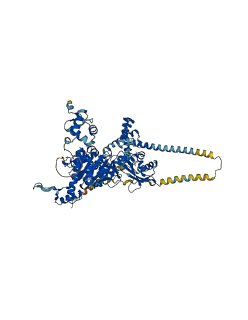
Descriptions
The autoinhibited protein was predicted that may have potential autoinhibitory elements via cis-regPred.
Autoinhibitory domains (AIDs)
Target domain |
|
Relief mechanism |
|
Assay |
cis-regPred |
Accessory elements
No accessory elements
Autoinhibited structure

Activated structure
9 structures for Q9I0M3
| Entry ID | Method | Resolution | Chain | Position | Source |
|---|---|---|---|---|---|
| 2IUT | X-ray | 225 A | A/B | 247-811 | PDB |
| 2IUU | X-ray | 290 A | A/B/C/D/E/F | 247-728 | PDB |
| 2J5O | NMR | - | A | 742-811 | PDB |
| 2VE8 | X-ray | 140 A | A/B/C/D/E/F/G/H | 739-811 | PDB |
| 2VE9 | X-ray | 190 A | A/B/C/D/E/F | 739-811 | PDB |
| 6T8B | EM | 365 A | A/B/C/D/E/F | 247-728 | PDB |
| 6T8G | EM | 434 A | A/B/C/D/E/F | 247-728 | PDB |
| 6T8O | EM | 399 A | A/B/C/D/E/F | 247-728 | PDB |
| AF-Q9I0M3-F1 | Predicted | AlphaFoldDB |
No variants for Q9I0M3
| Variant ID(s) | Position | Change | Description | Diseaes Association | Provenance |
|---|---|---|---|---|---|
| No variants for Q9I0M3 | |||||
No associated diseases with Q9I0M3
6 regional properties for Q9I0M3
| Type | Name | Position | InterPro Accession |
|---|---|---|---|
| domain | Tubulin/FtsZ, GTPase domain | 35 - 240 | IPR003008-1 |
| domain | Tubulin/FtsZ, GTPase domain | 241 - 262 | IPR003008-2 |
| domain | Tubulin/FtsZ, 2-layer sandwich domain | 236 - 353 | IPR018316 |
| conserved_site | Cell division protein FtsZ, conserved site | 66 - 100 | IPR020805-1 |
| conserved_site | Cell division protein FtsZ, conserved site | 119 - 140 | IPR020805-2 |
| domain | Cell division protein FtsZ, C-terminal | 251 - 344 | IPR024757 |
2 GO annotations of cellular component
| Name | Definition |
|---|---|
| integral component of membrane | The component of a membrane consisting of the gene products and protein complexes having at least some part of their peptide sequence embedded in the hydrophobic region of the membrane. |
| plasma membrane | The membrane surrounding a cell that separates the cell from its external environment. It consists of a phospholipid bilayer and associated proteins. |
2 GO annotations of molecular function
| Name | Definition |
|---|---|
| ATP binding | Binding to ATP, adenosine 5'-triphosphate, a universally important coenzyme and enzyme regulator. |
| DNA binding | Any molecular function by which a gene product interacts selectively and non-covalently with DNA (deoxyribonucleic acid). |
4 GO annotations of biological process
| Name | Definition |
|---|---|
| cell cycle | The progression of biochemical and morphological phases and events that occur in a cell during successive cell replication or nuclear replication events. Canonically, the cell cycle comprises the replication and segregation of genetic material followed by the division of the cell, but in endocycles or syncytial cells nuclear replication or nuclear division may not be followed by cell division. |
| cell division | The process resulting in division and partitioning of components of a cell to form more cells; may or may not be accompanied by the physical separation of a cell into distinct, individually membrane-bounded daughter cells. |
| cellular response to antibiotic | Any process that results in a change in state or activity of a cell (in terms of movement, secretion, enzyme production, gene expression, etc.) as a result of an antibiotic stimulus. An antibiotic is a chemical substance produced by a microorganism which has the capacity to inhibit the growth of or to kill other microorganisms. |
| chromosome segregation | The process in which genetic material, in the form of chromosomes, is organized into specific structures and then physically separated and apportioned to two or more sets. In eukaryotes, chromosome segregation begins with the condensation of chromosomes, includes chromosome separation, and ends when chromosomes have completed movement to the spindle poles. |
No homologous proteins in AiPD
| UniProt AC | Gene Name | Protein Name | Species | Evidence Code |
|---|---|---|---|---|
| No homologous proteins | ||||
| 10 | 20 | 30 | 40 | 50 | 60 |
| MRRKNSDLKD | STTASHAAAW | RQQLHSRLKE | GVLIALGALC | LYLWMALLTY | DSADPSWSHS |
| 70 | 80 | 90 | 100 | 110 | 120 |
| SQVDQVQNAA | GRLGAVSADI | LFMTLGYFAY | LFPLLLGIKT | WQVFRRRNLP | WEWNTWLFSW |
| 130 | 140 | 150 | 160 | 170 | 180 |
| RLVGLIFLIL | AGSALAYIHF | HASGHMPASA | SAGGAIGQSL | GRVAVDALNV | QGSTLVFFAL |
| 190 | 200 | 210 | 220 | 230 | 240 |
| FLFGLTVFAD | LSWFKVMDVT | GKITLDFFEL | IQNAFNRWMG | ARAERKQLVA | QLREVDERVA |
| 250 | 260 | 270 | 280 | 290 | 300 |
| EVVAPSVPDR | REQSKAKERL | LEREEALAKH | MSEREKRPPP | KIDPPPSPKA | PEPSKRVLKE |
| 310 | 320 | 330 | 340 | 350 | 360 |
| KQAPLFVDTA | VEGTLPPLSL | LDPAEVKQKS | YSPESLEAMS | RLLEIKLKEF | GVEVSVDSVH |
| 370 | 380 | 390 | 400 | 410 | 420 |
| PGPVITRFEI | QPAAGVKVSR | ISNLAKDLAR | SLAVISVRVV | EVIPGKTTVG | IEIPNEDRQM |
| 430 | 440 | 450 | 460 | 470 | 480 |
| VRFSEVLSSP | EYDEHKSTVP | LALGHDIGGR | PIITDLAKMP | HLLVAGTTGS | GKSVGVNAML |
| 490 | 500 | 510 | 520 | 530 | 540 |
| LSILFKSTPS | EARLIMIDPK | MLELSIYEGI | PHLLCPVVTD | MKEAANALRW | SVAEMERRYR |
| 550 | 560 | 570 | 580 | 590 | 600 |
| LMAAMGVRNL | AGFNRKVKDA | EEAGTPLTDP | LFRRESPDDE | PPQLSTLPTI | VVVVDEFADM |
| 610 | 620 | 630 | 640 | 650 | 660 |
| MMIVGKKVEE | LIARIAQKAR | AAGIHLILAT | QRPSVDVITG | LIKANIPTRI | AFQVSSKIDS |
| 670 | 680 | 690 | 700 | 710 | 720 |
| RTILDQGGAE | QLLGHGDMLY | LPPGTGLPIR | VHGAFVSDDE | VHRVVEAWKL | RGAPDYIEDI |
| 730 | 740 | 750 | 760 | 770 | 780 |
| LAGVDEGGGG | GGSFDGGDGS | GEGSEDDPLY | DEAVRFVTES | RRASISAVQR | KLKIGYNRAA |
| 790 | 800 | 810 | |||
| RMIEAMEMAG | VVTPMNTNGS | REVIAPAPVR | D |