Q9HXY5
Gene name |
PA3647 |
Protein name |
Skp-like protein |
Names |
|
Species |
Pseudomonas aeruginosa (strain ATCC 15692 / DSM 22644 / CIP 104116 / JCM 14847 / LMG 12228 / 1C / PRS 101 / PAO1) |
KEGG Pathway |
pae:PA3647 |
EC number |
|
Protein Class |
|
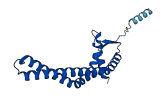
Descriptions
The autoinhibited protein was predicted that may have potential autoinhibitory elements via cis-regPred.
Autoinhibitory domains (AIDs)
Target domain |
|
Relief mechanism |
|
Assay |
cis-regPred |
Accessory elements
No accessory elements
Autoinhibited structure

Activated structure
1 structures for Q9HXY5
| Entry ID | Method | Resolution | Chain | Position | Source |
|---|---|---|---|---|---|
| AF-Q9HXY5-F1 | Predicted | AlphaFoldDB |
No variants for Q9HXY5
| Variant ID(s) | Position | Change | Description | Diseaes Association | Provenance |
|---|---|---|---|---|---|
| No variants for Q9HXY5 | |||||
No associated diseases with Q9HXY5
No regional properties for Q9HXY5
| Type | Name | Position | InterPro Accession |
|---|---|---|---|
| No domain, repeats, and functional sites for Q9HXY5 | |||
1 GO annotations of cellular component
| Name | Definition |
|---|---|
| outer membrane-bounded periplasmic space | The region between the inner (cytoplasmic or plasma) membrane and outer membrane of organisms with two membranes such as Gram negative bacteria. These periplasmic spaces are relatively thick and contain a thin peptidoglycan layer (PGL), also referred to as a thin cell wall. |
1 GO annotations of molecular function
| Name | Definition |
|---|---|
| unfolded protein binding | Binding to an unfolded protein. |
4 GO annotations of biological process
| Name | Definition |
|---|---|
| chaperone-mediated protein folding | The process of inhibiting aggregation and assisting in the covalent and noncovalent assembly of single chain polypeptides or multisubunit complexes into the correct tertiary structure that is dependent on interaction with a chaperone. |
| protein insertion into membrane from inner side | The process in which a protein is incorporated into a lipid bilayer, e.g., the prokaryotic, mitochondrial, or chloroplast inner membrane, from the inner side. |
| protein maturation by protein folding | The process of assisting in the covalent and noncovalent assembly of single chain polypeptides or multisubunit complexes into the correct tertiary structure that results in the attainment of the full functional capacity of a protein. |
| protein stabilization | Any process involved in maintaining the structure and integrity of a protein and preventing it from degradation or aggregation. |
No homologous proteins in AiPD
| UniProt AC | Gene Name | Protein Name | Species | Evidence Code |
|---|---|---|---|---|
| No homologous proteins | ||||
| 10 | 20 | 30 | 40 | 50 | 60 |
| MRKFTQFVLI | TAAIMAAPSA | FAEMKIAVLN | YQMALLESDA | AKQYAVDAEK | KFGPQLNKLK |
| 70 | 80 | 90 | 100 | 110 | 120 |
| NLERDAKALQ | DKLVSNGSKM | SQGDREKAEL | DFKQKARDFQ | FQSKELNESK | AAADRDMLKK |
| 130 | 140 | 150 | 160 | ||
| LKPKLDQAVE | ETIKKGGYDM | VIERGAVVDV | KPQYDITRQV | IERMNQLR |