Q9HWR3
Gene name |
bphP (PA4117) |
Protein name |
Bacteriophytochrome |
Names |
Phytochrome-like protein |
Species |
Pseudomonas aeruginosa (strain ATCC 15692 / DSM 22644 / CIP 104116 / JCM 14847 / LMG 12228 / 1C / PRS 101 / PAO1) |
KEGG Pathway |
pae:PA4117 |
EC number |
2.7.13.3: Protein-histidine kinases |
Protein Class |
|
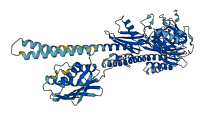
Descriptions
The autoinhibited protein was predicted that may have potential autoinhibitory elements via cis-regPred.
Autoinhibitory domains (AIDs)
Target domain |
|
Relief mechanism |
|
Assay |
cis-regPred |
Accessory elements
No accessory elements
Autoinhibited structure

Activated structure
8 structures for Q9HWR3
| Entry ID | Method | Resolution | Chain | Position | Source |
|---|---|---|---|---|---|
| 3C2W | X-ray | 290 A | A/B/C/D/E/F/G/H | 1-497 | PDB |
| 3G6O | X-ray | 285 A | A/B | 1-497 | PDB |
| 3IBR | X-ray | 297 A | A/B | 1-497 | PDB |
| 3NHQ | X-ray | 255 A | A/B/C/D/E/F/G/H | 1-497 | PDB |
| 3NOP | X-ray | 280 A | C | 1-497 | PDB |
| 3NOT | X-ray | 270 A | C | 1-497 | PDB |
| 3NOU | X-ray | 300 A | C | 1-497 | PDB |
| AF-Q9HWR3-F1 | Predicted | AlphaFoldDB |
No variants for Q9HWR3
| Variant ID(s) | Position | Change | Description | Diseaes Association | Provenance |
|---|---|---|---|---|---|
| No variants for Q9HWR3 | |||||
No associated diseases with Q9HWR3
7 regional properties for Q9HWR3
| Type | Name | Position | InterPro Accession |
|---|---|---|---|
| domain | GAF domain | 139 - 313 | IPR003018 |
| domain | Histidine kinase/HSP90-like ATPase | 610 - 721 | IPR003594 |
| domain | Signal transduction histidine kinase, dimerisation/phosphoacceptor domain | 501 - 566 | IPR003661 |
| domain | Histidine kinase domain | 510 - 721 | IPR005467 |
| domain | Phytochrome, central region | 324 - 496 | IPR013515 |
| domain | PAS fold-2 | 12 - 76 | IPR013654 |
| domain | Phytochrome chromophore attachment domain | 139 - 297 | IPR016132 |
Functions
| Description | ||
|---|---|---|
| EC Number | 2.7.13.3 | Protein-histidine kinases |
| Subcellular Localization |
|
|
| PANTHER Family | ||
| PANTHER Subfamily | ||
| PANTHER Protein Class | ||
| PANTHER Pathway Category | No pathway information available | |
No GO annotations of cellular component
| Name | Definition |
|---|---|
| No GO annotations for cellular component |
6 GO annotations of molecular function
| Name | Definition |
|---|---|
| ATP binding | Binding to ATP, adenosine 5'-triphosphate, a universally important coenzyme and enzyme regulator. |
| identical protein binding | Binding to an identical protein or proteins. |
| phosphorelay response regulator activity | Responds to a phosphorelay sensor to initiate a change in cell state or activity. The activity of the response regulator is regulated by transfer of a phosphate from a histidine residue in the sensor, to an aspartate residue in the response regulator. Many but not all response regulators act as transcriptional regulators to elicit a response. |
| phosphorelay sensor kinase activity | Catalysis of the phosphorylation of a histidine residue in response to detection of an extracellular signal such as a chemical ligand or change in environment, to initiate a change in cell state or activity. The two-component sensor is a histidine kinase that autophosphorylates a histidine residue in its active site. The phosphate is then transferred to an aspartate residue in a downstream response regulator, to trigger a response. |
| photoreceptor activity | The function of absorbing and responding to incidental electromagnetic radiation, particularly visible light. The response may involve a change in conformation. |
| protein kinase activator activity | Binds to and increases the activity of a protein kinase, an enzyme which phosphorylates a protein. |
3 GO annotations of biological process
| Name | Definition |
|---|---|
| detection of visible light | The series of events in which a visible light stimulus is received by a cell and converted into a molecular signal. A visible light stimulus is electromagnetic radiation that can be perceived visually by an organism; for organisms lacking a visual system, this can be defined as light with a wavelength within the range 380 to 780 nm. |
| osmosensory signaling via phosphorelay pathway | The series of molecular signals generated in response to osmotic change, as mediated through a phosphorelay system. |
| regulation of DNA-templated transcription | Any process that modulates the frequency, rate or extent of cellular DNA-templated transcription. |
No homologous proteins in AiPD
| UniProt AC | Gene Name | Protein Name | Species | Evidence Code |
|---|---|---|---|---|
| No homologous proteins | ||||
| 10 | 20 | 30 | 40 | 50 | 60 |
| MTSITPVTLA | NCEDEPIHVP | GAIQPHGALV | TLRADGMVLA | ASENIQALLG | FVASPGSYLT |
| 70 | 80 | 90 | 100 | 110 | 120 |
| QEQVGPEVLR | MLEEGLTGNG | PWSNSVETRI | GEHLFDVIGH | SYKEVFYLEF | EIRTADTLSI |
| 130 | 140 | 150 | 160 | 170 | 180 |
| TSFTLNAQRI | IAQVQLHNDT | ASLLSNVTDE | LRRMTGYDRV | MAYRFRHDDS | GEVVAESRRE |
| 190 | 200 | 210 | 220 | 230 | 240 |
| DLESYLGQRY | PASDIPAQAR | RLYIQNPIRL | IADVAYTPMR | VFPALNPETN | ESFDLSYSVL |
| 250 | 260 | 270 | 280 | 290 | 300 |
| RSVSPIHCEY | LTNMGVRASM | SISIVVGGKL | WGLFSCHHMS | PKLIPYPVRM | SFQIFSQVCS |
| 310 | 320 | 330 | 340 | 350 | 360 |
| AIVERLEQGR | IAELLRVSTE | RRLALARRAR | DADDLFGALA | HPDDGIAALI | PCDGALVMLG |
| 370 | 380 | 390 | 400 | 410 | 420 |
| GRTLSIRGDF | ERQAGNVLQR | LQRDPERDIY | HTDNWPQPSE | DSPDGGDCCG | VLAIRFHRQE |
| 430 | 440 | 450 | 460 | 470 | 480 |
| SGWIFWFRHE | EVHRIRWGGK | PEKLLTIGPS | GPRLTPRGSF | EAWEEVVRGH | STPWSETDLA |
| 490 | 500 | 510 | 520 | 530 | 540 |
| IAEKLRLDLM | ELCLNHAAEV | DRMRQRLIAV | LGHDLRNPLQ | SISMAAALLS | SSDTRTTELR |
| 550 | 560 | 570 | 580 | 590 | 600 |
| QHISASSSRM | ERLVSQILDM | SRLQSGIGLT | VNPVDTDVSQ | LVRQIVCETD | VAYPGLVIEI |
| 610 | 620 | 630 | 640 | 650 | 660 |
| AIDPQVRAVV | DPDRYAQVAA | NLLSNARHHG | LPGRPVLVTL | TRQGDEVCLS | VLNETSGLSE |
| 670 | 680 | 690 | 700 | 710 | 720 |
| AQLANLFEPF | KRESADNQRN | RNGLGIGLYI | SQAIAQAHQG | RIDVDCRDDV | ITFCLRLPVR |
| QAETGSSS |