Q9HFW7
Gene name |
gna-3 (NCU05206) |
Protein name |
Guanine nucleotide-binding protein alpha-3 subunit |
Names |
GP3-alpha |
Species |
Neurospora crassa (strain ATCC 24698 / 74-OR23-1A / CBS 708.71 / DSM 1257 / FGSC 987) |
KEGG Pathway |
ncr:NCU05206 |
EC number |
|
Protein Class |
|
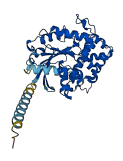
Descriptions
The autoinhibited protein was predicted that may have potential autoinhibitory elements via cis-regPred.
Autoinhibitory domains (AIDs)
Target domain |
|
Relief mechanism |
|
Assay |
cis-regPred |
Accessory elements
No accessory elements
Autoinhibited structure

Activated structure
1 structures for Q9HFW7
| Entry ID | Method | Resolution | Chain | Position | Source |
|---|---|---|---|---|---|
| AF-Q9HFW7-F1 | Predicted | AlphaFoldDB |
No variants for Q9HFW7
| Variant ID(s) | Position | Change | Description | Diseaes Association | Provenance |
|---|---|---|---|---|---|
| No variants for Q9HFW7 | |||||
No associated diseases with Q9HFW7
1 GO annotations of cellular component
| Name | Definition |
|---|---|
| heterotrimeric G-protein complex | Any of a family of heterotrimeric GTP-binding and hydrolyzing proteins; they belong to a superfamily of GTPases that includes monomeric proteins such as EF-Tu and RAS. Heterotrimeric G-proteins consist of three subunits; the alpha subunit contains the guanine nucleotide binding site and possesses GTPase activity; the beta and gamma subunits are tightly associated and function as a beta-gamma heterodimer; extrinsic plasma membrane proteins (cytoplasmic face) that function as a complex to transduce signals from G protein-coupled receptors to an effector protein. |
5 GO annotations of molecular function
| Name | Definition |
|---|---|
| G protein-coupled receptor binding | Binding to a G protein-coupled receptor. |
| G-protein beta/gamma-subunit complex binding | Binding to a complex of G-protein beta/gamma subunits. |
| GTP binding | Binding to GTP, guanosine triphosphate. |
| GTPase activity | Catalysis of the reaction: GTP + H2O = GDP + H+ + phosphate. |
| metal ion binding | Binding to a metal ion. |
4 GO annotations of biological process
| Name | Definition |
|---|---|
| adenylate cyclase-activating G protein-coupled receptor signaling pathway | A G protein-coupled receptor signaling pathway in which the signal is transmitted via the activation of adenylyl cyclase activity and a subsequent increase in the intracellular concentration of cyclic AMP (cAMP). |
| adenylate cyclase-modulating G protein-coupled receptor signaling pathway | A G protein-coupled receptor signaling pathway in which the signal is transmitted via the activation or inhibition of adenylyl cyclase activity and a subsequent change in the intracellular concentration of cyclic AMP (cAMP). |
| conidium formation | The process of producing non-motile spores, called conidia, via mitotic asexual reproduction in higher fungi. Conidia are haploid cells genetically identical to their haploid parent. They are produced by conversion of hyphal elements, or are borne on sporogenous cells on or within specialized structures termed conidiophores, and participate in dispersal of the fungus. |
| sporulation resulting in formation of a cellular spore | The process in which a relatively unspecialized cell acquires the specialized features of a cellular spore, a cell form that can be used for dissemination, for survival of adverse conditions because of its heat and dessication resistance, and/or for reproduction. |
No homologous proteins in AiPD
| UniProt AC | Gene Name | Protein Name | Species | Evidence Code |
|---|---|---|---|---|
| No homologous proteins | ||||
| 10 | 20 | 30 | 40 | 50 | 60 |
| MGACMSKNDE | ETEQKKRSQK | IDRDLEEDSK | KLRKECKILL | LGSGESGKST | IVKQMKIIHL |
| 70 | 80 | 90 | 100 | 110 | 120 |
| KGYSDEELTN | YRPTVYKNLL | ECAKAVVNAM | HQFDIQPADP | SLRPYVEFLQ | DYNMEGCPPG |
| 130 | 140 | 150 | 160 | 170 | 180 |
| QSIDPKVGTA | IQALWNDPAK | EQLMERQTEF | YLMDSAEYFF | TEVMRIVAED | YRPNEMDVLR |
| 190 | 200 | 210 | 220 | 230 | 240 |
| ARTKTTGIYE | TRFKMGQLSI | HMFDVGGQRS | ERKKWIHCFE | NVTSIIFCVA | LSEYDQVLLE |
| 250 | 260 | 270 | 280 | 290 | 300 |
| ESSQNRMMES | LLLFDSVVNS | RWFMRTSIIL | FLNKVDIFKQ | KLGRSPLGNY | FPDYSGGNDV |
| 310 | 320 | 330 | 340 | 350 | |
| NKAAKYLLWR | FNQVNRAHLN | LYPHLTQATD | TSNIRLVFAA | VKETILNNAL | KDSGIL |