Q9HES9
Gene name |
kinA |
Protein name |
Kinesin-like protein |
Names |
|
Species |
Homo sapiens (Human) |
KEGG Pathway |
|
EC number |
|
Protein Class |
TOLL-LIKE RECEPTOR 7-RELATED (PTHR47410) |
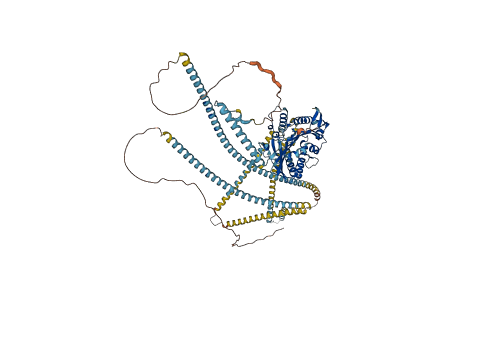
Descriptions
TLR9 (Toll-like receptor 9) plays a key role in the innate immune system in response to unmethylated CpG DNA. After stimulation of cells with CpG DNA, TLR9 redistributes from the endoplasmic reticulum to lysosomes, where a signaling cascade is triggered by recruitment of the MyD88 adaptor molecule. TLR9 is a type I transmembrane protein characterized by an extracellular leucine-rich repeat (LRR) domain, a transmembrane helix, and an intracellular Toll/interleukin-1 receptor (TIR) homology domain. TLR9 undergoes proteolytic cleavage, executed by cysteine proteases, in the endolysosomal compartment, and molecular modeling shows that the cleavage sites are situated between LRR14 and LRR15, as being part of a flexible loop that could render TLR9 susceptible to proteolysis. On a molar basis, the C-terminal cleavage fragment of TLR9 binds CpG DNA more strongly than does full-length TLR9, although full-length TLR9 binds CpG DNA. The broadly specific inhibitor z-FA-fmk is most effective at blocking the cleavage and, accordingly, abrogated TNF production in cells exposed to the TLR9 agonist CpG DNA.
Autoinhibitory domains (AIDs)
Target domain |
9-342 (Kinesin motor domain) |
Relief mechanism |
Partner binding |
Assay |
Deletion assay |
Accessory elements
No accessory elements
Autoinhibited structure

Activated structure
1 structures for Q9HES9
| Entry ID | Method | Resolution | Chain | Position | Source |
|---|---|---|---|---|---|
| AF-Q9HES9-F1 | Predicted | AlphaFoldDB |
No variants for Q9HES9
| Variant ID(s) | Position | Change | Description | Diseaes Association | Provenance |
|---|---|---|---|---|---|
| No variants for Q9HES9 | |||||
No associated diseases with Q9HES9
No regional properties for Q9HES9
| Type | Name | Position | InterPro Accession |
|---|---|---|---|
| No domain, repeats, and functional sites for Q9HES9 | |||
Functions
| Description | ||
|---|---|---|
| EC Number | ||
| Subcellular Localization |
|
|
| PANTHER Family | PTHR47410 | TOLL-LIKE RECEPTOR 7-RELATED |
| PANTHER Subfamily | PTHR47410:SF3 | TOLL-LIKE RECEPTOR 9 |
| PANTHER Protein Class | transmembrane signal receptor | |
| PANTHER Pathway Category |
Toll receptor signaling pathway TLR |
|
1 GO annotations of cellular component
| Name | Definition |
|---|---|
| microtubule | Any of the long, generally straight, hollow tubes of internal diameter 12-15 nm and external diameter 24 nm found in a wide variety of eukaryotic cells; each consists (usually) of 13 protofilaments of polymeric tubulin, staggered in such a manner that the tubulin monomers are arranged in a helical pattern on the microtubular surface, and with the alpha/beta axes of the tubulin subunits parallel to the long axis of the tubule; exist in equilibrium with pool of tubulin monomers and can be rapidly assembled or disassembled in response to physiological stimuli; concerned with force generation, e.g. in the spindle. |
3 GO annotations of molecular function
| Name | Definition |
|---|---|
| ATP binding | Binding to ATP, adenosine 5'-triphosphate, a universally important coenzyme and enzyme regulator. |
| microtubule binding | Binding to a microtubule, a filament composed of tubulin monomers. |
| microtubule motor activity | A motor activity that generates movement along a microtubule, driven by ATP hydrolysis. |
1 GO annotations of biological process
| Name | Definition |
|---|---|
| microtubule-based movement | A microtubule-based process that results in the movement of organelles, other microtubules, or other cellular components. Examples include motor-driven movement along microtubules and movement driven by polymerization or depolymerization of microtubules. |
No homologous proteins in AiPD
| UniProt AC | Gene Name | Protein Name | Species | Evidence Code |
|---|---|---|---|---|
| No homologous proteins | ||||
| 10 | 20 | 30 | 40 | 50 | 60 |
| MGFCRSALHP | LSLLVQAIML | AMTLALGTLP | AFLPCELQPH | GLVNCNWLFL | KSVPHFSMAA |
| 70 | 80 | 90 | 100 | 110 | 120 |
| PRGNVTSLSL | SSNRIHHLHD | SDFAHLPSLR | HLNLKWNCPP | VGLSPMHFPC | HMTIEPSTFL |
| 130 | 140 | 150 | 160 | 170 | 180 |
| AVPTLEELNL | SYNNIMTVPA | LPKSLISLSL | SHTNILMLDS | ASLAGLHALR | FLFMDGNCYY |
| 190 | 200 | 210 | 220 | 230 | 240 |
| KNPCRQALEV | APGALLGLGN | LTHLSLKYNN | LTVVPRNLPS | SLEYLLLSYN | RIVKLAPEDL |
| 250 | 260 | 270 | 280 | 290 | 300 |
| ANLTALRVLD | VGGNCRRCDH | APNPCMECPR | HFPQLHPDTF | SHLSRLEGLV | LKDSSLSWLN |
| 310 | 320 | 330 | 340 | 350 | 360 |
| ASWFRGLGNL | RVLDLSENFL | YKCITKTKAF | QGLTQLRKLN | LSFNYQKRVS | FAHLSLAPSF |
| 370 | 380 | 390 | 400 | 410 | 420 |
| GSLVALKELD | MHGIFFRSLD | ETTLRPLARL | PMLQTLRLQM | NFINQAQLGI | FRAFPGLRYV |
| 430 | 440 | 450 | 460 | 470 | 480 |
| DLSDNRISGA | SELTATMGEA | DGGEKVWLQP | GDLAPAPVDT | PSSEDFRPNC | STLNFTLDLS |
| 490 | 500 | 510 | 520 | 530 | 540 |
| RNNLVTVQPE | MFAQLSHLQC | LRLSHNCISQ | AVNGSQFLPL | TGLQVLDLSH | NKLDLYHEHS |
| 550 | 560 | 570 | 580 | 590 | 600 |
| FTELPRLEAL | DLSYNSQPFG | MQGVGHNFSF | VAHLRTLRHL | SLAHNNIHSQ | VSQQLCSTSL |
| 610 | 620 | 630 | 640 | 650 | 660 |
| RALDFSGNAL | GHMWAEGDLY | LHFFQGLSGL | IWLDLSQNRL | HTLLPQTLRN | LPKSLQVLRL |
| 670 | 680 | 690 | 700 | 710 | 720 |
| RDNYLAFFKW | WSLHFLPKLE | VLDLAGNQLK | ALTNGSLPAG | TRLRRLDVSC | NSISFVAPGF |
| 730 | 740 | 750 | 760 | 770 | 780 |
| FSKAKELREL | NLSANALKTV | DHSWFGPLAS | ALQILDVSAN | PLHCACGAAF | MDFLLEVQAA |
| 790 | 800 | 810 | 820 | 830 | 840 |
| VPGLPSRVKC | GSPGQLQGLS | IFAQDLRLCL | DEALSWDCFA | LSLLAVALGL | GVPMLHHLCG |
| 850 | 860 | 870 | 880 | 890 | 900 |
| WDLWYCFHLC | LAWLPWRGRQ | SGRDEDALPY | DAFVVFDKTQ | SAVADWVYNE | LRGQLEECRG |
| 910 | 920 | 930 | 940 | 950 | 960 |
| RWALRLCLEE | RDWLPGKTLF | ENLWASVYGS | RKTLFVLAHT | DRVSGLLRAS | FLLAQQRLLE |
| 970 | 980 | 990 | 1000 | 1010 | 1020 |
| DRKDVVVLVI | LSPDGRRSRY | VRLRQRLCRQ | SVLLWPHQPS | GQRSFWAQLG | MALTRDNHHF |
| 1030 | |||||
| YNRNFCQGPT | AE |