Q9GRX6
Gene name |
aif (DDB_G0288247) |
Protein name |
Apoptosis-inducing factor 1, mitochondrial |
Names |
Ddaif |
Species |
Dictyostelium discoideum (Slime mold) |
KEGG Pathway |
ddi:DDB_G0288247 |
EC number |
|
Protein Class |
|
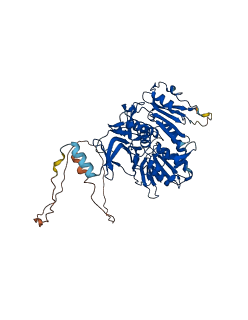
Descriptions
The autoinhibited protein was predicted that may have potential autoinhibitory elements via cis-regPred.
Autoinhibitory domains (AIDs)
Target domain |
|
Relief mechanism |
|
Assay |
cis-regPred |
Accessory elements
No accessory elements
Autoinhibited structure

Activated structure
1 structures for Q9GRX6
| Entry ID | Method | Resolution | Chain | Position | Source |
|---|---|---|---|---|---|
| AF-Q9GRX6-F1 | Predicted | AlphaFoldDB |
No variants for Q9GRX6
| Variant ID(s) | Position | Change | Description | Diseaes Association | Provenance |
|---|---|---|---|---|---|
| No variants for Q9GRX6 | |||||
No associated diseases with Q9GRX6
Functions
6 GO annotations of cellular component
| Name | Definition |
|---|---|
| cytoplasm | The contents of a cell excluding the plasma membrane and nucleus, but including other subcellular structures. |
| mitochondrial intermembrane space | The region between the inner and outer lipid bilayers of the mitochondrial envelope. |
| mitochondrion | A semiautonomous, self replicating organelle that occurs in varying numbers, shapes, and sizes in the cytoplasm of virtually all eukaryotic cells. It is notably the site of tissue respiration. |
| nucleus | A membrane-bounded organelle of eukaryotic cells in which chromosomes are housed and replicated. In most cells, the nucleus contains all of the cell's chromosomes except the organellar chromosomes, and is the site of RNA synthesis and processing. In some species, or in specialized cell types, RNA metabolism or DNA replication may be absent. |
| pathogen-containing vacuole | A membrane-bound intracellular compartment that is formed upon internalization of a pathogen into a host cell, and in which the pathogen resides. |
| phagocytic vesicle | A membrane-bounded intracellular vesicle that arises from the ingestion of particulate material by phagocytosis. |
6 GO annotations of molecular function
| Name | Definition |
|---|---|
| DNA binding | Any molecular function by which a gene product interacts selectively and non-covalently with DNA (deoxyribonucleic acid). |
| FAD binding | Binding to the oxidized form, FAD, of flavin-adenine dinucleotide, the coenzyme or the prosthetic group of various flavoprotein oxidoreductase enzymes. |
| NAD(P)H oxidase H2O2-forming activity | Catalysis of the reaction: NAD(P)H + H+ + O2 = NAD(P)+ + hydrogen peroxide. |
| NADH dehydrogenase activity | Catalysis of the reaction: NADH + H+ + acceptor = NAD+ + reduced acceptor. |
| oxidoreductase activity, acting on NAD(P)H | Catalysis of an oxidation-reduction (redox) reaction in which NADH or NADPH acts as a hydrogen or electron donor and reduces a hydrogen or electron acceptor. |
| protein dimerization activity | The formation of a protein dimer, a macromolecular structure consists of two noncovalently associated identical or nonidentical subunits. |
9 GO annotations of biological process
| Name | Definition |
|---|---|
| chromosome condensation | The progressive compaction of dispersed interphase chromatin into threadlike chromosomes prior to mitotic or meiotic nuclear division, or during apoptosis, in eukaryotic cells. |
| DNA catabolic process | The cellular DNA metabolic process resulting in the breakdown of DNA, deoxyribonucleic acid, one of the two main types of nucleic acid, consisting of a long unbranched macromolecule formed from one or two strands of linked deoxyribonucleotides, the 3'-phosphate group of each constituent deoxyribonucleotide being joined in 3',5'-phosphodiester linkage to the 5'-hydroxyl group of the deoxyribose moiety of the next one. |
| mitochondrial fission | The division of a mitochondrion within a cell to form two or more separate mitochondrial compartments. |
| mitochondrial proton-transporting ATP synthase complex assembly | The aggregation, arrangement and bonding together of a proton-transporting ATP synthase in the mitochondrial inner membrane. |
| mitochondrial respiratory chain complex assembly | The aggregation, arrangement and bonding together of a set of components to form a mitochondrial respiratory chain complex. |
| programmed cell death | A process which begins when a cell receives an internal or external signal and activates a series of biochemical events (signaling pathway). The process ends with the death of the cell. |
| protein import into mitochondrial intermembrane space | The import of proteins into the space between the inner and outer mitochondrial membranes. |
| regulation of mitochondrial depolarization | Any process that modulates the frequency, rate or extent of the change in the membrane potential of the mitochondria from negative to positive. |
| regulation of response to oxidative stress | Any process that modulates the frequency, rate or extent of response to oxidative stress. |
No homologous proteins in AiPD
| UniProt AC | Gene Name | Protein Name | Species | Evidence Code |
|---|---|---|---|---|
| No homologous proteins | ||||
| 10 | 20 | 30 | 40 | 50 | 60 |
| MIRNLTKLTK | FTIGNRFYQS | SSKGRFSGKN | GNNAFKSIVG | VSVGVSALFA | GCVFLDQEKE |
| 70 | 80 | 90 | 100 | 110 | 120 |
| PESTPSIDVK | EKKSQPPKTK | EDYQKKMDEE | YDIEQFKYVI | IGGGTAAYHA | IDKILENDKE |
| 130 | 140 | 150 | 160 | 170 | 180 |
| ATILLISKEY | EVPYQRPPLT | KSLWATKDDN | VVNTLNFSDW | SGKKQNLLYE | QESAYGNEIL |
| 190 | 200 | 210 | 220 | 230 | 240 |
| QFIRTKKVID | LHIDEKLVLL | NDGKLIRYDK | CLIATGGEPR | QLKFTSTNDK | KISTYRTVED |
| 250 | 260 | 270 | 280 | 290 | 300 |
| FRKLYEVVKD | GGKHVTVLGG | GFLGSELTCA | INSNFQDKNI | KIDQIFPESG | VLSTLFPDYL |
| 310 | 320 | 330 | 340 | 350 | 360 |
| SKYATEEIIK | SGVNVHTGTL | IKDVVDNSEN | GRLTVTLNNG | KTFETDHVVV | AAGIIPNTNV |
| 370 | 380 | 390 | 400 | 410 | 420 |
| VKSTTLEIDP | INGGYVVNPE | LQARTDLYVA | GDVASYYDFS | LGVRRRVEHH | DHARATGEMA |
| 430 | 440 | 450 | 460 | 470 | 480 |
| GSNMSTKDTP | APYTYQPFFW | SDLTPGVGFE | AVGNTSSKLK | TFSVWEKPSS | DETKQSYTKG |
| 490 | 500 | 510 | 520 | 530 | |
| NIYYLNDNNN | VVGVLCYGNY | GKMDTARDLI | LKRRTIEDLN | QLQHAIDFDE | HH |