Q9GLV6
Gene name |
DDX58 |
Protein name |
Antiviral innate immune response receptor RIG-I |
Names |
DEAD box protein 58, Probable ATP-dependent RNA helicase DDX58, RHIV-1, RIG-I-like receptor 1, RLR-1, RNA helicase induced by virus, Retinoic acid-inducible gene 1 protein, RIG-1, Retinoic acid-inducible gene I protein, RIG-I |
Species |
Sus scrofa (Pig) |
KEGG Pathway |
|
EC number |
3.6.4.13: Acting on ATP; involved in cellular and subcellular movement |
Protein Class |
|
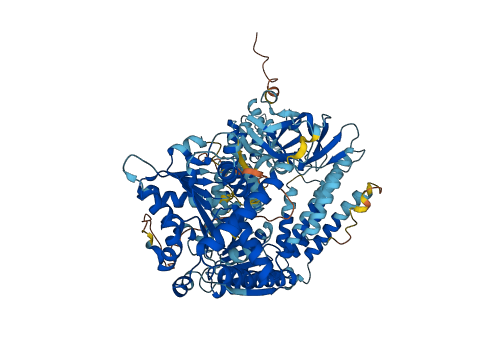
Descriptions
Autoinhibitory domains (AIDs)
Target domain |
1-186 (CARD domain) |
Relief mechanism |
Ligand binding |
Assay |
|
Accessory elements
No accessory elements
References
- Oshiumi H et al. (2013) "A distinct role of Riplet-mediated K63-Linked polyubiquitination of the RIG-I repressor domain in human antiviral innate immune responses", PLoS pathogens, 9, e1003533
- Gack MU et al. (2007) "TRIM25 RING-finger E3 ubiquitin ligase is essential for RIG-I-mediated antiviral activity", Nature, 446, 916-920
Autoinhibited structure

Activated structure
1 structures for Q9GLV6
| Entry ID | Method | Resolution | Chain | Position | Source |
|---|---|---|---|---|---|
| AF-Q9GLV6-F1 | Predicted | AlphaFoldDB |
No variants for Q9GLV6
| Variant ID(s) | Position | Change | Description | Diseaes Association | Provenance |
|---|---|---|---|---|---|
| No variants for Q9GLV6 | |||||
No associated diseases with Q9GLV6
8 regional properties for Q9GLV6
| Type | Name | Position | InterPro Accession |
|---|---|---|---|
| domain | Helicase, C-terminal | 613 - 779 | IPR001650 |
| domain | DEAD/DEAH box helicase domain | 244 - 409 | IPR011545 |
| domain | Helicase superfamily 1/2, ATP-binding domain | 237 - 450 | IPR014001 |
| domain | RIG-I-like receptor, C-terminal regulatory domain | 795 - 928 | IPR021673 |
| domain | Caspase recruitment domain | 1 - 92 | IPR031964-1 |
| domain | Caspase recruitment domain | 100 - 186 | IPR031964-2 |
| domain | RIG-I-like receptor, C-terminal | 456 - 604 | IPR041204 |
| domain | RIG-I, CARD domain repeat 2 | 100 - 186 | IPR042145 |
Functions
| Description | ||
|---|---|---|
| EC Number | 3.6.4.13 | Acting on ATP; involved in cellular and subcellular movement |
| Subcellular Localization |
|
|
| PANTHER Family | ||
| PANTHER Subfamily | ||
| PANTHER Protein Class | ||
| PANTHER Pathway Category | No pathway information available | |
5 GO annotations of cellular component
| Name | Definition |
|---|---|
| actin cytoskeleton | The part of the cytoskeleton (the internal framework of a cell) composed of actin and associated proteins. Includes actin cytoskeleton-associated complexes. |
| bicellular tight junction | An occluding cell-cell junction that is composed of a branching network of sealing strands that completely encircles the apical end of each cell in an epithelial sheet; the outer leaflets of the two interacting plasma membranes are seen to be tightly apposed where sealing strands are present. Each sealing strand is composed of a long row of transmembrane adhesion proteins embedded in each of the two interacting plasma membranes. |
| cytoplasm | The contents of a cell excluding the plasma membrane and nucleus, but including other subcellular structures. |
| ribonucleoprotein complex | A macromolecular complex that contains both RNA and protein molecules. |
| ruffle membrane | The portion of the plasma membrane surrounding a ruffle. |
6 GO annotations of molecular function
| Name | Definition |
|---|---|
| ATP binding | Binding to ATP, adenosine 5'-triphosphate, a universally important coenzyme and enzyme regulator. |
| ATP hydrolysis activity | Catalysis of the reaction: ATP + H2O = ADP + H+ phosphate. ATP hydrolysis is used in some reactions as an energy source, for example to catalyze a reaction or drive transport against a concentration gradient. |
| double-stranded RNA binding | Binding to double-stranded RNA. |
| RNA helicase activity | Unwinding of an RNA helix, driven by ATP hydrolysis. |
| single-stranded RNA binding | Binding to single-stranded RNA. |
| zinc ion binding | Binding to a zinc ion (Zn). |
14 GO annotations of biological process
| Name | Definition |
|---|---|
| antiviral innate immune response | A defense response against viruses mediated through an innate immune response. An innate immune response is mediated by germline encoded components that directly recognize components of potential pathogens. |
| cellular response to exogenous dsRNA | Any process that results in a change in state or activity of a cell (in terms of movement, secretion, enzyme production, gene expression, etc.) as a result of an exogenous double-stranded RNA stimulus. |
| innate immune response | Innate immune responses are defense responses mediated by germline encoded components that directly recognize components of potential pathogens. |
| positive regulation of defense response to virus by host | Any host process that results in the promotion of antiviral immune response mechanisms, thereby limiting viral replication. |
| positive regulation of interferon-alpha production | Any process that activates or increases the frequency, rate, or extent of interferon-alpha production. |
| positive regulation of interferon-beta production | Any process that activates or increases the frequency, rate, or extent of interferon-beta production. |
| positive regulation of interleukin-6 production | Any process that activates or increases the frequency, rate, or extent of interleukin-6 production. |
| positive regulation of myeloid dendritic cell cytokine production | Any process that activates or increases the frequency, rate, or extent of myeloid dendritic cell cytokine production. |
| positive regulation of response to cytokine stimulus | Any process that increases the rate, frequency, or extent of a response to cytokine stimulus. |
| positive regulation of tumor necrosis factor production | Any process that activates or increases the frequency, rate or extent of tumor necrosis factor production. |
| regulation of cell migration | Any process that modulates the frequency, rate or extent of cell migration. |
| response to exogenous dsRNA | Any process that results in a change in state or activity of a cell or an organism (in terms of movement, secretion, enzyme production, gene expression, etc.) as a result of an exogenous double-stranded RNA stimulus. |
| response to virus | Any process that results in a change in state or activity of a cell or an organism (in terms of movement, secretion, enzyme production, gene expression, etc.) as a result of a stimulus from a virus. |
| RIG-I signaling pathway | The series of molecular signals initiated by the binding of viral RNA to a pattern recognition receptor (PRR) RIG-1 (also known as DDX58). RIG-I is a cytoplasmic receptor that detects RNA synthesized during viral replication and triggers a signaling pathway to protect the host against viral infection, for example by inducing the expression of antiviral cytokines. |
5 homologous proteins in AiPD
| UniProt AC | Gene Name | Protein Name | Species | Evidence Code |
|---|---|---|---|---|
| Q96C10 | DHX58 | ATP-dependent RNA helicase DHX58 | Homo sapiens (Human) | PR |
| Q9BYX4 | IFIH1 | Interferon-induced helicase C domain-containing protein 1 | Homo sapiens (Human) | PR |
| O95786 | RIGI | Antiviral innate immune response receptor RIG-I | Homo sapiens (Human) | EV |
| Q8R5F7 | Ifih1 | Interferon-induced helicase C domain-containing protein 1 | Mus musculus (Mouse) | PR |
| Q6Q899 | Ddx58 | Antiviral innate immune response receptor RIG-I | Mus musculus (Mouse) | SS |
| 10 | 20 | 30 | 40 | 50 | 60 |
| MTAEQRRNLH | AFGDYVRKTL | DPTFILSYMA | PWFRDDEVQH | IQAEKNNKGP | TEAASLFLQF |
| 70 | 80 | 90 | 100 | 110 | 120 |
| LLELQEEGWF | RGFLDALNQA | GYCGLCEAIE | SWDFQKIEKL | EEYRSLLRRL | QPEFKTTINP |
| 130 | 140 | 150 | 160 | 170 | 180 |
| KDILPEIAEC | LISQECEEIL | QICSSKGLMA | GAEKMVECLL | RSDKENWPKT | LKLALEKEES |
| 190 | 200 | 210 | 220 | 230 | 240 |
| RFSELWMVDK | GAEDVKMKDL | EDDEMKTCDV | QIFYKEEPEN | QNLSQNSCSS | SAPHTYSPLK |
| 250 | 260 | 270 | 280 | 290 | 300 |
| PRKYQLELAL | PAQNGKNTII | CAPTGCGKTF | VSLLICEHHL | KKFPRGRKGK | VVFFAIQLPV |
| 310 | 320 | 330 | 340 | 350 | 360 |
| YEQQKSVFSK | HFERLGYKVA | GISGATSDTV | CVEQIVENSD | IIILTPQILV | NCLTNGTIPS |
| 370 | 380 | 390 | 400 | 410 | 420 |
| LSVFTLMIFD | ECHNTSKQHP | YNVIMFSYLD | RKLGGSSDSL | PQVIGLTASV | GVGDAKNKAE |
| 430 | 440 | 450 | 460 | 470 | 480 |
| ATEYICKLCA | SLDTSVIATV | RDNLEELEEV | VYKPQKFFRK | VELRTTDRFK | CIISQLMMEI |
| 490 | 500 | 510 | 520 | 530 | 540 |
| ESLAKSIFEE | LGTITLGGLF | QIQNSNFGTQ | KYEQWIVKVQ | KECAVFQMPD | KDKESRICKA |
| 550 | 560 | 570 | 580 | 590 | 600 |
| LFSYMSHLRI | YNDALIINEH | ARMKDALDYL | KDFFRNIRAA | GFDEIEQDLT | QRFEEKLQEL |
| 610 | 620 | 630 | 640 | 650 | 660 |
| ESISIDPSNE | NPKLRDLCFI | LQEEYHLNPE | TRTILFVKTR | ALVDALKKWI | KENPKLSFLK |
| 670 | 680 | 690 | 700 | 710 | 720 |
| PSILTGRGKT | NQNIGMTLPA | QKCVLDTFRT | DKDNKILITT | SVADEGIDIA | QCNLVILYEY |
| 730 | 740 | 750 | 760 | 770 | 780 |
| VGNVIKMIQT | RGRGRARGSK | CFLLTANADL | IDKEKMNMYK | EEMMNGAILI | LQTWDEAVFK |
| 790 | 800 | 810 | 820 | 830 | 840 |
| EKIHQIQIRE | KIIRDNQGKP | EPVPDKKTKK | LLCKKCKAFA | CYTADIRMVE | KCHFTVVGDA |
| 850 | 860 | 870 | 880 | 890 | 900 |
| FRERFVSKLH | PKPKSFGNIE | KRAKIYCARP | DCSHDWGIYV | RYKAFEMPFI | KIESFVVEDI |
| 910 | 920 | 930 | |||
| ATGVQTVHAK | WKDFNFEKLS | FDAAEMAGGA | QDLGLQGMGN |