Descriptions
The autoinhibited protein was predicted that may have potential autoinhibitory elements via cis-regPred.
Autoinhibitory domains (AIDs)
Target domain |
|
Relief mechanism |
|
Assay |
cis-regPred |
Accessory elements
No accessory elements
Autoinhibited structure

Activated structure
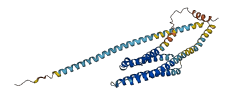
1 structures for Q9GLM8
| Entry ID | Method | Resolution | Chain | Position | Source |
|---|---|---|---|---|---|
| AF-Q9GLM8-F1 | Predicted | AlphaFoldDB |
No variants for Q9GLM8
| Variant ID(s) | Position | Change | Description | Diseaes Association | Provenance |
|---|---|---|---|---|---|
| No variants for Q9GLM8 | |||||
No associated diseases with Q9GLM8
4 regional properties for Q9GLM8
| Type | Name | Position | InterPro Accession |
|---|---|---|---|
| domain | Ribosomal protein L30, N-terminal | 26 - 97 | IPR012988 |
| domain | Ribosomal protein L30, ferredoxin-like fold domain | 102 - 152 | IPR016082 |
| conserved_site | Ribosomal protein L30, conserved site | 120 - 152 | IPR018038 |
| domain | Ribosomal protein L7, eukaryotic/archaeal | 101 - 260 | IPR035808 |
Functions
7 GO annotations of cellular component
| Name | Definition |
|---|---|
| chylomicron | A large lipoprotein particle (diameter 75-1200 nm) composed of a central core of triglycerides and cholesterol surrounded by a protein-phospholipid coating. The proteins include one molecule of apolipoprotein B-48 and may include a variety of apolipoproteins, including APOAs, APOCs and APOE. Chylomicrons are found in blood or lymph and carry lipids from the intestines into other body tissues. |
| extracellular matrix | A structure lying external to one or more cells, which provides structural support, biochemical or biomechanical cues for cells or tissues. |
| extracellular space | That part of a multicellular organism outside the cells proper, usually taken to be outside the plasma membranes, and occupied by fluid. |
| high-density lipoprotein particle | A lipoprotein particle with a high density (typically 1.063-1.21 g/ml) and a diameter of 5-10 nm that contains APOAs and may contain APOCs and APOE; found in blood and carries lipids from body tissues to the liver as part of the reverse cholesterol transport process. |
| intermediate-density lipoprotein particle | A triglyceride-rich lipoprotein particle that typically contains APOB100, APOE and APOCs and has a density of 1.006-1.019 g/ml and a diameter of between 25-30 nm. IDL particles are found in blood and are formed by the delipidation of very-low-density lipoprotein particles (VLDL). IDL particles are removed from blood by the liver, following binding to the APOE receptor, or are converted to low-density lipoprotein (LDL). |
| low-density lipoprotein particle | A lipoprotein particle, rich in cholesterol esters and low in triglycerides that is typically composed of APOB100 and APOE and has a density of 1.02-1.06 g/ml and a diameter of between 20-25 nm. LDL particles are formed from VLDL particles (via IDL) by the loss of triglyceride and gain of cholesterol ester. They transport endogenous cholesterol (and to some extent triglycerides) from peripheral tissues back to the liver. |
| very-low-density lipoprotein particle | A triglyceride-rich lipoprotein particle that is typically composed of APOB100, APOE and APOCs and has a density of about 1.006 g/ml and a diameter of between 20-80 nm. It is found in blood and transports endogenous products (newly synthesized cholesterol and triglycerides) from the liver. |
6 GO annotations of molecular function
| Name | Definition |
|---|---|
| amyloid-beta binding | Binding to an amyloid-beta peptide/protein. |
| heparan sulfate proteoglycan binding | Binding to a heparan sulfate proteoglycan, any proteoglycan containing heparan sulfate as the glycosaminoglycan carbohydrate unit. |
| heparin binding | Binding to heparin, a member of a group of glycosaminoglycans found mainly as an intracellular component of mast cells and which consist predominantly of alternating alpha-(1->4)-linked D-galactose and N-acetyl-D-glucosamine-6-sulfate residues. |
| identical protein binding | Binding to an identical protein or proteins. |
| lipid binding | Binding to a lipid. |
| low-density lipoprotein particle receptor binding | Binding to a low-density lipoprotein receptor. |
10 GO annotations of biological process
| Name | Definition |
|---|---|
| cholesterol efflux | The directed movement of cholesterol, cholest-5-en-3-beta-ol, out of a cell or organelle. |
| chylomicron remnant clearance | The process in which a chylomicron remnant is removed from the blood via receptor-mediated endocytosis into liver cells and its constituent parts degraded. |
| high-density lipoprotein particle assembly | The non-covalent aggregation and arrangement of proteins and lipids to form a high-density lipoprotein particle. |
| intermediate-density lipoprotein particle clearance | The process in which a intermediate-density lipoprotein particle is removed from the blood via receptor-mediated endocytosis and its constituent parts degraded. |
| lipoprotein biosynthetic process | The chemical reactions and pathways resulting in the formation of any conjugated, water-soluble protein in which the covalently attached nonprotein group consists of a lipid or lipids. |
| negative regulation of amyloid fibril formation | Any process that stops, prevents or reduces the frequency, rate or extent of amyloid fibril formation. |
| neuron projection development | The process whose specific outcome is the progression of a neuron projection over time, from its formation to the mature structure. A neuron projection is any process extending from a neural cell, such as axons or dendrites (collectively called neurites). |
| positive regulation of amyloid-beta clearance | Any process that activates or increases the frequency, rate or extent of amyloid-beta clearance. |
| triglyceride-rich lipoprotein particle clearance | The process in which a triglyceride-rich lipoprotein particle is removed from the blood via receptor-mediated endocytosis and its constituent parts degraded. |
| very-low-density lipoprotein particle clearance | The process in which a very-low-density lipoprotein particle is removed from the blood via receptor-mediated endocytosis and its constituent parts degraded. |
No homologous proteins in AiPD
| UniProt AC | Gene Name | Protein Name | Species | Evidence Code |
|---|---|---|---|---|
| No homologous proteins | ||||
| 10 | 20 | 30 | 40 | 50 | 60 |
| MKVLWAALLV | TFLAGCQAKV | EQAVETEPEP | ELHQQAEWQS | GQRWELALGR | FWDYLRWVQT |
| 70 | 80 | 90 | 100 | 110 | 120 |
| LSEQVQEELL | SSQVTQELTA | LMDETMKELK | AYKSELEEQL | TPVAEETRAR | LSKELQAAQA |
| 130 | 140 | 150 | 160 | 170 | 180 |
| RLGADMEDVR | GRLAQYRGEV | QAMLGQSTEE | LRARLASHLR | KLRKRLLRDA | DDLQKRLAVY |
| 190 | 200 | 210 | 220 | 230 | 240 |
| QAGAREGAER | GVSAIRERLG | PLVEQGRVRA | ATVGSLAGQP | LQERAQAWGE | RLRARMEEMG |
| 250 | 260 | 270 | 280 | 290 | 300 |
| SRTRDRLDEV | KEQVAEVRAK | LEEQAQQIRL | QAEAFQARLK | SWFEPLVEDM | QRQWAGLVEK |
| 310 | |||||
| VQAAMGTSAA | PVPSDNH |