Q9FYR6
Gene name |
OVA6 |
Protein name |
Proline--tRNA ligase, chloroplastic/mitochondrial |
Names |
Prolyl-tRNA Synthetase 1, PRORS1, Prolyl-tRNA synthetase, ProRS, Protein OVULE ABORTION 6 |
Species |
Arabidopsis thaliana (Mouse-ear cress) |
KEGG Pathway |
ath:AT5G52520 |
EC number |
6.1.1.15: Ligases forming aminoacyl-tRNA and related compounds |
Protein Class |
|
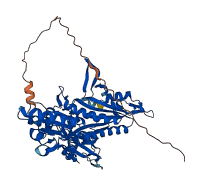
Descriptions
The autoinhibited protein was predicted that may have potential autoinhibitory elements via cis-regPred.
Autoinhibitory domains (AIDs)
Target domain |
|
Relief mechanism |
|
Assay |
cis-regPred |
Accessory elements
No accessory elements
Autoinhibited structure

Activated structure
1 structures for Q9FYR6
| Entry ID | Method | Resolution | Chain | Position | Source |
|---|---|---|---|---|---|
| AF-Q9FYR6-F1 | Predicted | AlphaFoldDB |
28 variants for Q9FYR6
| Variant ID(s) | Position | Change | Description | Diseaes Association | Provenance |
|---|---|---|---|---|---|
| ENSVATH12719432 | 11 | L>F | No | 1000Genomes | |
| ENSVATH07402278 | 20 | T>N | No | 1000Genomes | |
| tmp_5_21311172_C_A | 21 | R>S | No | 1000Genomes | |
| tmp_5_21311200_T_G | 30 | V>G | No | 1000Genomes | |
| ENSVATH00729510 | 30 | V>L | No | 1000Genomes | |
| ENSVATH14628161 | 35 | R>K | No | 1000Genomes | |
| tmp_5_21311263_A_G | 51 | E>G | No | 1000Genomes | |
| tmp_5_21311277_G_A | 56 | E>K | No | 1000Genomes | |
| ENSVATH12719433 | 62 | S>P | No | 1000Genomes | |
| ENSVATH00729513 | 111 | D>G | No | 1000Genomes | |
| tmp_5_21311842_T_G | 141 | S>A | No | 1000Genomes | |
| tmp_5_21312301_C_T | 226 | T>I | No | 1000Genomes | |
| ENSVATH12719486 | 234 | A>V | No | 1000Genomes | |
| tmp_5_21312471_T_C | 254 | I>T | No | 1000Genomes | |
| tmp_5_21312514_T_G | 268 | D>E | No | 1000Genomes | |
| tmp_5_21312570_C_T | 287 | T>I | No | 1000Genomes | |
| ENSVATH07402287 | 302 | Q>R | No | 1000Genomes | |
| ENSVATH12719492 | 304 | A>S | No | 1000Genomes | |
| tmp_5_21312801_C_T | 304 | A>V | No | 1000Genomes | |
| ENSVATH12719493 | 351 | I>V | No | 1000Genomes | |
| ENSVATH00729525 | 387 | T>A | No | 1000Genomes | |
| ENSVATH14628166 | 413 | R>L | No | 1000Genomes | |
| ENSVATH14628167 | 418 | N>S | No | 1000Genomes | |
| ENSVATH00729527 | 427 | V>I | No | 1000Genomes | |
| ENSVATH12719526 | 437 | I>M | No | 1000Genomes | |
| tmp_5_21313528_C_T | 457 | T>I | No | 1000Genomes | |
| ENSVATH03414942 | 486 | S>L | No | 1000Genomes | |
| ENSVATH12719527 | 486 | S>T | No | 1000Genomes |
No associated diseases with Q9FYR6
5 regional properties for Q9FYR6
| Type | Name | Position | InterPro Accession |
|---|---|---|---|
| domain | Aminoacyl-tRNA synthetase, class II (G/ P/ S/T) | 160 - 329 | IPR002314 |
| domain | Anticodon-binding | 348 - 450 | IPR004154 |
| domain | Aminoacyl-tRNA synthetase, class II | 93 - 341 | IPR006195 |
| domain | Proline-tRNA ligase, class II, C-terminal | 477 - 543 | IPR016061 |
| domain | Prolyl-tRNA synthetase, catalytic domain | 72 - 331 | IPR033721 |
Functions
| Description | ||
|---|---|---|
| EC Number | 6.1.1.15 | Ligases forming aminoacyl-tRNA and related compounds |
| Subcellular Localization |
|
|
| PANTHER Family | ||
| PANTHER Subfamily | ||
| PANTHER Protein Class | ||
| PANTHER Pathway Category | No pathway information available | |
5 GO annotations of cellular component
| Name | Definition |
|---|---|
| aminoacyl-tRNA synthetase multienzyme complex | A multienzyme complex found in all multicellular eukaryotes composed of eight proteins with aminoacyl-tRNA synthetase activities (abbreviated as: ArgRS, AspRS, GluProRS, GlnRS, IleRS, LeuRS, LysRS, MetRS where RS is the enzyme, preceded by the amino acid it uses as a substrate) as well as three non-synthetase proteins (p43, p38, and p18) with diverse functions. Several of these subunits are known dimers, so the total polypeptide count in the multisynthetase complex is at least fifteen. All of the enzymes in this assembly catalyze the same reaction, the covalent attachment of an amino acid to either the 2'- or 3'-hydroxyl of the 3'-terminal adenosine of tRNA, but using different substrates. |
| chloroplast | A chlorophyll-containing plastid with thylakoids organized into grana and frets, or stroma thylakoids, and embedded in a stroma. |
| chloroplast stroma | The space enclosed by the double membrane of a chloroplast but excluding the thylakoid space. It contains DNA, ribosomes and some temporary products of photosynthesis. |
| cytoplasm | The contents of a cell excluding the plasma membrane and nucleus, but including other subcellular structures. |
| mitochondrion | A semiautonomous, self replicating organelle that occurs in varying numbers, shapes, and sizes in the cytoplasm of virtually all eukaryotic cells. It is notably the site of tissue respiration. |
2 GO annotations of molecular function
| Name | Definition |
|---|---|
| ATP binding | Binding to ATP, adenosine 5'-triphosphate, a universally important coenzyme and enzyme regulator. |
| proline-tRNA ligase activity | Catalysis of the reaction: ATP + L-proline + tRNA(Pro) = AMP + diphosphate + L-prolyl-tRNA(Pro). |
5 GO annotations of biological process
| Name | Definition |
|---|---|
| embryo sac development | The process whose specific outcome is the progression of the embryo sac over time, from its formation to the mature structure. The process begins with the meiosis of the megasporocyte to form four haploid megaspores. Three of the megaspores disintegrate, and the fourth undergoes mitosis giving rise to a binucleate syncytial embryo sac. The two haploid nuclei migrate to the opposite poles of the embryo sac and then undergo two rounds of mitosis generating four haploid nuclei at each pole. One nucleus from each set of four migrates to the center of the cell. Cellularization occurs, resulting in an eight-nucleate seven-celled structure. This structure contains two synergid cells and an egg cell at the micropylar end, and three antipodal cells at the other end. A binucleate endosperm mother cell is formed at the center. The two polar nuclei fuse resulting in a mononucleate diploid endosperm mother cell. The three antipodal cells degenerate. |
| plant ovule development | The process whose specific outcome is the progression of the ovule over time, from its formation to the mature structure. The ovule is the structure in seed plants enclosing the female gametophyte, and is composed of the nucellus, one or two integuments, and the funiculus; it develops into the seed. |
| prolyl-tRNA aminoacylation | The process of coupling proline to prolyl-tRNA, catalyzed by prolyl-tRNA synthetase. The prolyl-tRNA synthetase is a class-II synthetase. The activated amino acid is transferred to the 3'-OH group of a methionine-accetping tRNA. |
| regulation of photosynthesis | Any process that modulates the frequency, rate or extent of photosynthesis. |
| seed development | The process whose specific outcome is the progression of the seed over time, from its formation to the mature structure. A seed is a propagating organ formed in the sexual reproductive cycle of gymnosperms and angiosperms, consisting of a protective coat enclosing an embryo and food reserves. |
No homologous proteins in AiPD
| UniProt AC | Gene Name | Protein Name | Species | Evidence Code |
|---|---|---|---|---|
| No homologous proteins | ||||
| 10 | 20 | 30 | 40 | 50 | 60 |
| MVSSSLRLPS | LTSLLFPATT | RYPATLRRTV | CLRNRPLSGF | ATAPSGTASP | ETKSSEVDRL |
| 70 | 80 | 90 | 100 | 110 | 120 |
| RSDRAVTPRS | QDFNAWYLDV | IASAELADYG | PVRGTMVIRP | YGYAIWEAIQ | DYLNVKFKET |
| 130 | 140 | 150 | 160 | 170 | 180 |
| GHSNMYFPQF | IPYSFIEKEA | SHVEGFSPEL | ALVTVGGGKE | LEEKLVVRPT | SETIVNHMFT |
| 190 | 200 | 210 | 220 | 230 | 240 |
| QWIHSYRDLP | LMINQWANVT | RWEMRTKPFI | RTLEFLWQEG | HTAHATPEEA | EKEAKQMIEI |
| 250 | 260 | 270 | 280 | 290 | 300 |
| YTRFAFEQTA | IPVIPGRKSK | LETFAGADIT | YTIEAMMGDR | KALQAGTSHN | LGQNFSRAFG |
| 310 | 320 | 330 | 340 | 350 | 360 |
| TQFADENGER | QHVWQTSWAV | STRFVGGIIM | THGDDTGLML | PPKIAPIQVV | IVPIWKKDTE |
| 370 | 380 | 390 | 400 | 410 | 420 |
| KTGVLSAASS | VKEALQTAGV | RVKLDDTDQR | TPGWKFNFWE | MKGIPLRIEI | GPRDVSSNSV |
| 430 | 440 | 450 | 460 | 470 | 480 |
| VVSRRDVPGK | AGKVFGISME | PSTLVAYVKE | KLDEIQTSLL | EKALSFRDSN | IVDVNSYAEL |
| 490 | 500 | 510 | 520 | 530 | 540 |
| KDAISSGKWA | RGPWSASDAD | EQRVKEETGA | TIRCFPFEQT | QGTKTCLMTG | NPAEEVAIFA |
| KSY |