Q9FLX7
Gene name |
At5g52840 (MXC20.6) |
Protein name |
Probable NADH dehydrogenase [ubiquinone] 1 alpha subcomplex subunit 5, mitochondrial |
Names |
|
Species |
Arabidopsis thaliana (Mouse-ear cress) |
KEGG Pathway |
ath:AT5G52840 |
EC number |
|
Protein Class |
|
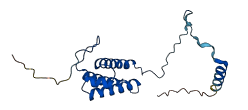
Descriptions
The autoinhibited protein was predicted that may have potential autoinhibitory elements via cis-regPred.
Autoinhibitory domains (AIDs)
Target domain |
|
Relief mechanism |
|
Assay |
cis-regPred |
Accessory elements
No accessory elements
Autoinhibited structure

Activated structure
11 structures for Q9FLX7
| Entry ID | Method | Resolution | Chain | Position | Source |
|---|---|---|---|---|---|
| 7A23 | EM | 370 A | R | 1-169 | PDB |
| 7A24 | EM | 380 A | R | 1-169 | PDB |
| 7AQR | EM | 291 A | V | 1-169 | PDB |
| 7AR7 | EM | 372 A | V | 12-151 | PDB |
| 7AR8 | EM | 353 A | V | 1-169 | PDB |
| 7ARB | EM | 341 A | V | 1-169 | PDB |
| 8BEE | EM | 204 A | V | 1-169 | PDB |
| 8BPX | EM | 209 A | V | 1-169 | PDB |
| 8BQ5 | EM | 273 A | V | 1-169 | PDB |
| 8BQ6 | EM | 280 A | V | 1-169 | PDB |
| AF-Q9FLX7-F1 | Predicted | AlphaFoldDB |
5 variants for Q9FLX7
| Variant ID(s) | Position | Change | Description | Diseaes Association | Provenance |
|---|---|---|---|---|---|
| ENSVATH07404211 | 55 | K>R | No | 1000Genomes | |
| ENSVATH12725013 | 73 | D>V | No | 1000Genomes | |
| tmp_5_21413973_G_A | 86 | V>I | No | 1000Genomes | |
| tmp_5_21414655_C_T | 124 | A>V | No | 1000Genomes | |
| tmp_5_21414787_A_G | 168 | K>R | No | 1000Genomes |
No associated diseases with Q9FLX7
No regional properties for Q9FLX7
| Type | Name | Position | InterPro Accession |
|---|---|---|---|
| No domain, repeats, and functional sites for Q9FLX7 | |||
5 GO annotations of cellular component
| Name | Definition |
|---|---|
| mitochondrial membrane | Either of the lipid bilayers that surround the mitochondrion and form the mitochondrial envelope. |
| mitochondrial respiratory chain complex I | A protein complex located in the mitochondrial inner membrane that forms part of the mitochondrial respiratory chain. It contains about 25 different polypeptide subunits, including NADH dehydrogenase (ubiquinone), flavin mononucleotide and several different iron-sulfur clusters containing non-heme iron. The iron undergoes oxidation-reduction between Fe(II) and Fe(III), and catalyzes proton translocation linked to the oxidation of NADH by ubiquinone. |
| mitochondrion | A semiautonomous, self replicating organelle that occurs in varying numbers, shapes, and sizes in the cytoplasm of virtually all eukaryotic cells. It is notably the site of tissue respiration. |
| plastid | Any member of a family of organelles found in the cytoplasm of plants and some protists, which are membrane-bounded and contain DNA. Plant plastids develop from a common type, the proplastid. |
| respiratory chain complex I | Respiratory chain complex I is an enzyme of the respiratory chain. It consists of several polypeptide chains and is L-shaped, with a horizontal arm lying in the membrane and a vertical arm that projects into the matrix. The electrons of NADH enter the chain at this complex. |
No GO annotations of molecular function
| Name | Definition |
|---|---|
| No GO annotations for molecular function |
2 GO annotations of biological process
| Name | Definition |
|---|---|
| photorespiration | A light-dependent catabolic process occurring concomitantly with photosynthesis in plants (especially C3 plants) whereby dioxygen (O2) is consumed and carbon dioxide (CO2) is evolved. The substrate is glycolate formed in large quantities in chloroplasts from 2-phosphoglycolate generated from ribulose 1,5-bisphosphate by the action of ribulose-bisphosphate carboxylase; the glycolate enters the peroxisomes where it is converted by glycolate oxidase to glyoxylate which undergoes transamination to glycine. This then passes into the mitochondria where it is decarboxylated forming one molecule of serine for every two molecules of glycine. This pathway also exists in photosynthetic bacteria. |
| respiratory electron transport chain | A process in which a series of electron carriers operate together to transfer electrons from donors such as NADH and FADH2 to any of several different terminal electron acceptors to generate a transmembrane electrochemical gradient. |
No homologous proteins in AiPD
| UniProt AC | Gene Name | Protein Name | Species | Evidence Code |
|---|---|---|---|---|
| No homologous proteins | ||||
| 10 | 20 | 30 | 40 | 50 | 60 |
| MFLRAIGRPL | LAKVKQTTGI | VGLDVVPNAR | AVLIDLYSKT | LKEIQAVPED | EGYRKAVESF |
| 70 | 80 | 90 | 100 | 110 | 120 |
| TRQRLNVCKE | EEDWEMIEKR | LGCGQVEELI | EEARDELTLI | GKMIEWDPWG | VPDDYECEVI |
| 130 | 140 | 150 | 160 | ||
| ENDAPIPKHV | PQHRPGPLPE | QFYKTLEGLI | AESKTEIPAA | TPSDPQLKE |