Q9F721
Gene name |
petB (CT0303) |
Protein name |
Cytochrome bc complex cytochrome b subunit |
Names |
|
Species |
Chlorobaculum tepidum (strain ATCC 49652 / DSM 12025 / NBRC 103806 / TLS) (Chlorobium tepidum) |
KEGG Pathway |
cte:CT0303 |
EC number |
|
Protein Class |
|
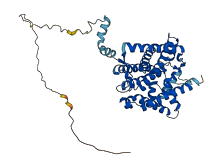
Descriptions
The autoinhibited protein was predicted that may have potential autoinhibitory elements via cis-regPred.
Autoinhibitory domains (AIDs)
Target domain |
|
Relief mechanism |
|
Assay |
cis-regPred |
Accessory elements
No accessory elements
Autoinhibited structure

Activated structure
1 structures for Q9F721
| Entry ID | Method | Resolution | Chain | Position | Source |
|---|---|---|---|---|---|
| AF-Q9F721-F1 | Predicted | AlphaFoldDB |
No variants for Q9F721
| Variant ID(s) | Position | Change | Description | Diseaes Association | Provenance |
|---|---|---|---|---|---|
| No variants for Q9F721 | |||||
No associated diseases with Q9F721
3 GO annotations of cellular component
| Name | Definition |
|---|---|
| integral component of membrane | The component of a membrane consisting of the gene products and protein complexes having at least some part of their peptide sequence embedded in the hydrophobic region of the membrane. |
| plasma membrane | The membrane surrounding a cell that separates the cell from its external environment. It consists of a phospholipid bilayer and associated proteins. |
| respirasome | The protein complexes that form the electron transport system (the respiratory chain), associated with a cell membrane, usually the plasma membrane (in prokaryotes) or the inner mitochondrial membrane (on eukaryotes). The respiratory chain complexes transfer electrons from an electron donor to an electron acceptor and are associated with a proton pump to create a transmembrane electrochemical gradient. |
2 GO annotations of molecular function
| Name | Definition |
|---|---|
| electron transfer activity | Any molecular entity that serves as an electron acceptor and electron donor in an electron transport chain. An electron transport chain is a process in which a series of electron carriers operate together to transfer electrons from donors to any of several different terminal electron acceptors to generate a transmembrane electrochemical gradient. |
| metal ion binding | Binding to a metal ion. |
1 GO annotations of biological process
| Name | Definition |
|---|---|
| respiratory electron transport chain | A process in which a series of electron carriers operate together to transfer electrons from donors such as NADH and FADH2 to any of several different terminal electron acceptors to generate a transmembrane electrochemical gradient. |
No homologous proteins in AiPD
| UniProt AC | Gene Name | Protein Name | Species | Evidence Code |
|---|---|---|---|---|
| No homologous proteins | ||||
| 10 | 20 | 30 | 40 | 50 | 60 |
| MAENTQNPAA | GTAPAKPKPA | VPGAAKPAAP | GAAKPAAKAP | AKPAAPAATA | PSGVYKPPVD |
| 70 | 80 | 90 | 100 | 110 | 120 |
| RPDPNPFKDS | KMSGVASWFQ | ERFYVLNPII | DYMKHKEVPK | HRLSFWYYFG | GLGLFFFIIQ |
| 130 | 140 | 150 | 160 | 170 | 180 |
| ILTGLLLLQY | YKPTETDAFS | SFLFIQGQVP | FGWLIRQIHA | WSANLMILML | FIHMFSTFFM |
| 190 | 200 | 210 | 220 | 230 | 240 |
| KSYRKPRELL | WVSGFILLVL | TLGFGFTGYL | LPWNELAFFA | TQVGTEVPKV | APGGAFLVEI |
| 250 | 260 | 270 | 280 | 290 | 300 |
| LRGGPDVSGE | TLTRMFSLHV | VLLPGLVMLV | LAAHLTLVQV | LGTSAPIGYK | EAGLIKGYDK |
| 310 | 320 | 330 | 340 | 350 | 360 |
| FFPTFLAKDG | IGWLIGFALL | VYLAVMFPWE | IGVKANPLSP | APVGIKPEWY | FWAQFQLLKD |
| 370 | 380 | 390 | 400 | 410 | 420 |
| FKFEGGELLA | IILFTIGGVV | WMLVPFLDRQ | ASQEKKSPMF | TIFGLLVLAF | LLINTYRVYD |
| SYVLHLPK |