Q9F314
Gene name |
tig |
Protein name |
Trigger factor |
Names |
TF, PPIase |
Species |
Streptomyces coelicolor (strain ATCC BAA-471 / A3(2) / M145) |
KEGG Pathway |
sco:SCO2620 |
EC number |
5.2.1.8: Cis-trans isomerases |
Protein Class |
|
Descriptions
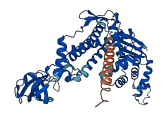
The autoinhibited protein was predicted that may have potential autoinhibitory elements via cis-regPred.
Autoinhibitory domains (AIDs)
Target domain |
|
Relief mechanism |
|
Assay |
cis-regPred |
Accessory elements
No accessory elements
Autoinhibited structure

Activated structure
1 structures for Q9F314
| Entry ID | Method | Resolution | Chain | Position | Source |
|---|---|---|---|---|---|
| AF-Q9F314-F1 | Predicted | AlphaFoldDB |
No variants for Q9F314
| Variant ID(s) | Position | Change | Description | Diseaes Association | Provenance |
|---|---|---|---|---|---|
| No variants for Q9F314 | |||||
2 associated diseases with Q9F314
[MIM: 616300]: Short-rib thoracic dysplasia 13 with or without polydactyly (SRTD13)
A form of short-rib thoracic dysplasia, a group of autosomal recessive ciliopathies that are characterized by a constricted thoracic cage, short ribs, shortened tubular bones, and a 'trident' appearance of the acetabular roof. Polydactyly is variably present. Non-skeletal involvement can include cleft lip/palate as well as anomalies of major organs such as the brain, eye, heart, kidneys, liver, pancreas, intestines, and genitalia. Some forms of the disease are lethal in the neonatal period due to respiratory insufficiency secondary to a severely restricted thoracic cage, whereas others are compatible with life. Disease spectrum encompasses Ellis-van Creveld syndrome, asphyxiating thoracic dystrophy (Jeune syndrome), Mainzer-Saldino syndrome, and short rib-polydactyly syndrome. {ECO:0000269|PubMed:25361962}. Note=The disease is caused by variants affecting the gene represented in this entry.
[MIM: 617761]: Joubert syndrome 31 (JBTS31)
A form of Joubert syndrome, a disorder presenting with cerebellar ataxia, oculomotor apraxia, hypotonia, neonatal breathing abnormalities and psychomotor delay. Neuroradiologically, it is characterized by cerebellar vermian hypoplasia/aplasia, thickened and reoriented superior cerebellar peduncles, and an abnormally large interpeduncular fossa, giving the appearance of a molar tooth on transaxial slices (molar tooth sign). Additional variable features include retinal dystrophy, renal disease, liver fibrosis, and polydactyly. JBTS31 inheritance is autosomal recessive. {ECO:0000269|PubMed:27208211}. Note=The disease is caused by variants affecting the gene represented in this entry.
Without disease ID
- A form of short-rib thoracic dysplasia, a group of autosomal recessive ciliopathies that are characterized by a constricted thoracic cage, short ribs, shortened tubular bones, and a 'trident' appearance of the acetabular roof. Polydactyly is variably present. Non-skeletal involvement can include cleft lip/palate as well as anomalies of major organs such as the brain, eye, heart, kidneys, liver, pancreas, intestines, and genitalia. Some forms of the disease are lethal in the neonatal period due to respiratory insufficiency secondary to a severely restricted thoracic cage, whereas others are compatible with life. Disease spectrum encompasses Ellis-van Creveld syndrome, asphyxiating thoracic dystrophy (Jeune syndrome), Mainzer-Saldino syndrome, and short rib-polydactyly syndrome. {ECO:0000269|PubMed:25361962}. Note=The disease is caused by variants affecting the gene represented in this entry.
- A form of Joubert syndrome, a disorder presenting with cerebellar ataxia, oculomotor apraxia, hypotonia, neonatal breathing abnormalities and psychomotor delay. Neuroradiologically, it is characterized by cerebellar vermian hypoplasia/aplasia, thickened and reoriented superior cerebellar peduncles, and an abnormally large interpeduncular fossa, giving the appearance of a molar tooth on transaxial slices (molar tooth sign). Additional variable features include retinal dystrophy, renal disease, liver fibrosis, and polydactyly. JBTS31 inheritance is autosomal recessive. {ECO:0000269|PubMed:27208211}. Note=The disease is caused by variants affecting the gene represented in this entry.
Functions
| Description | ||
|---|---|---|
| EC Number | 5.2.1.8 | Cis-trans isomerases |
| Subcellular Localization |
|
|
| PANTHER Family | ||
| PANTHER Subfamily | ||
| PANTHER Protein Class | ||
| PANTHER Pathway Category | No pathway information available | |
1 GO annotations of cellular component
| Name | Definition |
|---|---|
| cytoplasm | The contents of a cell excluding the plasma membrane and nucleus, but including other subcellular structures. |
3 GO annotations of molecular function
| Name | Definition |
|---|---|
| peptidyl-prolyl cis-trans isomerase activity | Catalysis of the reaction: peptidyl-proline (omega=180) = peptidyl-proline (omega=0). |
| protein folding chaperone | Binding to a protein or a protein-containing complex to assist the protein folding process. |
| ribosome binding | Binding to a ribosome. |
6 GO annotations of biological process
| Name | Definition |
|---|---|
| 'de novo' cotranslational protein folding | The process of assisting in the correct noncovalent assembly of the ribosome-bound nascent chains of a multidomain protein whilst other parts of the protein are still being translated. |
| cell cycle | The progression of biochemical and morphological phases and events that occur in a cell during successive cell replication or nuclear replication events. Canonically, the cell cycle comprises the replication and segregation of genetic material followed by the division of the cell, but in endocycles or syncytial cells nuclear replication or nuclear division may not be followed by cell division. |
| cell division | The process resulting in division and partitioning of components of a cell to form more cells; may or may not be accompanied by the physical separation of a cell into distinct, individually membrane-bounded daughter cells. |
| chaperone-mediated protein folding | The process of inhibiting aggregation and assisting in the covalent and noncovalent assembly of single chain polypeptides or multisubunit complexes into the correct tertiary structure that is dependent on interaction with a chaperone. |
| protein transport | The directed movement of proteins into, out of or within a cell, or between cells, by means of some agent such as a transporter or pore. |
| protein unfolding | The process of assisting in the disassembly of non-covalent linkages in a protein or protein aggregate, often where the proteins are in a non-functional or denatured state. |
No homologous proteins in AiPD
| UniProt AC | Gene Name | Protein Name | Species | Evidence Code |
|---|---|---|---|---|
| No homologous proteins | ||||
| 10 | 20 | 30 | 40 | 50 | 60 |
| MKSAVETLNP | TRVRLTVEVP | FEELKDSLDA | AYKKINQQVT | VKGFRKGKIP | ARVIDQRFGR |
| 70 | 80 | 90 | 100 | 110 | 120 |
| GAVLEEAVND | ALPKFYTDAV | NEAELNPLGQ | PEVDITELKD | GETLNFTAEV | DIRPSIEIPD |
| 130 | 140 | 150 | 160 | 170 | 180 |
| YSGIEVEVDA | VEVTDEDVEK | SVEQLRERFA | STSPVERAAA | DGDVLTLDLQ | AKVDGEILED |
| 190 | 200 | 210 | 220 | 230 | 240 |
| GVADGVSYTI | GSGELLDGID | EAVKGLEAGG | EATFTSELKG | GSAAGKEAEV | TVKVSQVAAR |
| 250 | 260 | 270 | 280 | 290 | 300 |
| ELPELDDDFA | QLASEFDTLE | ELQADSRKRL | ANMKQYDQAT | QAQERVLDKL | LELVEVPVPE |
| 310 | 320 | 330 | 340 | 350 | 360 |
| KLLEDEINTR | KHNLEHHQLG | QMGLDLEKYL | ELQGKTAEEF | ETETREAAVK | GIKTQFVLDE |
| 370 | 380 | 390 | 400 | 410 | 420 |
| LVKQEKLNVS | QEELTEHLMR | RAASSGMSPD | QFAQAVVEQG | QVPLLVGEVA | RGKALAAVVE |
| 430 | 440 | 450 | 460 | ||
| KATVKDTNGE | IVDLDDEEDE | ETEAAEADAT | EAADAEKADD | KAEEKTEG |