Q9EP73
Gene name |
Cd274 (B7h1, Pdcd1l1, Pdcd1lg1, Pdl1) |
Protein name |
Programmed cell death 1 ligand 1 |
Names |
|
Species |
Mus musculus (Mouse) |
KEGG Pathway |
mmu:60533 |
EC number |
|
Protein Class |
|
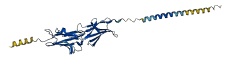
Descriptions
The autoinhibited protein was predicted that may have potential autoinhibitory elements via cis-regPred.
Autoinhibitory domains (AIDs)
Target domain |
|
Relief mechanism |
|
Assay |
cis-regPred |
Accessory elements
No accessory elements
Autoinhibited structure

Activated structure
2 structures for Q9EP73
| Entry ID | Method | Resolution | Chain | Position | Source |
|---|---|---|---|---|---|
| 6SRU | X-ray | 253 A | A/B/C/D/E/F/G/H/I/J | 19-134 | PDB |
| AF-Q9EP73-F1 | Predicted | AlphaFoldDB |
22 variants for Q9EP73
| Variant ID(s) | Position | Change | Description | Diseaes Association | Provenance |
|---|---|---|---|---|---|
| rs37044441 | 6 | G>V | No | EVA | |
| rs3389535085 | 7 | I>F | No | EVA | |
| rs251909469 | 17 | R>Q | No | EVA | |
| rs3389533235 | 30 | V>M | No | EVA | |
| rs3389513929 | 57 | W>R | No | EVA | |
| rs3389442459 | 73 | D>N | No | EVA | |
| rs37022100 | 115 | I>M | No | EVA | |
| rs37912150 | 171 | H>R | No | EVA | |
| rs3389534282 | 179 | S>N | No | EVA | |
| rs3408974249 | 192 | V>M | No | EVA | |
| rs239039257 | 215 | P>S | No | EVA | |
| rs251256479 | 221 | A>V | No | EVA | |
| rs3389539001 | 228 | L>M | No | EVA | |
| rs38354091 | 233 | P>L | No | EVA | |
| rs250204703 | 235 | Q>R | No | EVA | |
| rs3389538989 | 255 | T>P | No | EVA | |
| rs3389545734 | 256 | V>G | No | EVA | |
| rs36389645 | 261 | R>K | No | EVA | |
| rs3389535158 | 274 | V>F | No | EVA | |
| rs3389545720 | 283 | N>I | No | EVA | |
| rs254030040 | 284 | D>N | No | EVA | |
| rs3389499745 | 287 | F>S | No | EVA |
No associated diseases with Q9EP73
6 regional properties for Q9EP73
| Type | Name | Position | InterPro Accession |
|---|---|---|---|
| domain | Immunoglobulin subtype | 24 - 131 | IPR003599-1 |
| domain | Immunoglobulin subtype | 138 - 226 | IPR003599-2 |
| domain | Immunoglobulin-like domain | 33 - 127 | IPR007110-1 |
| domain | Immunoglobulin-like domain | 133 - 224 | IPR007110-2 |
| domain | Immunoglobulin V-set domain | 29 - 119 | IPR013106 |
| domain | CD80-like, immunoglobulin C2-set | 147 - 215 | IPR013162 |
Functions
9 GO annotations of cellular component
| Name | Definition |
|---|---|
| actin cytoskeleton | The part of the cytoskeleton (the internal framework of a cell) composed of actin and associated proteins. Includes actin cytoskeleton-associated complexes. |
| cell surface | The external part of the cell wall and/or plasma membrane. |
| early endosome membrane | The lipid bilayer surrounding an early endosome. |
| external side of plasma membrane | The leaflet of the plasma membrane that faces away from the cytoplasm and any proteins embedded or anchored in it or attached to its surface. |
| extracellular exosome | A vesicle that is released into the extracellular region by fusion of the limiting endosomal membrane of a multivesicular body with the plasma membrane. Extracellular exosomes, also simply called exosomes, have a diameter of about 40-100 nm. |
| integral component of membrane | The component of a membrane consisting of the gene products and protein complexes having at least some part of their peptide sequence embedded in the hydrophobic region of the membrane. |
| nucleoplasm | That part of the nuclear content other than the chromosomes or the nucleolus. |
| plasma membrane | The membrane surrounding a cell that separates the cell from its external environment. It consists of a phospholipid bilayer and associated proteins. |
| recycling endosome membrane | The lipid bilayer surrounding a recycling endosome. |
No GO annotations of molecular function
| Name | Definition |
|---|---|
| No GO annotations for molecular function |
20 GO annotations of biological process
| Name | Definition |
|---|---|
| adaptive immune response | An immune response mediated by cells expressing specific receptors for antigen produced through a somatic diversification process, and allowing for an enhanced secondary response to subsequent exposures to the same antigen (immunological memory). |
| cell surface receptor signaling pathway | The series of molecular signals initiated by activation of a receptor on the surface of a cell. The pathway begins with binding of an extracellular ligand to a cell surface receptor, or for receptors that signal in the absence of a ligand, by ligand-withdrawal or the activity of a constitutively active receptor. The pathway ends with regulation of a downstream cellular process, e.g. transcription. |
| cellular response to lipopolysaccharide | Any process that results in a change in state or activity of a cell (in terms of movement, secretion, enzyme production, gene expression, etc.) as a result of a lipopolysaccharide stimulus; lipopolysaccharide is a major component of the cell wall of gram-negative bacteria. |
| immune response | Any immune system process that functions in the calibrated response of an organism to a potential internal or invasive threat. |
| negative regulation of activated T cell proliferation | Any process that stops, prevents or reduces the rate or extent of activated T cell proliferation. |
| negative regulation of CD4-positive, alpha-beta T cell proliferation | Any process that stops, prevents or reduces the frequency, rate or extent of CD4-positive, alpha-beta T cell proliferation. |
| negative regulation of CD8-positive, alpha-beta T cell activation | Any process that stops, prevents or reduces the frequency, rate or extent of CD8-positive, alpha-beta T cell activation. |
| negative regulation of interferon-gamma production | Any process that stops, prevents, or reduces the frequency, rate, or extent of interferon-gamma production. Interferon-gamma is also known as type II interferon. |
| negative regulation of interleukin-10 production | Any process that stops, prevents, or reduces the frequency, rate, or extent of interleukin-10 production. |
| negative regulation of T cell proliferation | Any process that stops, prevents or reduces the rate or extent of T cell proliferation. |
| negative regulation of tumor necrosis factor superfamily cytokine production | Any process that stops, prevents or reduces the frequency, rate or extent of tumor necrosis factor superfamily cytokine production. |
| positive regulation of activated CD8-positive, alpha-beta T cell apoptotic process | Any process that activates or increases the frequency, rate or extent of activated CD8-positive, alpha-beta T cell apoptotic process. |
| positive regulation of cell migration | Any process that activates or increases the frequency, rate or extent of cell migration. |
| positive regulation of interleukin-10 production | Any process that activates or increases the frequency, rate, or extent of interleukin-10 production. |
| positive regulation of T cell proliferation | Any process that activates or increases the rate or extent of T cell proliferation. |
| positive regulation of tolerance induction to tumor cell | Any process that activates or increases the frequency, rate, or extent of tolerance induction to tumor cell. |
| response to cytokine | Any process that results in a change in state or activity of a cell or an organism (in terms of movement, secretion, enzyme production, gene expression, etc.) as a result of a cytokine stimulus. |
| signal transduction | The cellular process in which a signal is conveyed to trigger a change in the activity or state of a cell. Signal transduction begins with reception of a signal (e.g. a ligand binding to a receptor or receptor activation by a stimulus such as light), or for signal transduction in the absence of ligand, signal-withdrawal or the activity of a constitutively active receptor. Signal transduction ends with regulation of a downstream cellular process, e.g. regulation of transcription or regulation of a metabolic process. Signal transduction covers signaling from receptors located on the surface of the cell and signaling via molecules located within the cell. For signaling between cells, signal transduction is restricted to events at and within the receiving cell. |
| T cell costimulation | The process of providing, via surface-bound receptor-ligand pairs, a second, antigen-independent, signal in addition to that provided by the T cell receptor to augment T cell activation. |
| toxin transport | The directed movement of a toxin into, out of or within a cell, or between cells, by means of some agent such as a transporter or pore. |
1 homologous proteins in AiPD
| UniProt AC | Gene Name | Protein Name | Species | Evidence Code |
|---|---|---|---|---|
| Q9NZQ7 | CD274 | Programmed cell death 1 ligand 1 | Homo sapiens (Human) | PR |
| 10 | 20 | 30 | 40 | 50 | 60 |
| MRIFAGIIFT | ACCHLLRAFT | ITAPKDLYVV | EYGSNVTMEC | RFPVERELDL | LALVVYWEKE |
| 70 | 80 | 90 | 100 | 110 | 120 |
| DEQVIQFVAG | EEDLKPQHSN | FRGRASLPKD | QLLKGNAALQ | ITDVKLQDAG | VYCCIISYGG |
| 130 | 140 | 150 | 160 | 170 | 180 |
| ADYKRITLKV | NAPYRKINQR | ISVDPATSEH | ELICQAEGYP | EAEVIWTNSD | HQPVSGKRSV |
| 190 | 200 | 210 | 220 | 230 | 240 |
| TTSRTEGMLL | NVTSSLRVNA | TANDVFYCTF | WRSQPGQNHT | AELIIPELPA | THPPQNRTHW |
| 250 | 260 | 270 | 280 | ||
| VLLGSILLFL | IVVSTVLLFL | RKQVRMLDVE | KCGVEDTSSK | NRNDTQFEET |