Descriptions
The autoinhibited protein was predicted that may have potential autoinhibitory elements via cis-regPred.
Autoinhibitory domains (AIDs)
Target domain |
|
Relief mechanism |
|
Assay |
cis-regPred |
Accessory elements
No accessory elements
Autoinhibited structure

Activated structure
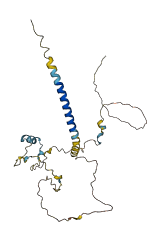
1 structures for Q9D7R2
| Entry ID | Method | Resolution | Chain | Position | Source |
|---|---|---|---|---|---|
| AF-Q9D7R2-F1 | Predicted | AlphaFoldDB |
No variants for Q9D7R2
| Variant ID(s) | Position | Change | Description | Diseaes Association | Provenance |
|---|---|---|---|---|---|
| No variants for Q9D7R2 | |||||
No associated diseases with Q9D7R2
No regional properties for Q9D7R2
| Type | Name | Position | InterPro Accession |
|---|---|---|---|
| No domain, repeats, and functional sites for Q9D7R2 | |||
5 GO annotations of cellular component
| Name | Definition |
|---|---|
| early endosome membrane | The lipid bilayer surrounding an early endosome. |
| endosome membrane | The lipid bilayer surrounding an endosome. |
| Golgi membrane | The lipid bilayer surrounding any of the compartments of the Golgi apparatus. |
| integral component of membrane | The component of a membrane consisting of the gene products and protein complexes having at least some part of their peptide sequence embedded in the hydrophobic region of the membrane. |
| intracellular membrane-bounded organelle | Organized structure of distinctive morphology and function, bounded by a single or double lipid bilayer membrane and occurring within the cell. Includes the nucleus, mitochondria, plastids, vacuoles, and vesicles. Excludes the plasma membrane. |
2 GO annotations of molecular function
| Name | Definition |
|---|---|
| R-SMAD binding | Binding to a receptor-regulated SMAD signaling protein. |
| WW domain binding | Binding to a WW domain of a protein, a small module composed of 40 amino acids and plays a role in mediating protein-protein interactions via proline-rich regions. |
3 GO annotations of biological process
| Name | Definition |
|---|---|
| negative regulation of pathway-restricted SMAD protein phosphorylation | Any process that decreases the rate, frequency or extent of pathway-restricted SMAD protein phosphorylation. Pathway-restricted SMAD proteins and common-partner SMAD proteins are involved in the transforming growth factor beta receptor signaling pathways. |
| negative regulation of SMAD protein complex assembly | Any process that decreases the rate, frequency, or extent of SMAD protein complex assembly. SMAD protein complex assembly is the aggregation, arrangement and bonding together of a set of components to form a protein complex that contains SMAD proteins. |
| negative regulation of transforming growth factor beta receptor signaling pathway | Any process that stops, prevents, or reduces the frequency, rate or extent of any TGF-beta receptor signaling pathway. |
1 homologous proteins in AiPD
| UniProt AC | Gene Name | Protein Name | Species | Evidence Code |
|---|---|---|---|---|
| Q969W9 | PMEPA1 | Protein TMEPAI | Homo sapiens (Human) | PR |
| 10 | 20 | 30 | 40 | 50 | 60 |
| MSPARATAQR | SLFPSMEITE | LEFVQIVVIV | VVMMVMVVMI | TCLLSHYKLS | ARSFISRHSQ |
| 70 | 80 | 90 | 100 | 110 | 120 |
| ARRRDDGLSS | EGCLWPSEST | VSGGMPEPQV | YAPPRPTDRL | AVPPFIQRSR | FQPTYPYLQH |
| 130 | 140 | 150 | 160 | 170 | 180 |
| EIALPPTISL | SDGEEPPPYQ | GPCTLQLRDP | EQQLELNRES | VRAPPNRTIF | DSDLIDSTML |
| 190 | 200 | 210 | 220 | 230 | 240 |
| GGPCPPSSNS | GISATCYSSG | GRMEGPPPTY | SEVIGHYPGS | SFQHQQSNGP | SSLLEGTRLH |
| 250 | |||||
| HSHIAPLENK | EKEKQKGHPL |