Q9D5Y1
Gene name |
Ccdc39 |
Protein name |
Coiled-coil domain-containing protein 39 |
Names |
|
Species |
Mus musculus (Mouse) |
KEGG Pathway |
mmu:51938 |
EC number |
|
Protein Class |
|
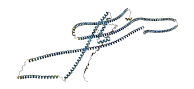
Descriptions
The autoinhibited protein was predicted that may have potential autoinhibitory elements via cis-regPred.
Autoinhibitory domains (AIDs)
Target domain |
|
Relief mechanism |
|
Assay |
cis-regPred |
Accessory elements
No accessory elements
Autoinhibited structure

Activated structure
1 structures for Q9D5Y1
| Entry ID | Method | Resolution | Chain | Position | Source |
|---|---|---|---|---|---|
| AF-Q9D5Y1-F1 | Predicted | AlphaFoldDB |
54 variants for Q9D5Y1
| Variant ID(s) | Position | Change | Description | Diseaes Association | Provenance |
|---|---|---|---|---|---|
| rs3388628053 | 13 | D>V | No | EVA | |
| rs230759403 | 32 | A>S | No | EVA | |
| rs3388629557 | 60 | K>* | No | EVA | |
| rs3388626875 | 70 | Q>H | No | EVA | |
| rs3388624752 | 78 | S>N | No | EVA | |
| rs3388626873 | 85 | H>D | No | EVA | |
| rs3388622962 | 109 | A>E | No | EVA | |
| rs234852753 | 125 | T>A | No | EVA | |
| rs36268004 | 131 | D>G | No | EVA | |
| rs3388623460 | 152 | H>Y | No | EVA | |
| rs3388627393 | 155 | S>G | No | EVA | |
| rs3388628110 | 159 | T>I | No | EVA | |
| rs214518779 | 185 | Y>C | No | EVA | |
| rs3388629515 | 198 | E>* | No | EVA | |
| rs3388626876 | 227 | W>* | No | EVA | |
| rs259816849 | 282 | K>R | No | EVA | |
| rs3388628895 | 320 | R>I | No | EVA | |
| rs3388624750 | 335 | V>I | No | EVA | |
| rs1132102514 | 336 | K>N | No | EVA | |
| rs230633387 | 392 | E>D | No | EVA | |
| rs3388627064 | 417 | K>E | No | EVA | |
| rs3388615388 | 454 | Q>* | No | EVA | |
| rs3392691178 | 464 | R>* | No | EVA | |
| rs3392846749 | 466 | S>* | No | EVA | |
| rs39108852 | 479 | A>T | No | EVA | |
| rs3388623488 | 495 | K>* | No | EVA | |
| rs3388628104 | 498 | L>F | No | EVA | |
| rs3388624870 | 507 | K>* | No | EVA | |
| rs3388627405 | 516 | K>N | No | EVA | |
| rs3388628098 | 532 | K>I | No | EVA | |
| rs3388616979 | 545 | K>M | No | EVA | |
| rs3388629518 | 549 | K>R | No | EVA | |
| rs261827043 | 617 | V>I | No | EVA | |
| rs220078657 | 622 | K>Q | No | EVA | |
| rs251425356 | 623 | T>N | No | EVA | |
| rs36993548 | 624 | M>I | No | EVA | |
| rs3388624885 | 697 | N>D | No | EVA | |
| rs3388627431 | 697 | N>K | No | EVA | |
| rs3388628075 | 700 | Q>R | No | EVA | |
| rs37370015 | 705 | C>S | No | EVA | |
| rs3388621460 | 735 | T>S | No | EVA | |
| rs3388609331 | 740 | Y>N | No | EVA | |
| rs254303753 | 742 | C>F | No | EVA | |
| rs3388628105 | 783 | F>S | No | EVA | |
| rs3388628123 | 784 | Q>L | No | EVA | |
| rs3388628835 | 791 | E>D | No | EVA | |
| rs3388626879 | 812 | I>S | No | EVA | |
| rs3388620022 | 823 | E>K | No | EVA | |
| rs250255992 | 853 | A>G | No | EVA | |
| rs3388609362 | 874 | S>L | No | EVA | |
| rs229946019 | 886 | F>L | No | EVA | |
| rs263064025 | 894 | L>P | No | EVA | |
| rs3388615419 | 909 | E>K | No | EVA | |
| rs251000656 | 915 | N>S | No | EVA |
No associated diseases with Q9D5Y1
No regional properties for Q9D5Y1
| Type | Name | Position | InterPro Accession |
|---|---|---|---|
| No domain, repeats, and functional sites for Q9D5Y1 | |||
5 GO annotations of cellular component
| Name | Definition |
|---|---|
| 9+2 motile cilium | A motile cilium where the axoneme has a ring of nine outer microtubule doublets plus two central microtubules (and is therefore called a 9+2 axoneme). |
| axoneme | The bundle of microtubules and associated proteins that forms the core of cilia (also called flagella) in eukaryotic cells and is responsible for their movements. |
| cilium | A specialized eukaryotic organelle that consists of a filiform extrusion of the cell surface and of some cytoplasmic parts. Each cilium is largely bounded by an extrusion of the cytoplasmic (plasma) membrane, and contains a regular longitudinal array of microtubules, anchored to a basal body. |
| cytosol | The part of the cytoplasm that does not contain organelles but which does contain other particulate matter, such as protein complexes. |
| extracellular region | The space external to the outermost structure of a cell. For cells without external protective or external encapsulating structures this refers to space outside of the plasma membrane. This term covers the host cell environment outside an intracellular parasite. |
No GO annotations of molecular function
| Name | Definition |
|---|---|
| No GO annotations for molecular function |
21 GO annotations of biological process
| Name | Definition |
|---|---|
| axonemal dynein complex assembly | The aggregation, arrangement and bonding together of a set of components to form an axonemal dynein complex, a dynein complex found in eukaryotic cilia and flagella, in which the motor domain heads interact with adjacent microtubules to generate a sliding force which is converted to a bending motion. |
| brain development | The process whose specific outcome is the progression of the brain over time, from its formation to the mature structure. Brain development begins with patterning events in the neural tube and ends with the mature structure that is the center of thought and emotion. The brain is responsible for the coordination and control of bodily activities and the interpretation of information from the senses (sight, hearing, smell, etc.). |
| cerebrospinal fluid circulation | The neurological system process driven by motile cilia on ependymal cells of the brain by which cerebrospinal fluid circulates from the sites of secretion to the sites of absorption. In ventricular cavities, the flow is unidirectional and rostrocaudal, in subarachnoid spaces, the flow is multi-directional. |
| cilium movement | The directed, self-propelled movement of a cilium. |
| cilium-dependent cell motility | Cell motility due to the motion of one or more eukaryotic cilia. A eukaryotic cilium is a specialized organelle that consists of a filiform extrusion of the cell surface. Each cilium is bounded by an extrusion of the cytoplasmic (plasma) membrane, and contains a regular longitudinal array of microtubules, anchored basally in a centriole. |
| determination of digestive tract left/right asymmetry | Determination of the asymmetric location of various parts of the digestive tract with respect to the left and right halves of the organism. The digestive tract is the anatomical structure through which food passes and is processed. |
| determination of left/right symmetry | The establishment of an organism's body plan or part of an organism with respect to the left and right halves. The pattern can either be symmetric, such that the halves are mirror images, or asymmetric where the pattern deviates from this symmetry. |
| determination of liver left/right asymmetry | Determination of the asymmetric location of the liver with respect to the left and right halves of the organism. |
| determination of pancreatic left/right asymmetry | Determination of the asymmetric location of the pancreas with respect to the left and right halves of the organism. |
| epithelial cilium movement involved in determination of left/right asymmetry | The movement of cilia of epithelial cells of the Left Right Organizer (LRO), also referred to as the node in mouse or the Kupffer's vesicle in zebrafish, resulting in the leftward fluid flow across the LRO and generation or transport of a signal which determines asymmetry in an organism's body plan with respect to the left and right halves. |
| epithelial cilium movement involved in extracellular fluid movement | The directed, self-propelled movement of cilia of epithelial cells. Depending on the type of cell, there may be one or many cilia per cell. This movement is usually coordinated between many epithelial cells, and serves to move extracellular fluid. |
| establishment of left/right asymmetry | The initial formation of the type asymmetry in an organism's body plan or part of an organism with respect to the left and right halves. |
| establishment of localization in cell | Any process, occuring in a cell, that localizes a substance or cellular component. This may occur via movement, tethering or selective degradation. |
| flagellated sperm motility | The directed, self-propelled movement of a cilium (aka flagellum) that contributes to the movement of a flagellated sperm. |
| heart development | The process whose specific outcome is the progression of the heart over time, from its formation to the mature structure. The heart is a hollow, muscular organ, which, by contracting rhythmically, keeps up the circulation of the blood. |
| heart looping | The tube morphogenesis process in which the primitive heart tube loops asymmetrically. This looping brings the primitive heart chambers into alignment preceding their future integration. Heart looping begins with dextral-looping and ends when the main regional divisions of the mature heart and primordium of the great arterial trunks become established preceeding septation. |
| inner dynein arm assembly | The aggregation, arrangement and bonding together of a set of components to form an axonemal dynein inner arm, an inner arm structure present on the outer doublet microtubules of ciliary and flagellar axonemes. |
| lung development | The process whose specific outcome is the progression of the lung over time, from its formation to the mature structure. In all air-breathing vertebrates the lungs are developed from the ventral wall of the oesophagus as a pouch which divides into two sacs. In amphibians and many reptiles the lungs retain very nearly this primitive sac-like character, but in the higher forms the connection with the esophagus becomes elongated into the windpipe and the inner walls of the sacs become more and more divided, until, in the mammals, the air spaces become minutely divided into tubes ending in small air cells, in the walls of which the blood circulates in a fine network of capillaries. In mammals the lungs are more or less divided into lobes, and each lung occupies a separate cavity in the thorax. |
| motile cilium assembly | The aggregation, arrangement and bonding together of a set of components to form a motile cilium. |
| protein localization to cilium | A process in which a protein is transported to, or maintained in, a location within a cilium. |
| regulation of cilium beat frequency | Any process that modulates the frequency of cilium movement, the directed, self-propelled movement of a cilium. |
No homologous proteins in AiPD
| UniProt AC | Gene Name | Protein Name | Species | Evidence Code |
|---|---|---|---|---|
| No homologous proteins | ||||
| 10 | 20 | 30 | 40 | 50 | 60 |
| MCSEFLSELH | WEDGFAIPVA | NQENKILEDQ | LAKLREEKSN | LQDQLHDYEE | RINSMTSHLK |
| 70 | 80 | 90 | 100 | 110 | 120 |
| NVNQEFLFTQ | SLYKARESEI | ESEEHFKAIA | ERELGRVKNE | TQLLEKEMAI | IRERKSQMEN |
| 130 | 140 | 150 | 160 | 170 | 180 |
| NIFKTTQKLD | DLKCQMNWDQ | QALEAWLEES | AHKDSDSLTL | QKYSQQDDNK | IRALTLQLEK |
| 190 | 200 | 210 | 220 | 230 | 240 |
| LTMEYNEKRK | LLDSELTETL | SAQLELDKAA | QDFRKIHLER | QELIQQWENT | IEQMQRRDQE |
| 250 | 260 | 270 | 280 | 290 | 300 |
| IDNCALALSR | IKQEAREKEG | VVKEKIKFLE | NEVENNIEYE | RKISVAERKV | SKCRMDYQRH |
| 310 | 320 | 330 | 340 | 350 | 360 |
| EGNRSQLKDE | LDTLKTTLNR | TSSDLQALRK | NISKVKKDIF | DETLRLQKLK | HHNEVVKHKL |
| 370 | 380 | 390 | 400 | 410 | 420 |
| KMITEKTLSI | EEKATNMEDM | LKEEEKGLKE | VEVQLGIVKD | VLFKKVQELQ | NEIAKEKALV |
| 430 | 440 | 450 | 460 | 470 | 480 |
| SEIEGTRSSL | KHLNKQLHKL | DFETLKQQEI | MYSQDFYIQQ | VERRMSRLKG | EINSEEKQAL |
| 490 | 500 | 510 | 520 | 530 | 540 |
| EAKILELKKT | MDEKKSTLSL | LESQIKKLHN | DLYFIKKSNG | KNNDEKESLM | NKISELNLFI |
| 550 | 560 | 570 | 580 | 590 | 600 |
| DRSEKELSKA | KAVKEDMMIE | DNLLKLQVKR | ARELLYSKAE | EVLSLEKRKQ | QLGKDMEERA |
| 610 | 620 | 630 | 640 | 650 | 660 |
| EEIKVHKAML | TSQIRCVEQQ | RKTMSSEFHE | RLSKIDKLKN | RYEILTVVML | PPEGEEEKTQ |
| 670 | 680 | 690 | 700 | 710 | 720 |
| SYYVIKAAQE | KEELQREGDS | LDAKINKAEK | EIYALQNTLQ | VLNSCNSNYK | QSFKKVTPSS |
| 730 | 740 | 750 | 760 | 770 | 780 |
| DEYALKIQLE | EQKRTADERY | RCKQRQIREL | QEDIQSMENT | FEVIGHLANN | AKEKLTEKQT |
| 790 | 800 | 810 | 820 | 830 | 840 |
| LAFQLRKETE | EQKPKLQRIT | KQCGRLRREI | RILKQTDNET | LEEQDIQLRE | IIQFHKDIDQ |
| 850 | 860 | 870 | 880 | 890 | 900 |
| MLVNAMENAE | IHAIFKTYFE | QNGLELPTAR | GPSSRSSSQS | SSLSSFRSLE | DVTLQSPPTA |
| 910 | 920 | 930 | |||
| KVIQLRFPEP | PPATNDSSRS | ASSGSNSNIP | KEKKLSK |