Q9D424
Gene name |
Cabyr (Cbp86) |
Protein name |
Calcium-binding tyrosine phosphorylation-regulated protein |
Names |
Calcium-binding protein 86, Testis-specific calcium-binding protein CBP86 |
Species |
Mus musculus (Mouse) |
KEGG Pathway |
mmu:71132 |
EC number |
|
Protein Class |
|
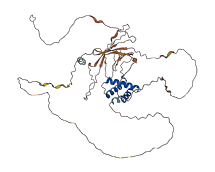
Descriptions
The autoinhibited protein was predicted that may have potential autoinhibitory elements via cis-regPred.
Autoinhibitory domains (AIDs)
Target domain |
|
Relief mechanism |
|
Assay |
cis-regPred |
Accessory elements
No accessory elements
Autoinhibited structure

Activated structure
1 structures for Q9D424
| Entry ID | Method | Resolution | Chain | Position | Source |
|---|---|---|---|---|---|
| AF-Q9D424-F1 | Predicted | AlphaFoldDB |
17 variants for Q9D424
| Variant ID(s) | Position | Change | Description | Diseaes Association | Provenance |
|---|---|---|---|---|---|
| rs3389496934 | 3 | S>P | No | EVA | |
| rs3389504267 | 8 | L>F | No | EVA | |
| rs229865463 | 9 | V>L | No | EVA | |
| rs3408291504 | 17 | L>Q | No | EVA | |
| rs3389479559 | 35 | Q>* | No | EVA | |
| rs46039101 | 83 | I>L | No | EVA | |
| rs3389482247 | 85 | E>* | No | EVA | |
| rs3389482247 | 85 | E>Q | No | EVA | |
| rs3389492194 | 90 | P>L | No | EVA | |
| rs3389490182 | 181 | M>L | No | EVA | |
| rs3389488651 | 183 | G>D | No | EVA | |
| rs3389479557 | 208 | V>L | No | EVA | |
| rs51366378 | 209 | L>M | No | EVA | |
| rs248014237 | 257 | S>L | No | EVA | |
| rs29560555 | 287 | N>K | No | EVA | |
| rs221844501 | 352 | S>P | No | EVA | |
| rs1133780446 | 410 | D>Y | No | EVA |
No associated diseases with Q9D424
Functions
8 GO annotations of cellular component
| Name | Definition |
|---|---|
| cytoplasm | The contents of a cell excluding the plasma membrane and nucleus, but including other subcellular structures. |
| cytoskeleton | A cellular structure that forms the internal framework of eukaryotic and prokaryotic cells. The cytoskeleton includes intermediate filaments, microfilaments, microtubules, the microtrabecular lattice, and other structures characterized by a polymeric filamentous nature and long-range order within the cell. The various elements of the cytoskeleton not only serve in the maintenance of cellular shape but also have roles in other cellular functions, including cellular movement, cell division, endocytosis, and movement of organelles. |
| cytosol | The part of the cytoplasm that does not contain organelles but which does contain other particulate matter, such as protein complexes. |
| motile cilium | A cilium which may have a variable arrangement of axonemal microtubules and also contains molecular motors. It may beat with a whip-like pattern that promotes cell motility or transport of fluids and other cells across a cell surface, such as on epithelial cells that line the lumenal ducts of various tissues; or they may display a distinct twirling motion that directs fluid flow asymmetrically across the cellular surface to affect asymmetric body plan organization. Motile cilia can be found in single as well as multiple copies per cell. |
| nucleoplasm | That part of the nuclear content other than the chromosomes or the nucleolus. |
| sperm end piece | The short tip of the sperm flagellum, adjacent to the sperm principal piece and furthest from the sperm head, which contains only the axoneme surrounded by the plasma membrane. |
| sperm fibrous sheath | A cytoskeletal structure surrounding the axoneme and outer dense fibers of the sperm flagellum. Consists of two longitudinal columns connected by closely arrayed semicircular ribs that assemble from distal to proximal throughout spermiogenesis. The fibrous sheath probably influences the degree of flexibility, plane of flagellar motion, and the shape of the flagellar beat. |
| sperm principal piece | The segment of the sperm flagellum where the mitochondrial sheath ends, and the outer dense fibers (ODFs) associated with outer axonemal doublets 3 and 8 are replaced by the 2 longitudinal columns of the fibrous sheath (FS) which run the length of the principal piece and are stabilized by circumferential ribs. The principal piece makes up ~2/3 of the length of the sperm flagellum and is defined by the presence of the FS and of only 7 (rather than 9) ODFs which taper and then terminate near the distal end of the principal piece. |
3 GO annotations of molecular function
| Name | Definition |
|---|---|
| calcium ion binding | Binding to a calcium ion (Ca2+). |
| enzyme binding | Binding to an enzyme, a protein with catalytic activity. |
| protein domain specific binding | Binding to a specific domain of a protein. |
2 GO annotations of biological process
| Name | Definition |
|---|---|
| calcium-mediated signaling | Any intracellular signal transduction in which the signal is passed on within the cell via calcium ions. |
| sperm capacitation | A process required for sperm to reach fertilization competence. Sperm undergo an incompletely understood series of morphological and molecular maturational processes, termed capacitation, involving, among other processes, protein tyrosine phosphorylation and increased intracellular calcium. |
No homologous proteins in AiPD
| UniProt AC | Gene Name | Protein Name | Species | Evidence Code |
|---|---|---|---|---|
| No homologous proteins | ||||
| 10 | 20 | 30 | 40 | 50 | 60 |
| MISSKPRLVV | PYGLKTLLEG | VSRAILKTNP | TNITQFAAVY | FKELIVFREG | NSSLDIKDLI |
| 70 | 80 | 90 | 100 | 110 | 120 |
| KQFHQMKVEK | WAEGVTVEKK | ECIKEPIKPP | PVPCKPTHME | KSTDTEEDNV | AGPLFSNKTT |
| 130 | 140 | 150 | 160 | 170 | 180 |
| QFPSVHAEVQ | SEETSEGARG | PSDKPTTPKT | DYTPPSSPPP | APVSAEYAYV | PADPAQFAAQ |
| 190 | 200 | 210 | 220 | 230 | 240 |
| MLGNVPSTYS | EVLMVDVATS | TPAVPQDVLS | AEFAEEVVLS | APLVCSGETV | EVQVVSKTSA |
| 250 | 260 | 270 | 280 | 290 | 300 |
| QVVVGPVSEA | EPPKASSAPL | QGEQEPPAHE | APDTQVTSAS | RISSIYNDVP | VNEGVVYVEE |
| 310 | 320 | 330 | 340 | 350 | 360 |
| IPGYIVIPFT | DHDQVACVKE | IEQSPPGSPK | AVEPKTKISI | ESLKTVQVEE | NSQHKSSVHV |
| 370 | 380 | 390 | 400 | 410 | 420 |
| EAEATVLLSN | TALDGQPEVP | AEPLDAEGFF | KVASENSLHL | ETEIVIINPD | DPGQEESGGN |
| 430 | 440 | 450 | |||
| AAPHSSGDPF | PPAPGGLTEP | EMQPDGEAAP | EQV |