Q9D1F4
Gene name |
Akt1s1 |
Protein name |
Proline-rich AKT1 substrate 1 |
Names |
Proline-rich AKT substrate |
Species |
Mus musculus (Mouse) |
KEGG Pathway |
mmu:67605 |
EC number |
|
Protein Class |
|
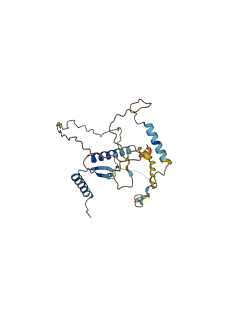
Descriptions
The autoinhibited protein was predicted that may have potential autoinhibitory elements via cis-regPred.
Autoinhibitory domains (AIDs)
Target domain |
|
Relief mechanism |
|
Assay |
cis-regPred |
Accessory elements
No accessory elements
Autoinhibited structure

Activated structure
1 structures for Q9D1F4
| Entry ID | Method | Resolution | Chain | Position | Source |
|---|---|---|---|---|---|
| AF-Q9D1F4-F1 | Predicted | AlphaFoldDB |
30 variants for Q9D1F4
| Variant ID(s) | Position | Change | Description | Diseaes Association | Provenance |
|---|---|---|---|---|---|
| rs13459520 | 21 | Q>R | No | EVA | |
| rs1134513355 | 31 | L>Q | No | EVA | |
| rs1133842859 | 36 | P>S | No | EVA | |
| rs1132713565 | 39 | P>L | No | EVA | |
| rs1132083323 | 51 | R>H | No | EVA | |
| rs1134410385 | 72 | A>V | No | EVA | |
| rs1131921881 | 78 | P>L | No | EVA | |
| rs3388886963 | 119 | E>K | No | EVA | |
| rs3388903520 | 139 | Q>K | No | EVA | |
| rs243516165 | 166 | T>P | No | EVA | |
| rs1133150937 | 173 | A>T | No | EVA | |
| rs1133207189 | 175 | A>V | No | EVA | |
| rs1132758061 | 186 | P>L | No | EVA | |
| rs1132090393 | 188 | S>L | No | EVA | |
| rs1133028298 | 190 | P>S | No | EVA | |
| rs1131894961 | 192 | W>* | No | EVA | |
| rs1131969650 | 201 | A>V | No | EVA | |
| rs3397707599 | 202 | R>L | No | EVA | |
| rs3397871534 | 204 | S>A | No | EVA | |
| rs1133159972 | 207 | E>K | No | EVA | |
| rs1133983533 | 209 | G>S | No | EVA | |
| rs3397443920 | 220 | A>V | No | EVA | |
| rs1133044993 | 225 | A>T | No | EVA | |
| rs1135257158 | 229 | R>L | No | EVA | |
| rs1135286791 | 231 | A>D | No | EVA | |
| rs1134998077 | 232 | E>G | No | EVA | |
| rs1131898033 | 242 | R>Q | No | EVA | |
| rs1134658032 | 243 | P>S | No | EVA | |
| rs1133566228 | 246 | N>S | No | EVA | |
| rs1132708143 | 253 | L>Q | No | EVA |
No associated diseases with Q9D1F4
1 regional properties for Q9D1F4
| Type | Name | Position | InterPro Accession |
|---|---|---|---|
| domain | GPCR, rhodopsin-like, 7TM | 53 - 400 | IPR017452 |
Functions
5 GO annotations of cellular component
| Name | Definition |
|---|---|
| cytoplasm | The contents of a cell excluding the plasma membrane and nucleus, but including other subcellular structures. |
| cytosol | The part of the cytoplasm that does not contain organelles but which does contain other particulate matter, such as protein complexes. |
| nucleus | A membrane-bounded organelle of eukaryotic cells in which chromosomes are housed and replicated. In most cells, the nucleus contains all of the cell's chromosomes except the organellar chromosomes, and is the site of RNA synthesis and processing. In some species, or in specialized cell types, RNA metabolism or DNA replication may be absent. |
| protein-containing complex | A stable assembly of two or more macromolecules, i.e. proteins, nucleic acids, carbohydrates or lipids, in which at least one component is a protein and the constituent parts function together. |
| TORC1 complex | A protein complex that contains at least TOR (target of rapamycin) and Raptor (regulatory-associated protein of TOR), or orthologs of, in complex with other signaling components. Mediates the phosphorylation and activation of S6K. In Saccharomyces, the complex contains Kog1p, Lst8p, Tco89p, and either Tor1p or Tor2p. |
No GO annotations of molecular function
| Name | Definition |
|---|---|
| No GO annotations for molecular function |
7 GO annotations of biological process
| Name | Definition |
|---|---|
| negative regulation of cell size | Any process that reduces cell size. |
| negative regulation of protein kinase activity | Any process that stops, prevents, or reduces the frequency, rate or extent of protein kinase activity. |
| negative regulation of TOR signaling | Any process that stops, prevents, or reduces the frequency, rate or extent of TOR signaling. |
| neurotrophin TRK receptor signaling pathway | The series of molecular signals initiated by neurotrophin binding to its receptor on the surface of a target cell where the receptor possesses tyrosine kinase activity, and ending with the regulation of a downstream cellular process, e.g. transcription. |
| Notch signaling pathway | The series of molecular signals initiated by an extracellular ligand binding to the receptor Notch on the surface of a target cell, and ending with the regulation of a downstream cellular process, e.g. transcription. |
| regulation of apoptotic process | Any process that modulates the occurrence or rate of cell death by apoptotic process. |
| regulation of neuron apoptotic process | Any process that modulates the occurrence or rate of cell death by apoptotic process in neurons. |
1 homologous proteins in AiPD
| UniProt AC | Gene Name | Protein Name | Species | Evidence Code |
|---|---|---|---|---|
| Q96B36 | AKT1S1 | Proline-rich AKT1 substrate 1 | Homo sapiens (Human) | PR |
| 10 | 20 | 30 | 40 | 50 | 60 |
| MASGRPEELW | EAVVGAAERF | QARTGTELVL | LTAAPPPPPR | PGPCAYAAHG | RGALAEAARR |
| 70 | 80 | 90 | 100 | 110 | 120 |
| CLHDIAQAHR | AATATRPPGP | PPAPQPPSPA | PSPPPRPALA | REDEEEDEDE | PTETETSGER |
| 130 | 140 | 150 | 160 | 170 | 180 |
| LGGSDNGGLF | MMDEDATLQD | LPPFCESDPE | STDDGSLSEE | TPAGPTACPQ | PPATALPTQQ |
| 190 | 200 | 210 | 220 | 230 | 240 |
| YAKSLPVSVP | VWAFKEKRTE | ARSSDEENGP | PSSPDLDRIA | ASMRALVLRE | AEDTQVFGDL |
| 250 | |||||
| PRPRLNTSDF | QKLKRKY |