Q9CWT2
Gene name |
Bex4 |
Protein name |
Protein BEX4 |
Names |
Brain-expressed X-linked protein 4 |
Species |
Mus musculus (Mouse) |
KEGG Pathway |
mmu:406217 |
EC number |
|
Protein Class |
|
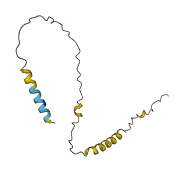
Descriptions
The autoinhibited protein was predicted that may have potential autoinhibitory elements via cis-regPred.
Autoinhibitory domains (AIDs)
Target domain |
|
Relief mechanism |
|
Assay |
cis-regPred |
Accessory elements
No accessory elements
Autoinhibited structure

Activated structure
1 structures for Q9CWT2
| Entry ID | Method | Resolution | Chain | Position | Source |
|---|---|---|---|---|---|
| AF-Q9CWT2-F1 | Predicted | AlphaFoldDB |
7 variants for Q9CWT2
| Variant ID(s) | Position | Change | Description | Diseaes Association | Provenance |
|---|---|---|---|---|---|
| rs3412224536 | 3 | S>Y | No | EVA | |
| rs3389575391 | 63 | A>V | No | EVA | |
| rs584720718 | 75 | G>A | No | EVA | |
| rs3412093325 | 92 | T>A | No | EVA | |
| rs578709525 | 93 | T>K | No | EVA | |
| rs581114443 | 100 | Y>S | No | EVA | |
| rs3389574214 | 118 | P>S | No | EVA |
No associated diseases with Q9CWT2
No regional properties for Q9CWT2
| Type | Name | Position | InterPro Accession |
|---|---|---|---|
| No domain, repeats, and functional sites for Q9CWT2 | |||
6 GO annotations of cellular component
| Name | Definition |
|---|---|
| cytoplasm | The contents of a cell excluding the plasma membrane and nucleus, but including other subcellular structures. |
| cytosol | The part of the cytoplasm that does not contain organelles but which does contain other particulate matter, such as protein complexes. |
| microtubule | Any of the long, generally straight, hollow tubes of internal diameter 12-15 nm and external diameter 24 nm found in a wide variety of eukaryotic cells; each consists (usually) of 13 protofilaments of polymeric tubulin, staggered in such a manner that the tubulin monomers are arranged in a helical pattern on the microtubular surface, and with the alpha/beta axes of the tubulin subunits parallel to the long axis of the tubule; exist in equilibrium with pool of tubulin monomers and can be rapidly assembled or disassembled in response to physiological stimuli; concerned with force generation, e.g. in the spindle. |
| nucleoplasm | That part of the nuclear content other than the chromosomes or the nucleolus. |
| nucleus | A membrane-bounded organelle of eukaryotic cells in which chromosomes are housed and replicated. In most cells, the nucleus contains all of the cell's chromosomes except the organellar chromosomes, and is the site of RNA synthesis and processing. In some species, or in specialized cell types, RNA metabolism or DNA replication may be absent. |
| spindle pole | Either of the ends of a spindle, where spindle microtubules are organized; usually contains a microtubule organizing center and accessory molecules, spindle microtubules and astral microtubules. |
2 GO annotations of molecular function
| Name | Definition |
|---|---|
| alpha-tubulin binding | Binding to the microtubule constituent protein alpha-tubulin. |
| histone deacetylase binding | Binding to histone deacetylase. |
5 GO annotations of biological process
| Name | Definition |
|---|---|
| chromosome segregation | The process in which genetic material, in the form of chromosomes, is organized into specific structures and then physically separated and apportioned to two or more sets. In eukaryotes, chromosome segregation begins with the condensation of chromosomes, includes chromosome separation, and ends when chromosomes have completed movement to the spindle poles. |
| negative regulation of tubulin deacetylation | Any process that stops, prevents or reduces the frequency, rate or extent of tubulin deacetylation. |
| regulation of cell migration | Any process that modulates the frequency, rate or extent of cell migration. |
| regulation of cell population proliferation | Any process that modulates the frequency, rate or extent of cell proliferation. |
| regulation of mitotic cell cycle | Any process that modulates the rate or extent of progress through the mitotic cell cycle. |
No homologous proteins in AiPD
| UniProt AC | Gene Name | Protein Name | Species | Evidence Code |
|---|---|---|---|---|
| No homologous proteins | ||||
| 10 | 20 | 30 | 40 | 50 | 60 |
| MASKFKQVIL | DLTVEKDKKD | KKGGKASKQS | EEEPHHLEEV | ENKKPGGNVR | RKVRRLVPNF |
| 70 | 80 | 90 | 100 | 110 | |
| LWAIPNRHVD | RNEGGEDVGR | FVVQGTEVKR | KTTEQQVRPY | RRFRTPEPDN | HYDFCLIP |