Q9CR68
Gene name |
Uqcrfs1 |
Protein name |
Cytochrome b-c1 complex subunit Rieske, mitochondrial |
Names |
Complex III subunit 5, Cytochrome b-c1 complex subunit 5, Rieske iron-sulfur protein, RISP, Rieske protein UQCRFS1, Ubiquinol-cytochrome c reductase iron-sulfur subunit |
Species |
Mus musculus (Mouse) |
KEGG Pathway |
mmu:66694 |
EC number |
7.1.1.8: Hydron translocation or charge separation linked to oxidoreductase reactions |
Protein Class |
|
Descriptions
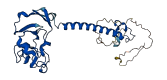
The autoinhibited protein was predicted that may have potential autoinhibitory elements via cis-regPred.
Autoinhibitory domains (AIDs)
Target domain |
|
Relief mechanism |
|
Assay |
cis-regPred |
Accessory elements
No accessory elements
Autoinhibited structure

Activated structure
1 structures for Q9CR68
| Entry ID | Method | Resolution | Chain | Position | Source |
|---|---|---|---|---|---|
| AF-Q9CR68-F1 | Predicted | AlphaFoldDB |
27 variants for Q9CR68
| Variant ID(s) | Position | Change | Description | Diseaes Association | Provenance |
|---|---|---|---|---|---|
| rs13474854 | 9 | G>R | No | EVA | |
| rs235223292 | 30 | L>V | No | EVA | |
| rs3389274301 | 92 | R>H | No | EVA | |
| rs3389274389 | 99 | S>I | No | EVA | |
| rs3389277189 | 107 | S>I | No | EVA | |
| rs3389272071 | 122 | T>S | No | EVA | |
| rs3389234348 | 128 | A>V | No | EVA | |
| rs3389268365 | 137 | V>I | No | EVA | |
| rs3389278096 | 139 | S>R | No | EVA | |
| rs3389272146 | 152 | I>* | No | EVA | |
| rs3389268314 | 153 | E>G | No | EVA | |
| rs3389268376 | 158 | D>G | No | EVA | |
| rs3404015967 | 161 | E>* | No | EVA | |
| rs3404019052 | 161 | E>A | No | EVA | |
| rs3389206216 | 170 | R>* | No | EVA | |
| rs3389272094 | 175 | F>C | No | EVA | |
| rs3389250857 | 183 | E>D | No | EVA | |
| rs3389278093 | 185 | D>V | No | EVA | |
| rs3389275312 | 189 | A>V | No | EVA | |
| rs3389250868 | 236 | C>S | No | EVA | |
| rs3389278126 | 237 | P>L | No | EVA | |
| rs3404328842 | 239 | H>Q | No | EVA | |
| rs3403577275 | 242 | H>Q | No | EVA | |
| rs3403312512 | 242 | H>Y | No | EVA | |
| rs3404193170 | 243 | Y>C | No | EVA | |
| rs3403312517 | 246 | S>T | No | EVA | |
| rs3389243547 | 275 | G>R | No | EVA |
No associated diseases with Q9CR68
Functions
| Description | ||
|---|---|---|
| EC Number | 7.1.1.8 | Hydron translocation or charge separation linked to oxidoreductase reactions |
| Subcellular Localization |
|
|
| PANTHER Family | ||
| PANTHER Subfamily | ||
| PANTHER Protein Class | ||
| PANTHER Pathway Category | No pathway information available | |
6 GO annotations of cellular component
| Name | Definition |
|---|---|
| mitochondrial inner membrane | The inner, i.e. lumen-facing, lipid bilayer of the mitochondrial envelope. It is highly folded to form cristae. |
| mitochondrial membrane | Either of the lipid bilayers that surround the mitochondrion and form the mitochondrial envelope. |
| mitochondrial respiratory chain complex III | A protein complex located in the mitochondrial inner membrane that forms part of the mitochondrial respiratory chain. Contains about 10 polypeptide subunits including four redox centers: cytochrome b/b6, cytochrome c1 and an 2Fe-2S cluster. Catalyzes the oxidation of ubiquinol by oxidized cytochrome c1. |
| mitochondrial respiratory chain complex IV | A protein complex located in the mitochondrial inner membrane that forms part of the mitochondrial respiratory chain. Contains the 13 polypeptide subunits of cytochrome c oxidase, including cytochrome a and cytochrome a3. Catalyzes the oxidation of reduced cytochrome c by dioxygen (O2). |
| mitochondrion | A semiautonomous, self replicating organelle that occurs in varying numbers, shapes, and sizes in the cytoplasm of virtually all eukaryotic cells. It is notably the site of tissue respiration. |
| myelin sheath | An electrically insulating fatty layer that surrounds the axons of many neurons. It is an outgrowth of glial cells: Schwann cells supply the myelin for peripheral neurons while oligodendrocytes supply it to those of the central nervous system. |
5 GO annotations of molecular function
| Name | Definition |
|---|---|
| 2 iron, 2 sulfur cluster binding | Binding to a 2 iron, 2 sulfur (2Fe-2S) cluster; this cluster consists of two iron atoms, with two inorganic sulfur atoms found between the irons and acting as bridging ligands. |
| metal ion binding | Binding to a metal ion. |
| oxidoreductase activity | Catalysis of an oxidation-reduction (redox) reaction, a reversible chemical reaction in which the oxidation state of an atom or atoms within a molecule is altered. One substrate acts as a hydrogen or electron donor and becomes oxidized, while the other acts as hydrogen or electron acceptor and becomes reduced. |
| protein-containing complex binding | Binding to a macromolecular complex. |
| ubiquinol-cytochrome-c reductase activity | Enables the transfer of a solute or solutes from one side of a membrane to the other according to the reaction: CoQH2 + 2 ferricytochrome c = CoQ + 2 ferrocytochrome c + 2 H+. |
6 GO annotations of biological process
| Name | Definition |
|---|---|
| cellular respiration | The enzymatic release of energy from inorganic and organic compounds (especially carbohydrates and fats) which either requires oxygen (aerobic respiration) or does not (anaerobic respiration). |
| mitochondrial electron transport, ubiquinol to cytochrome c | The transfer of electrons from ubiquinol to cytochrome c that occurs during oxidative phosphorylation, mediated by the multisubunit enzyme known as complex III. |
| respiratory electron transport chain | A process in which a series of electron carriers operate together to transfer electrons from donors such as NADH and FADH2 to any of several different terminal electron acceptors to generate a transmembrane electrochemical gradient. |
| response to antibiotic | Any process that results in a change in state or activity of a cell or an organism (in terms of movement, secretion, enzyme production, gene expression, etc.) as a result of an antibiotic stimulus. An antibiotic is a chemical substance produced by a microorganism which has the capacity to inhibit the growth of or to kill other microorganisms. |
| response to hormone | Any process that results in a change in state or activity of a cell or an organism (in terms of movement, secretion, enzyme production, gene expression, etc.) as a result of a hormone stimulus. |
| response to xenobiotic stimulus | Any process that results in a change in state or activity of a cell or an organism (in terms of movement, secretion, enzyme production, gene expression, etc.) as a result of a stimulus from a xenobiotic, a compound foreign to the organim exposed to it. It may be synthesized by another organism (like ampicilin) or it can be a synthetic chemical. |
No homologous proteins in AiPD
| UniProt AC | Gene Name | Protein Name | Species | Evidence Code |
|---|---|---|---|---|
| No homologous proteins | ||||
| 10 | 20 | 30 | 40 | 50 | 60 |
| MLSVAARSGP | FAPVLSATSR | GVAGALRPLL | QGAVPAASEP | PVLDVKRPFL | CRESLSGQAA |
| 70 | 80 | 90 | 100 | 110 | 120 |
| ARPLVATVGL | NVPASVRFSH | TDVKVPDFSD | YRRAEVLDST | KSSKESSEAR | KGFSYLVTAT |
| 130 | 140 | 150 | 160 | 170 | 180 |
| TTVGVAYAAK | NVVSQFVSSM | SASADVLAMS | KIEIKLSDIP | EGKNMAFKWR | GKPLFVRHRT |
| 190 | 200 | 210 | 220 | 230 | 240 |
| KKEIDQEAAV | EVSQLRDPQH | DLDRVKKPEW | VILIGVCTHL | GCVPIANAGD | FGGYYCPCHG |
| 250 | 260 | 270 | |||
| SHYDASGRIR | KGPAPLNLEV | PAYEFTSDDV | VVVG |