Q9CMW1
Gene name |
acsA |
Protein name |
Acetyl-coenzyme A synthetase |
Names |
AcCoA synthetase, Acs, Acetate--CoA ligase, Acyl-activating enzyme |
Species |
Pasteurella multocida (strain Pm70) |
KEGG Pathway |
pmu:PM0692 |
EC number |
6.2.1.1: Acid--thiol ligases |
Protein Class |
|
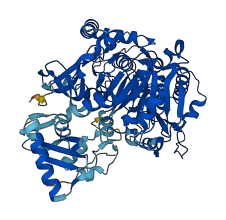
Descriptions
The autoinhibited protein was predicted that may have potential autoinhibitory elements via cis-regPred.
Autoinhibitory domains (AIDs)
Target domain |
|
Relief mechanism |
|
Assay |
cis-regPred |
Accessory elements
No accessory elements
Autoinhibited structure

Activated structure
1 structures for Q9CMW1
| Entry ID | Method | Resolution | Chain | Position | Source |
|---|---|---|---|---|---|
| AF-Q9CMW1-F1 | Predicted | AlphaFoldDB |
No variants for Q9CMW1
| Variant ID(s) | Position | Change | Description | Diseaes Association | Provenance |
|---|---|---|---|---|---|
| No variants for Q9CMW1 | |||||
No associated diseases with Q9CMW1
5 regional properties for Q9CMW1
| Type | Name | Position | InterPro Accession |
|---|---|---|---|
| domain | AMP-dependent synthetase/ligase domain | 93 - 527 | IPR000873 |
| conserved_site | Peptidase S26A, signal peptidase I, conserved site | 500 - 513 | IPR019758 |
| conserved_site | AMP-binding, conserved site | 264 - 275 | IPR020845 |
| domain | AMP-binding enzyme, C-terminal domain | 536 - 617 | IPR025110 |
| domain | Acetyl-coenzyme A synthetase, N-terminal domain | 31 - 86 | IPR032387 |
Functions
| Description | ||
|---|---|---|
| EC Number | 6.2.1.1 | Acid--thiol ligases |
| Subcellular Localization |
|
|
| PANTHER Family | ||
| PANTHER Subfamily | ||
| PANTHER Protein Class | ||
| PANTHER Pathway Category | No pathway information available | |
1 GO annotations of cellular component
| Name | Definition |
|---|---|
| integral component of membrane | The component of a membrane consisting of the gene products and protein complexes having at least some part of their peptide sequence embedded in the hydrophobic region of the membrane. |
5 GO annotations of molecular function
| Name | Definition |
|---|---|
| acetate-CoA ligase activity | Catalysis of the reaction: ATP + acetate + CoA = AMP + diphosphate + acetyl-CoA. |
| AMP binding | Binding to AMP, adenosine monophosphate. |
| ATP binding | Binding to ATP, adenosine 5'-triphosphate, a universally important coenzyme and enzyme regulator. |
| metal ion binding | Binding to a metal ion. |
| serine-type endopeptidase activity | Catalysis of the hydrolysis of internal, alpha-peptide bonds in a polypeptide chain by a catalytic mechanism that involves a catalytic triad consisting of a serine nucleophile that is activated by a proton relay involving an acidic residue (e.g. aspartate or glutamate) and a basic residue (usually histidine). |
1 GO annotations of biological process
| Name | Definition |
|---|---|
| acetyl-CoA biosynthetic process from acetate | The chemical reactions and pathways resulting in the formation of acetyl-CoA from acetate, either directly or via acetylphosphate. |
No homologous proteins in AiPD
| UniProt AC | Gene Name | Protein Name | Species | Evidence Code |
|---|---|---|---|---|
| No homologous proteins | ||||
| 10 | 20 | 30 | 40 | 50 | 60 |
| MPHNSMLKEN | RLFKPTDEFR | RQANISGLET | YQALWEFADK | DYLTYWSDLA | RELITWKKPF |
| 70 | 80 | 90 | 100 | 110 | 120 |
| MHIFDDSEAP | FYKWFSDGTL | NVSYNCLDRH | LPDKADKTAL | IFESDFGQVQ | LYTYAKLHNR |
| 130 | 140 | 150 | 160 | 170 | 180 |
| VCRFANALRE | LGIKKGDRVI | IYLPMLVEAV | IAMQACARIG | AVHSVVFGGF | SASALRDRIE |
| 190 | 200 | 210 | 220 | 230 | 240 |
| DAEAKLVITA | NAGLRGGKII | PLKETVDEAL | EMGCKTIENV | IVFHRVNIDT | PWKKGRDLWW |
| 250 | 260 | 270 | 280 | 290 | 300 |
| NELTANQPAF | CEPEWMNAED | PLFILYTSGS | TGKPKGIVHS | TGGYLLGALN | SFRNVFDNKP |
| 310 | 320 | 330 | 340 | 350 | 360 |
| NDIFWCTADV | GWITGHSYVC | YGPLANGATQ | VIFEGVPTYP | DPGRIWRMIQ | RHKINVFYTS |
| 370 | 380 | 390 | 400 | 410 | 420 |
| PTLIRSLTRL | GDHIPNKYDL | SSLRLLGSVG | EPINPSAWMW | FYEVVGKSRC | PIVDTWWQTE |
| 430 | 440 | 450 | 460 | 470 | 480 |
| TGSIMLAPIP | GVTATKPGSC | TLPLPGIMAE | VLDENGQKCA | VEQGGALAIK | RPFPSMLRTI |
| 490 | 500 | 510 | 520 | 530 | 540 |
| WNDPERYKST | YFPAEYGGKY | YIAGDNAHRD | KDGYFWILGR | TDDVLNVSGH | RLGTMEIESA |
| 550 | 560 | 570 | 580 | 590 | 600 |
| LVASPKVAEA | AVVGKPDEIK | GEAIVAFVVL | NDFRPEGEEA | RQLAEELKAW | VSNEIGKIAR |
| 610 | 620 | 630 | 640 | 650 | |
| PEDIRFADNL | PKTRSGKIMR | RLLRSIAKNE | MITQDISTLE | NPQIIGQLQQ | QWL |