Q9CMF4
Gene name |
nagB |
Protein name |
Glucosamine-6-phosphate deaminase |
Names |
GlcN6P deaminase, GNPDA, Glucosamine-6-phosphate isomerase |
Species |
Pasteurella multocida (strain Pm70) |
KEGG Pathway |
pmu:PM0875 |
EC number |
3.5.99.6: In other compounds |
Protein Class |
|
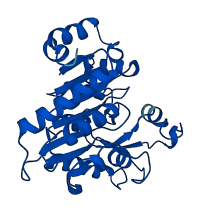
Descriptions
The autoinhibited protein was predicted that may have potential autoinhibitory elements via cis-regPred.
Autoinhibitory domains (AIDs)
Target domain |
|
Relief mechanism |
|
Assay |
cis-regPred |
Accessory elements
No accessory elements
Autoinhibited structure

Activated structure
2 structures for Q9CMF4
| Entry ID | Method | Resolution | Chain | Position | Source |
|---|---|---|---|---|---|
| 7LQM | X-ray | 230 A | A/B/C/D | 1-267 | PDB |
| AF-Q9CMF4-F1 | Predicted | AlphaFoldDB |
No variants for Q9CMF4
| Variant ID(s) | Position | Change | Description | Diseaes Association | Provenance |
|---|---|---|---|---|---|
| No variants for Q9CMF4 | |||||
No associated diseases with Q9CMF4
No regional properties for Q9CMF4
| Type | Name | Position | InterPro Accession |
|---|---|---|---|
| No domain, repeats, and functional sites for Q9CMF4 | |||
Functions
| Description | ||
|---|---|---|
| EC Number | 3.5.99.6 | In other compounds |
| Subcellular Localization |
|
|
| PANTHER Family | ||
| PANTHER Subfamily | ||
| PANTHER Protein Class | ||
| PANTHER Pathway Category | No pathway information available | |
1 GO annotations of cellular component
| Name | Definition |
|---|---|
| cytoplasm | The contents of a cell excluding the plasma membrane and nucleus, but including other subcellular structures. |
1 GO annotations of molecular function
| Name | Definition |
|---|---|
| glucosamine-6-phosphate deaminase activity | Catalysis of the reaction: D-glucosamine 6-phosphate + H(2)O = beta-D-fructose 6-phosphate + NH(4)(+). |
3 GO annotations of biological process
| Name | Definition |
|---|---|
| carbohydrate metabolic process | The chemical reactions and pathways involving carbohydrates, any of a group of organic compounds based of the general formula Cx(H2O)y. |
| N-acetylglucosamine metabolic process | The chemical reactions and pathways involving N-acetylglucosamine. The D isomer is a common structural unit of glycoproteins in plants, bacteria and animals; it is often the terminal sugar of an oligosaccharide group of a glycoprotein. |
| N-acetylneuraminate catabolic process | The chemical reactions and pathways resulting in the breakdown of N-acetylneuraminate, the anion of 5-(acetylamino)-3,5-dideoxy-D-glycero-D-galacto-non-3-ulosonic acid. |
No homologous proteins in AiPD
| UniProt AC | Gene Name | Protein Name | Species | Evidence Code |
|---|---|---|---|---|
| No homologous proteins | ||||
| 10 | 20 | 30 | 40 | 50 | 60 |
| MRLIPLHNVD | QVAKWSARYI | VDRINQFQPT | EARPFVLGLP | TGGTPLKTYE | ALIELYKAGE |
| 70 | 80 | 90 | 100 | 110 | 120 |
| VSFKHVVTFN | MDEYVGLPKE | HPESYHSFMY | KNFFDHVDIQ | EKNINILNGN | TEDHDAECQR |
| 130 | 140 | 150 | 160 | 170 | 180 |
| YEEKIKSYGK | IHLFMGGVGV | DGHIAFNEPA | SSLSSRTRIK | TLTEDTLIAN | SRFFDNDVNK |
| 190 | 200 | 210 | 220 | 230 | 240 |
| VPKYALTIGV | GTLLDAEEVM | ILVTGYNKAQ | ALQAAVEGSI | NHLWTVTALQ | MHRRAIIVCD |
| 250 | 260 | ||||
| EPATQELKVK | TVKYFTELEA | SAIRSVK |