Q9C5V6
Gene name |
TOP6B |
Protein name |
DNA topoisomerase 6 subunit B |
Names |
AtTOP6B, Protein BRASSINOSTEROID INSENSITIVE 3, Protein ELONGATED HYPOCOTYL 6, Protein ROOT HAIRLESS 3 |
Species |
Arabidopsis thaliana (Mouse-ear cress) |
KEGG Pathway |
ath:AT3G20780 |
EC number |
5.6.2.2: Enzymes altering nucleic acid conformation |
Protein Class |
|
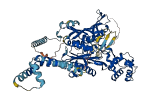
Descriptions
The autoinhibited protein was predicted that may have potential autoinhibitory elements via cis-regPred.
Autoinhibitory domains (AIDs)
Target domain |
|
Relief mechanism |
|
Assay |
cis-regPred |
Accessory elements
No accessory elements
Autoinhibited structure

Activated structure
1 structures for Q9C5V6
| Entry ID | Method | Resolution | Chain | Position | Source |
|---|---|---|---|---|---|
| AF-Q9C5V6-F1 | Predicted | AlphaFoldDB |
20 variants for Q9C5V6
| Variant ID(s) | Position | Change | Description | Diseaes Association | Provenance |
|---|---|---|---|---|---|
| ENSVATH10810895 | 21 | N>D | No | 1000Genomes | |
| tmp_3_7268123_G_A | 65 | A>V | No | 1000Genomes | |
| tmp_3_7267688_T_G | 129 | N>T | No | 1000Genomes | |
| ENSVATH13955027 | 133 | G>R | No | 1000Genomes | |
| ENSVATH05871945 | 139 | P>S | No | 1000Genomes | |
| ENSVATH00336743 | 153 | Y>F | No | 1000Genomes | |
| tmp_3_7266661_G_T | 242 | H>Q | No | 1000Genomes | |
| tmp_3_7266418_G_C | 288 | L>V | No | 1000Genomes | |
| tmp_3_7266398_C_G | 294 | E>D | No | 1000Genomes | |
| tmp_3_7266275_T_C | 305 | T>A | No | 1000Genomes | |
| ENSVATH10810834 | 342 | L>V | No | 1000Genomes | |
| ENSVATH05871913 | 405 | P>A | No | 1000Genomes | |
| ENSVATH05871909 | 432 | Q>H | No | 1000Genomes | |
| ENSVATH10810793 | 495 | Q>L | No | 1000Genomes | |
| tmp_3_7264552_G_C | 555 | Q>E | No | 1000Genomes | |
| ENSVATH13954974 | 569 | T>M | No | 1000Genomes | |
| tmp_3_7264167_T_C | 624 | Y>C | No | 1000Genomes | |
| ENSVATH10810789 | 632 | T>I | No | 1000Genomes | |
| ENSVATH00336734 | 638 | E>D | No | 1000Genomes | |
| ENSVATH05871898 | 648 | H>Y | No | 1000Genomes |
No associated diseases with Q9C5V6
Functions
| Description | ||
|---|---|---|
| EC Number | 5.6.2.2 | Enzymes altering nucleic acid conformation |
| Subcellular Localization |
|
|
| PANTHER Family | ||
| PANTHER Subfamily | ||
| PANTHER Protein Class | ||
| PANTHER Pathway Category | No pathway information available | |
4 GO annotations of cellular component
| Name | Definition |
|---|---|
| cytosol | The part of the cytoplasm that does not contain organelles but which does contain other particulate matter, such as protein complexes. |
| DNA topoisomerase type II (double strand cut, ATP-hydrolyzing) complex | Complex that possesses DNA topoisomerase II (double strand cut, ATP-hydrolyzing) activity. |
| nucleus | A membrane-bounded organelle of eukaryotic cells in which chromosomes are housed and replicated. In most cells, the nucleus contains all of the cell's chromosomes except the organellar chromosomes, and is the site of RNA synthesis and processing. In some species, or in specialized cell types, RNA metabolism or DNA replication may be absent. |
| small ribosomal subunit | The smaller of the two subunits of a ribosome. |
5 GO annotations of molecular function
| Name | Definition |
|---|---|
| ATP binding | Binding to ATP, adenosine 5'-triphosphate, a universally important coenzyme and enzyme regulator. |
| DNA binding | Any molecular function by which a gene product interacts selectively and non-covalently with DNA (deoxyribonucleic acid). |
| DNA topoisomerase type II (double strand cut, ATP-hydrolyzing) activity | Catalysis of a DNA topological transformation by transiently cleaving a pair of complementary DNA strands to form a gate through which a second double-stranded DNA segment is passed, after which the severed strands in the first DNA segment are rejoined, driven by ATP hydrolysis. The enzyme changes the linking number in multiples of 2. |
| identical protein binding | Binding to an identical protein or proteins. |
| protein homodimerization activity | Binding to an identical protein to form a homodimer. |
6 GO annotations of biological process
| Name | Definition |
|---|---|
| cell morphogenesis | The developmental process in which the size or shape of a cell is generated and organized. |
| DNA endoreduplication | Regulated re-replication of DNA within a single cell cycle, resulting in an increased cell ploidy. An example of this process occurs in the synthesis of Drosophila salivary gland cell polytene chromosomes. |
| DNA topological change | The process in which a transformation is induced in the topological structure of a double-stranded DNA helix, resulting in a change in linking number. |
| pattern specification process | Any developmental process that results in the creation of defined areas or spaces within an organism to which cells respond and eventually are instructed to differentiate. |
| response to brassinosteroid | Any process that results in a change in state or activity of a cell or an organism (in terms of movement, secretion, enzyme production, gene expression, etc.) as a result of a brassinosteroid stimulus. |
| trichome differentiation | The process in which a relatively unspecialized epidermal cell acquires the specialized features of a trichome cell. An example of this process is found in Arabidopsis thaliana. |
1 homologous proteins in AiPD
| UniProt AC | Gene Name | Protein Name | Species | Evidence Code |
|---|---|---|---|---|
| Q6H442 | TOP6B | DNA topoisomerase 6 subunit B | Oryza sativa subsp japonica (Rice) | PR |
| 10 | 20 | 30 | 40 | 50 | 60 |
| MAGDDLVETK | KGSSKNSKDS | NESKLKQKSP | AEFFAENKNI | AGFDNPGKSL | YTTVRELVEN |
| 70 | 80 | 90 | 100 | 110 | 120 |
| ALDSAESISE | LPEVEVTIEE | IVKSKFNSMI | GLIDRERVDT | QLYDDYETEK | ARGKRLAKEA |
| 130 | 140 | 150 | 160 | 170 | 180 |
| RASEIQAKNL | ASGKKNKEPG | VSKVLKARGE | ASYYKVTCKD | NGKGMPHDDI | PNMFGRVLSG |
| 190 | 200 | 210 | 220 | 230 | 240 |
| TKYGLKQTRG | KFGLGAKMAL | IWSKMSTGLP | IEISSSMKSQ | NYVTFCRLDI | DIHRNIPHIH |
| 250 | 260 | 270 | 280 | 290 | 300 |
| LHEKKGNKEK | WHGAEIQVVI | EGNWTTYRSK | ILHYMRQMAV | ITPYAQFLFR | FISETPEKNV |
| 310 | 320 | 330 | 340 | 350 | 360 |
| TIKFTRRTDV | MPPIPIETKH | HPSSVDLLLI | KRLITDTSKK | TLLQFLQNEF | VNINKTLAAR |
| 370 | 380 | 390 | 400 | 410 | 420 |
| LIGEMGPDFG | PSMAVKSVTS | QQMVRIHQLF | RQAKFDDPSG | DCLSPAGEYN | LRLGIIKELH |
| 430 | 440 | 450 | 460 | 470 | 480 |
| PDMVATYSGS | AQVFEGHPFI | VEAGVSLGGR | DVKQGINIFR | FANRIPLLFE | QGADVVTRTA |
| 490 | 500 | 510 | 520 | 530 | 540 |
| LKRINWNSYK | INQTQDKIGV | FVSIVSTKIP | FKGTGKEYIG | DDISEIATAV | KSAIQQCCIQ |
| 550 | 560 | 570 | 580 | 590 | 600 |
| LKSKIVKRLQ | AREQQERKRS | LSRYIPDATG | AVYEVLKQMT | EEHKTKRKRY | GEEDIVMLDK |
| 610 | 620 | 630 | 640 | 650 | 660 |
| VSKQIITKET | LKEKLAEHVE | QVDYEMALEY | ATQSGVSEEP | RENIYLQHLD | PNKSNFIDLH |
| SPTFVFRLML |