Q9C1W8
Gene name |
ppn1 (SPBC713.07c) |
Protein name |
Endopolyphosphatase |
Names |
|
Species |
Schizosaccharomyces pombe (strain 972 / ATCC 24843) (Fission yeast) |
KEGG Pathway |
spo:SPBC713.07c |
EC number |
3.6.1.10: In phosphorus-containing anhydrides |
Protein Class |
|
Descriptions
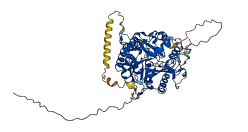
The autoinhibited protein was predicted that may have potential autoinhibitory elements via cis-regPred.
Autoinhibitory domains (AIDs)
Target domain |
|
Relief mechanism |
|
Assay |
cis-regPred |
Accessory elements
No accessory elements
Autoinhibited structure

Activated structure
1 structures for Q9C1W8
| Entry ID | Method | Resolution | Chain | Position | Source |
|---|---|---|---|---|---|
| AF-Q9C1W8-F1 | Predicted | AlphaFoldDB |
No variants for Q9C1W8
| Variant ID(s) | Position | Change | Description | Diseaes Association | Provenance |
|---|---|---|---|---|---|
| No variants for Q9C1W8 | |||||
No associated diseases with Q9C1W8
Functions
| Description | ||
|---|---|---|
| EC Number | 3.6.1.10 | In phosphorus-containing anhydrides |
| Subcellular Localization |
|
|
| PANTHER Family | ||
| PANTHER Subfamily | ||
| PANTHER Protein Class | ||
| PANTHER Pathway Category | No pathway information available | |
4 GO annotations of cellular component
| Name | Definition |
|---|---|
| cytoplasm | The contents of a cell excluding the plasma membrane and nucleus, but including other subcellular structures. |
| fungal-type vacuole | A vacuole that has both lytic and storage functions. The fungal vacuole is a large, membrane-bounded organelle that functions as a reservoir for the storage of small molecules (including polyphosphate, amino acids, several divalent cations (e.g. calcium), other ions, and other small molecules) as well as being the primary compartment for degradation. It is an acidic compartment, containing an ensemble of acid hydrolases. At least in S. cerevisiae, there are indications that the morphology of the vacuole is variable and correlated with the cell cycle, with logarithmically growing cells having a multilobed, reticulated vacuole, while stationary phase cells contain a single large structure. |
| fungal-type vacuole membrane | The lipid bilayer surrounding a vacuole, the shape of which correlates with cell cycle phase. The membrane separates its contents from the cytoplasm of the cell. An example of this structure is found in Saccharomyces cerevisiae. |
| integral component of membrane | The component of a membrane consisting of the gene products and protein complexes having at least some part of their peptide sequence embedded in the hydrophobic region of the membrane. |
2 GO annotations of molecular function
| Name | Definition |
|---|---|
| endopolyphosphatase activity | Catalysis of the reaction: polyphosphate + n H2O = (n+1) oligophosphate. The product contains 4 or 5 phosphate residues. |
| exopolyphosphatase activity | Catalysis of the reaction: polyphosphate(n) + H2O = polyphosphate(n-1) + phosphate. |
2 GO annotations of biological process
| Name | Definition |
|---|---|
| energy reserve metabolic process | The chemical reactions and pathways by which a cell derives energy from stored compounds such as fats or glycogen. |
| polyphosphate catabolic process | The chemical reactions and pathways resulting in the breakdown of a polyphosphate, the anion or salt of polyphosphoric acid. |
No homologous proteins in AiPD
| UniProt AC | Gene Name | Protein Name | Species | Evidence Code |
|---|---|---|---|---|
| No homologous proteins | ||||
| 10 | 20 | 30 | 40 | 50 | 60 |
| MRPSVITVAV | LFVQSTWASF | AFGNPMSMRN | KAHTNDLVNS | KGKPLVGRFL | HITDMHPDIY |
| 70 | 80 | 90 | 100 | 110 | 120 |
| YEKGSTVDHY | CHSYDHNSDD | TPLGKSKVGY | LSPGPGYECD | SSPALIDKTL | EWLKEHQDDV |
| 130 | 140 | 150 | 160 | 170 | 180 |
| LGGIDFILWT | GDNSRHDNDN | HFPRTQSEIL | ASNEDLVNKM | IEAFPDVPIV | SAIGNNDIYP |
| 190 | 200 | 210 | 220 | 230 | 240 |
| HNIMEAGPSS | MTRQLAGAWD | ALIPYEERHT | FEKGSYYLCD | VIPDKLAAIS | INTLYLSNKN |
| 250 | 260 | 270 | 280 | 290 | 300 |
| AAVDGCPDDN | LDEPGSLFMR | WFKIQLEAYR | LKGMKVWLLG | HIPPTRGQWY | EDCYTSFTDL |
| 310 | 320 | 330 | 340 | 350 | 360 |
| LYEFRDIIVG | QLYGHMNINH | FVFLEFDKLP | VDTESYGIKS | AQPKYVKSLI | DAQYAELPTF |
| 370 | 380 | 390 | 400 | 410 | 420 |
| PENLTEEFLN | GTVGNYSLAT | VGGSIIPEMF | PTFRVYEYNI | SDIANQLDDR | EELTEITSFN |
| 430 | 440 | 450 | 460 | 470 | 480 |
| WETLEEQSQS | DYEIDKKKKK | KKKNNKKKKK | NKRKNIKPGP | LGPAYVPSLF | TPISFKQYFL |
| 490 | 500 | 510 | 520 | 530 | 540 |
| NTSNYMDATK | DTEISYELLY | TSKDSPYNMP | DLTVPEYMRL | AKRIATCDKP | EDPHQFKLQS |
| 550 | 560 | 570 | |||
| GDQNTFRISK | KKKPSICPIA | YTYLWHAYIG | SISDFED |