Q9BDQ5
Gene name |
BDKRB1 |
Protein name |
B1 bradykinin receptor |
Names |
B1R, BK-1 receptor |
Species |
Canis lupus familiaris (Dog) (Canis familiaris) |
KEGG Pathway |
cfa:490847 |
EC number |
|
Protein Class |
|
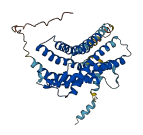
Descriptions
The autoinhibited protein was predicted that may have potential autoinhibitory elements via cis-regPred.
Autoinhibitory domains (AIDs)
Target domain |
|
Relief mechanism |
|
Assay |
cis-regPred |
Accessory elements
No accessory elements
Autoinhibited structure

Activated structure
1 structures for Q9BDQ5
| Entry ID | Method | Resolution | Chain | Position | Source |
|---|---|---|---|---|---|
| AF-Q9BDQ5-F1 | Predicted | AlphaFoldDB |
3 variants for Q9BDQ5
| Variant ID(s) | Position | Change | Description | Diseaes Association | Provenance |
|---|---|---|---|---|---|
| rs24497127 | 18 | S>L | No | EVA | |
| rs850805121 | 64 | P>T | No | EVA | |
| rs852373467 | 325 | K>N | No | EVA |
No associated diseases with Q9BDQ5
1 regional properties for Q9BDQ5
| Type | Name | Position | InterPro Accession |
|---|---|---|---|
| domain | GPCR, rhodopsin-like, 7TM | 53 - 309 | IPR017452 |
2 GO annotations of cellular component
| Name | Definition |
|---|---|
| integral component of membrane | The component of a membrane consisting of the gene products and protein complexes having at least some part of their peptide sequence embedded in the hydrophobic region of the membrane. |
| plasma membrane | The membrane surrounding a cell that separates the cell from its external environment. It consists of a phospholipid bilayer and associated proteins. |
2 GO annotations of molecular function
| Name | Definition |
|---|---|
| bradykinin receptor activity | Combining with bradykinin to initiate a change in cell activity. |
| peptide binding | Binding to a peptide, an organic compound comprising two or more amino acids linked by peptide bonds. |
3 GO annotations of biological process
| Name | Definition |
|---|---|
| inflammatory response | The immediate defensive reaction (by vertebrate tissue) to infection or injury caused by chemical or physical agents. The process is characterized by local vasodilation, extravasation of plasma into intercellular spaces and accumulation of white blood cells and macrophages. |
| response to lipopolysaccharide | Any process that results in a change in state or activity of an organism (in terms of movement, secretion, enzyme production, gene expression, etc.) as a result of a lipopolysaccharide stimulus; lipopolysaccharide is a major component of the cell wall of gram-negative bacteria. |
| response to mechanical stimulus | Any process that results in a change in state or activity of a cell or an organism (in terms of movement, secretion, enzyme production, gene expression, etc.) as a result of a mechanical stimulus. |
No homologous proteins in AiPD
| UniProt AC | Gene Name | Protein Name | Species | Evidence Code |
|---|---|---|---|---|
| No homologous proteins | ||||
| 10 | 20 | 30 | 40 | 50 | 60 |
| MASRAPLELL | PLNRSQLSPP | NATTCDDAPE | AWDLLHRVLP | SVIIIICVCG | LLGNLLVLAV |
| 70 | 80 | 90 | 100 | 110 | 120 |
| LLRPRRRLNV | AEMYLANLAA | SDLVFVLGLP | FWAANISNQF | RWPFGGLLCR | LVNGVIKANL |
| 130 | 140 | 150 | 160 | 170 | 180 |
| FISIFLVVAI | SRDRYRALVH | PMATRRRRQA | RATCVLIWVA | GSLLSVPTFL | FRSIEAVPEL |
| 190 | 200 | 210 | 220 | 230 | 240 |
| NNDSACVLLH | PPGAWHVARM | VELNVLGFLL | PLAAIVFFNC | HILASLRGRP | EVRGARCGGP |
| 250 | 260 | 270 | 280 | 290 | 300 |
| PDGRTTALIL | TFVAAFLVCW | TPYHFFAFLE | FLTQVQVVRG | CFWENFKDLG | LQYASFFAFI |
| 310 | 320 | 330 | 340 | ||
| NSCLNPVIYV | FVGRLFRTRV | WDLFKQCAPR | RPPAVSWSHR | KRVLQLFWQN |