Q9A131
Gene name |
mutM |
Protein name |
Formamidopyrimidine-DNA glycosylase |
Names |
Fapy-DNA glycosylase, DNA-(apurinic or apyrimidinic site) lyase MutM, AP lyase MutM |
Species |
Streptococcus pyogenes serotype M1 |
KEGG Pathway |
spz:M5005_Spy0408 |
EC number |
3.2.2.23: Hydrolyzing N-glycosyl compounds |
Protein Class |
|
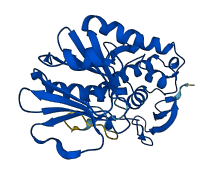
Descriptions
The autoinhibited protein was predicted that may have potential autoinhibitory elements via cis-regPred.
Autoinhibitory domains (AIDs)
Target domain |
|
Relief mechanism |
|
Assay |
cis-regPred |
Accessory elements
No accessory elements
Autoinhibited structure

Activated structure
1 structures for Q9A131
| Entry ID | Method | Resolution | Chain | Position | Source |
|---|---|---|---|---|---|
| AF-Q9A131-F1 | Predicted | AlphaFoldDB |
No variants for Q9A131
| Variant ID(s) | Position | Change | Description | Diseaes Association | Provenance |
|---|---|---|---|---|---|
| No variants for Q9A131 | |||||
No associated diseases with Q9A131
5 regional properties for Q9A131
| Type | Name | Position | InterPro Accession |
|---|---|---|---|
| domain | Zinc finger, DNA glycosylase/AP lyase-type | 237 - 271 | IPR000214 |
| domain | Zinc finger, FPG/IleRS-type | 243 - 271 | IPR010663 |
| domain | Formamidopyrimidine-DNA glycosylase, catalytic domain | 1 - 117 | IPR012319 |
| domain | DNA glycosylase/AP lyase, H2TH DNA-binding | 131 - 223 | IPR015886 |
| binding_site | DNA glycosylase/AP lyase, zinc finger domain, DNA-binding site | 246 - 270 | IPR015887 |
Functions
| Description | ||
|---|---|---|
| EC Number | 3.2.2.23 | Hydrolyzing N-glycosyl compounds |
| Subcellular Localization |
|
|
| PANTHER Family | ||
| PANTHER Subfamily | ||
| PANTHER Protein Class | ||
| PANTHER Pathway Category | No pathway information available | |
No GO annotations of cellular component
| Name | Definition |
|---|---|
| No GO annotations for cellular component |
4 GO annotations of molecular function
| Name | Definition |
|---|---|
| class I DNA-(apurinic or apyrimidinic site) endonuclease activity | Catalysis of the cleavage of an AP site 3' of the baseless site by a beta-lyase mechanism, leaving an unsaturated aldehyde, termed a 3'-(4-hydroxy-5-phospho-2-pentenal) residue, and a 5'-phosphate. |
| damaged DNA binding | Binding to damaged DNA. |
| oxidized purine nucleobase lesion DNA N-glycosylase activity | Catalysis of the removal of oxidized purine bases by cleaving the N-C1' glycosidic bond between the oxidized purine and the deoxyribose sugar. The reaction involves the formation of a covalent enzyme-substrate intermediate. Release of the enzyme and free base by a beta-elimination or a beta, gamma-elimination mechanism results in the cleavage of the DNA backbone 3' of the apurinic (AP) site. |
| zinc ion binding | Binding to a zinc ion (Zn). |
1 GO annotations of biological process
| Name | Definition |
|---|---|
| base-excision repair | In base excision repair, an altered base is removed by a DNA glycosylase enzyme, followed by excision of the resulting sugar phosphate. The small gap left in the DNA helix is filled in by the sequential action of DNA polymerase and DNA ligase. |
No homologous proteins in AiPD
| UniProt AC | Gene Name | Protein Name | Species | Evidence Code |
|---|---|---|---|---|
| No homologous proteins | ||||
| 10 | 20 | 30 | 40 | 50 | 60 |
| MPELPEVETV | RRGLETLVLG | QEIVAVTLKV | PKMVKTDLET | FALTLPGQII | QSVGRRGKYL |
| 70 | 80 | 90 | 100 | 110 | 120 |
| LIDLGQLVLV | SHLRMEGKYL | LFPDEVPDNK | HFHVFFELKN | GSTLVYQDVR | KFGTFDLIAK |
| 130 | 140 | 150 | 160 | 170 | 180 |
| SQLSAFFAKR | KLGPEPKKET | FKLKTFEAAL | LSSQKPIKPH | LLDQTLVAGL | GNIYVDEVLW |
| 190 | 200 | 210 | 220 | 230 | 240 |
| AAKVHPETAS | SRLNKAEIKR | LHDETIRILA | LGIEKGGSTV | RTYRNALGAD | GTMQDYLQVY |
| 250 | 260 | 270 | |||
| GQTGKPCPRC | GQAIVKLKVG | GRGTHICPKC | QKKRL |