Q99PL6
Gene name |
Ubxn6 |
Protein name |
UBX domain-containing protein 6 |
Names |
UBX domain-containing protein 1 |
Species |
Mus musculus (Mouse) |
KEGG Pathway |
mmu:66530 |
EC number |
|
Protein Class |
|
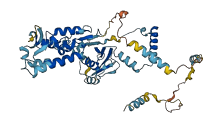
Descriptions
The autoinhibited protein was predicted that may have potential autoinhibitory elements via cis-regPred.
Autoinhibitory domains (AIDs)
Target domain |
|
Relief mechanism |
|
Assay |
cis-regPred |
Accessory elements
No accessory elements
Autoinhibited structure

Activated structure
1 structures for Q99PL6
| Entry ID | Method | Resolution | Chain | Position | Source |
|---|---|---|---|---|---|
| AF-Q99PL6-F1 | Predicted | AlphaFoldDB |
18 variants for Q99PL6
| Variant ID(s) | Position | Change | Description | Diseaes Association | Provenance |
|---|---|---|---|---|---|
| rs13471928 | 10 | A>T | No | EVA | |
| rs3389465331 | 66 | K>N | No | EVA | |
| rs3389419826 | 71 | R>P | No | EVA | |
| rs3389472381 | 84 | R>G | No | EVA | |
| rs3389482385 | 93 | S>Y | No | EVA | |
| rs254373540 | 104 | S>W | No | EVA | |
| rs3389472418 | 144 | A>T | No | EVA | |
| rs3389463338 | 146 | L>P | No | EVA | |
| rs3389471712 | 202 | K>E | No | EVA | |
| rs3389467068 | 222 | G>A | No | EVA | |
| rs3389463253 | 300 | V>M | No | EVA | |
| rs108744278 | 326 | E>D | No | EVA | |
| rs3389451281 | 338 | L>V | No | EVA | |
| rs230182132 | 339 | V>L | No | EVA | |
| rs232956292 | 361 | A>V | No | EVA | |
| rs3389439774 | 378 | E>Q | No | EVA | |
| rs48345088 | 416 | E>D | No | EVA | |
| rs226622170 | 420 | A>G | No | EVA |
No associated diseases with Q99PL6
Functions
10 GO annotations of cellular component
| Name | Definition |
|---|---|
| cytoplasm | The contents of a cell excluding the plasma membrane and nucleus, but including other subcellular structures. |
| cytosol | The part of the cytoplasm that does not contain organelles but which does contain other particulate matter, such as protein complexes. |
| early endosome membrane | The lipid bilayer surrounding an early endosome. |
| endosome | A vacuole to which materials ingested by endocytosis are delivered. |
| extrinsic component of membrane | The component of a membrane consisting of gene products and protein complexes that are loosely bound to one of its surfaces, but not integrated into the hydrophobic region. |
| late endosome membrane | The lipid bilayer surrounding a late endosome. |
| lysosomal membrane | The lipid bilayer surrounding the lysosome and separating its contents from the cell cytoplasm. |
| microtubule organizing center | An intracellular structure that can catalyze gamma-tubulin-dependent microtubule nucleation and that can anchor microtubules by interacting with their minus ends, plus ends or sides. |
| nucleus | A membrane-bounded organelle of eukaryotic cells in which chromosomes are housed and replicated. In most cells, the nucleus contains all of the cell's chromosomes except the organellar chromosomes, and is the site of RNA synthesis and processing. In some species, or in specialized cell types, RNA metabolism or DNA replication may be absent. |
| protein-containing complex | A stable assembly of two or more macromolecules, i.e. proteins, nucleic acids, carbohydrates or lipids, in which at least one component is a protein and the constituent parts function together. |
No GO annotations of molecular function
| Name | Definition |
|---|---|
| No GO annotations for molecular function |
3 GO annotations of biological process
| Name | Definition |
|---|---|
| endosome to lysosome transport via multivesicular body sorting pathway | The directed movement of substances from endosomes to lysosomes by a pathway in which molecules are sorted into multivesicular bodies, which then fuse with the lysosome. |
| ERAD pathway | The protein catabolic pathway which targets endoplasmic reticulum (ER)-resident proteins for degradation by the cytoplasmic proteasome. It begins with recognition of the ER-resident protein, includes retrotranslocation (dislocation) of the protein from the ER to the cytosol, protein modifications necessary for correct substrate transfer (e.g. ubiquitination), transport of the protein to the proteasome, and ends with degradation of the protein by the cytoplasmic proteasome. |
| macroautophagy | The major inducible pathway for the general turnover of cytoplasmic constituents in eukaryotic cells, it is also responsible for the degradation of active cytoplasmic enzymes and organelles during nutrient starvation. Macroautophagy involves the formation of double-membrane-bounded autophagosomes which enclose the cytoplasmic constituent targeted for degradation in a membrane-bounded structure. Autophagosomes then fuse with a lysosome (or vacuole) releasing single-membrane-bounded autophagic bodies that are then degraded within the lysosome (or vacuole). Some types of macroautophagy, e.g. pexophagy, mitophagy, involve selective targeting of the targets to be degraded. |
1 homologous proteins in AiPD
| UniProt AC | Gene Name | Protein Name | Species | Evidence Code |
|---|---|---|---|---|
| Q9ZU93 | PUX2 | Plant UBX domain-containing protein 2 | Arabidopsis thaliana (Mouse-ear cress) | PR |
| 10 | 20 | 30 | 40 | 50 | 60 |
| MKKFFQEIKA | DIKFKSAGPG | QKLTDSAGEK | TTKGKSPQLA | LRQPRQGPTD | EAQMAAAAAL |
| 70 | 80 | 90 | 100 | 110 | 120 |
| ARLEQKQPRA | RGPTSQDSIR | NQVRKELQAE | ATSSNNPGAP | GTNSVPEPKE | EISPHLAVPG |
| 130 | 140 | 150 | 160 | 170 | 180 |
| VFFICPLTGV | TLRRDQRDAH | IKQAILSHFS | TDPVAASIMK | IHTFNRDRDR | VKLGVDTIAK |
| 190 | 200 | 210 | 220 | 230 | 240 |
| YLDNIHLHPE | EEKYQKIKLQ | NKVFQERINC | LEGSHEFFEA | IGFKKVTLPV | PDQEGQEEFY |
| 250 | 260 | 270 | 280 | 290 | 300 |
| VLGEDARAQP | QNLARHKQQL | LDAEPVRATL | DRQLRVFRPS | ALASHFELPS | DFFSLTAEEV |
| 310 | 320 | 330 | 340 | 350 | 360 |
| KREQRLRTEA | VERLSSLRTK | AMREKEEQRE | LRKYTYALVR | VRLPDGCLLQ | GTFYAREKLS |
| 370 | 380 | 390 | 400 | 410 | 420 |
| ALFRFVREAL | QNDWLPFELR | ASGGQKLEEN | EALALNECGL | VPSALLTFSW | DASVLEDIRA |
| 430 | 440 | ||||
| AGAEPAKSVL | RPELLAAIEQ | LS |